

Who Is Driving the Trump-Germany Crisis and Why Are U.S. Troop Cuts in Germany Now on the Table?
The transatlantic alliance is facing one of its most serious stress tests in decades. President Donald Trump on Wednesday leveled a new threat against NATO ally Germany, suggesting he could soon reduce the U.S. military presence there as he continues to feud with Chancellor Friedrich Merz over the U.S.-Israel war against Iran. The trigger was a pointed public critique from Berlin that Washington had no viable exit strategy from the conflict, and Trump's response has placed the future of American military positioning in Europe under direct scrutiny.
For analysts tracking transatlantic security dynamics, this is not background noise. It is a structural signal about where U.S. foreign policy priorities are heading under this administration.
Who Said What: The Merz Remarks That Ignited Trump's Fury
Who started this diplomatic rupture matters for understanding its depth and durability.
Merz said Tuesday during a visit to a school in Marsberg, northwestern Germany, that the Trump administration's handling of the war was "ill-considered," comparing the conflict to previous U.S. interventions in Afghanistan and Iraq, comparisons the administration has strongly rejected.
Merz went further with a specific allegation about the state of U.S.-Iran negotiations. "The Iranians are obviously very skilled at negotiating, or rather, very skillful at not negotiating, letting the Americans travel to Islamabad and then leave again without any result," Merz told university students on Monday. "An entire nation is being humiliated by the Iranian leadership, especially by these so-called Revolutionary Guards. And so I hope that this ends as quickly as possible," he added, reflecting a broader frustration among European leaders about the conflict's trajectory.
The remarks touched a raw nerve in Washington. Trump hit back, posting on Truth Social that Merz appeared to think it was "OK for Iran to have a Nuclear Weapon. He doesn't know what he's talking about!" Trump added: "No wonder Germany is doing so poorly, both Economically, and otherwise!"
Who Is Friedrich Merz and What Is His Position on the Iran War?
Understanding who Merz is in the context of this dispute is essential to assessing the severity of the rupture.
The feud started when Merz, who had previously been closely aligned with the U.S. and Israel in their hawkish approach to Iran, questioned Washington's strategy in the conflict. This is not a traditional transatlantic critic speaking. Merz built his early chancellorship on a reputation for pragmatic alignment with Washington, which makes his public break all the more consequential for alliance cohesion.
After Merz's criticism of Trump this week, the German leader sought to bring down the temperature, saying on Wednesday that "the personal relationship between the American president and me is, from my perspective, still good."
Despite that attempt at de-escalation, Trump intensified the confrontation. The U.S. president suggested on Thursday that Merz should focus on German and European affairs rather than comment on the conflict in the Middle East, writing: "The Chancellor of Germany should spend more time on ending the war with Russia/Ukraine, where he has been totally ineffective, and fixing his broken Country, especially Immigration and Energy, and less time on interfering with those that are getting rid of the Iran Nuclear threat."
Who Ordered the U.S. Troop Review in Germany and What Forces Are at Stake?
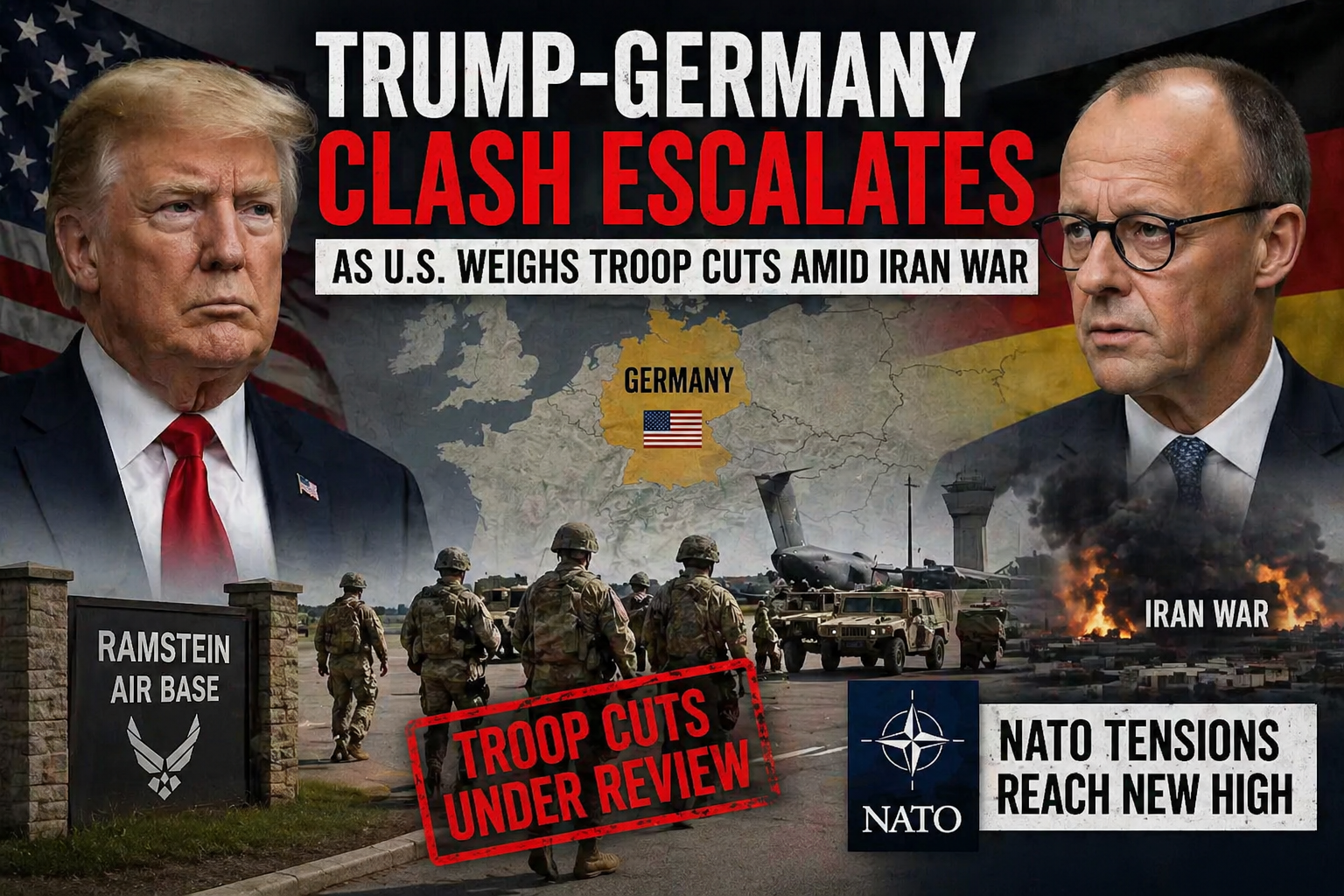
Trump made the threat in a social media post, saying: "The United States is studying and reviewing the possible reduction of Troops in Germany, with a determination to be made over the next short period of time."
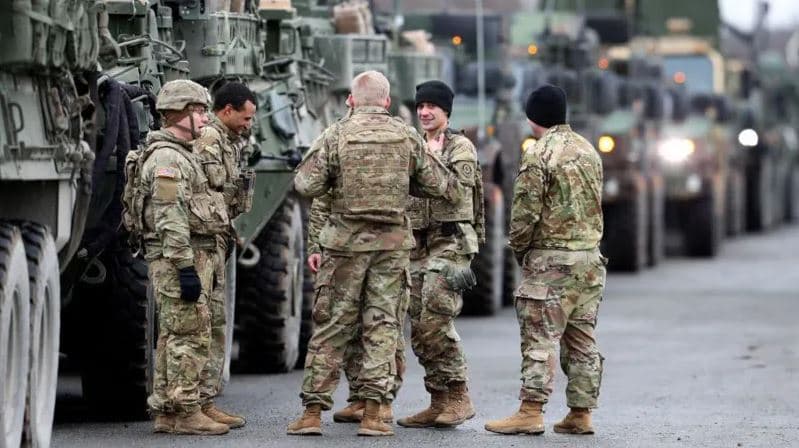
The scale of what could be withdrawn is significant. U.S. troop strength in Germany stood at 36,436, mainly army and air force personnel, stationed at 20 bases across the country in December, representing the largest such contingent in Europe.
Many troops and their families are based at Ramstein Air Base, which serves as a major transportation hub and command center for U.S. military operations in Europe, Africa, and the Middle East.
The U.S. also maintains several other major military facilities in the country, including the headquarters for U.S. European Command and U.S. Africa Command, and Landstuhl Regional Medical Center, the largest American hospital outside the United States. Any reduction in this footprint would not simply be symbolic. It would materially degrade NATO's operational architecture in Europe.
On Thursday, Trump extended his threat beyond Germany. When asked about the possibility of cuts to troop levels in Italy and Spain, Trump said: "I mean, they haven't been exactly on board. Yeah, probably will. Why shouldn't I? Italy has not been of any help. Spain has been horrible. Absolutely."
Who Else in Washington Is Backing Trump's Threat Against NATO Allies?
The troop-cut threat is not a solo presidential improvisation. It carries institutional weight from the Pentagon.
Defense Secretary Pete Hegseth, who reposted Trump's social media comment about possible troop cuts in Germany, told Congress on Wednesday that he expected allies to get on board with U.S. war efforts. "When allies do not step up, there will be consequences," Hegseth said during a hearing of the House Armed Services Committee. "In recent weeks, for instance, far too many of our NATO allies showed that they could not be relied upon to support our nation's operations against Iran. This is unconscionable, and we will remember," he added.
Some European countries have complained that the Trump administration did not consult them ahead of the U.S.-Israeli attacks on Iran. That lack of prior consultation sits at the heart of why so many NATO members have declined to endorse the war publicly, even as some have quietly enabled U.S. operations.
Who Is Most at Risk from a U.S. Military Drawdown in Europe?
The strategic consequences of any withdrawal extend well beyond German-American relations.
NATO experts say the frequent pronouncements about troop reductions have eroded the transatlantic alliance irretrievably. Former NATO Policy Director Fabrice Pothier told Euronews that the time has come to think of "Europe without the U.S."
Pothier described Europe as going through a "boiling frog moment" when it comes to relations with Washington, where "the situation gets worse every year," but European states are then reassured by the U.S. that "it's still a good ally."
On Friday, a Pentagon leak suggested that Spain could face being suspended from NATO in retaliation for not supporting the United States in its war with Iran. If that threat materializes, the alliance would face an institutional crisis with no postwar precedent.
Who Has Attempted This Before and What Happened?
Historical context matters here for assessing whether Trump will follow through.
During his first term in the White House, Trump moved to cut U.S. troops in Germany because he said the country spent too little on defense. In June 2020, Trump announced he was going to pull out about 9,500 of the roughly 34,500 U.S. troops then stationed in Germany, but the process never actually started. Democratic President Joe Biden formally stopped the planned withdrawal soon after taking office in 2021.
The situation today differs in one critical respect. Germany is now the top military spender in Europe and is on track to meet NATO's new target for member countries to spend 5% of gross domestic product on defense. The original justification for a troop cut, Germany's defense spending shortfall, no longer applies. The current rationale is purely political: punishment for dissenting over the Iran war.
Who Is Holding Out for a Diplomatic Off-Ramp and Is One Available?
Talks appear to have stalled, with Trump reportedly rejecting an Iranian offer to reopen the Strait of Hormuz if the U.S. lifted its ongoing blockade of Iranian ports and ended the war, White House press secretary Karoline Leavitt confirmed on Monday.
While a fragile ceasefire between the U.S. and Iran remains in place, there is no clear path in sight for a durable end to the conflict.
Trump has been portraying the war as necessary to prevent Iran from obtaining a nuclear weapon. However, Washington's own intelligence chief, Tulsi Gabbard, said last year that Tehran is not building one. That internal contradiction within the administration's stated rationale for the war adds a layer of strategic ambiguity that is making European partners increasingly uneasy.
Despite the pressure, Berlin is holding its ground on alliance commitments. In the wake of Trump's announcement, Merz reiterated how important the transatlantic alliance is to Berlin. "As you know, this transatlantic partnership is particularly close to our hearts, and to mine personally," he told reporters at a military base in Munster.