

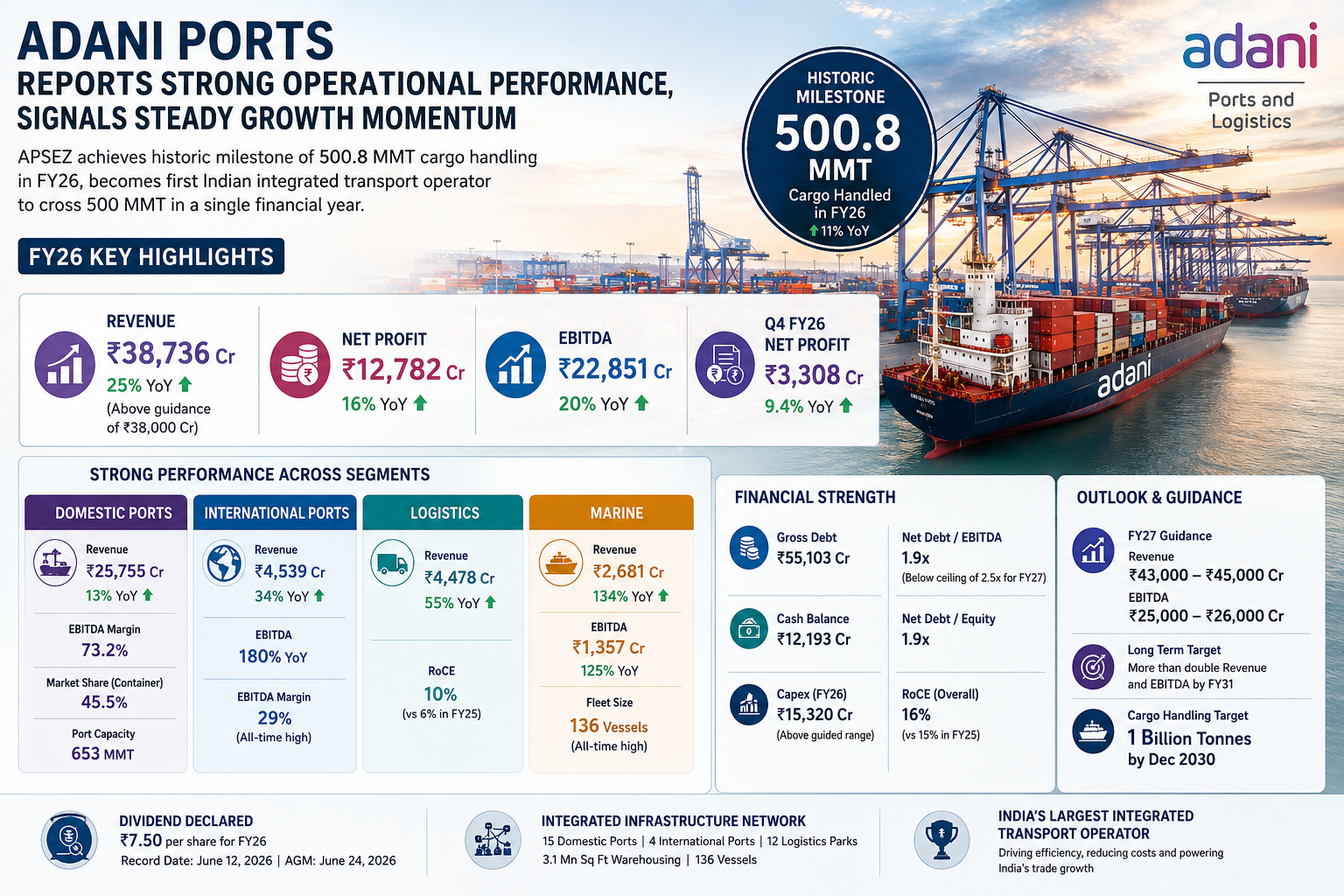
India's largest integrated transport operator, Adani Ports and Special Economic Zone Limited (APSEZ), closed out FY26 with numbers that reflect not just scale, but consistent strategic execution. The company posted full-year revenue of Rs 38,736 crore, a 25 percent year-on-year rise that surpassed its own guidance of Rs 38,000 crore. Net profit for the year rose 16 percent to Rs 12,782 crore, while EBITDA climbed 20 percent to Rs 22,851 crore.
At the core of the story is a single operational milestone: APSEZ became the first Indian integrated transport operator to handle over 500 million metric tonnes (MMT) of port cargo in a single financial year, reaching 500.8 MMT, up 11 percent from FY25.
What Did APSEZ Actually Report for FY26?
The results for the quarter and year ended March 31, 2026, showed broad-based growth across every business segment. Revenue from operations in Q4 FY26 alone reached Rs 10,738 crore, a 26 percent year-on-year increase. EBITDA for the quarter stood at Rs 6,020 crore at a 56 percent margin, while quarterly net profit rose 9.4 percent to Rs 3,308 crore. Total income for the quarter came in at Rs 11,489 crore, up 31 percent from the prior-year period.
Analysts had estimated Q4 profit at Rs 3,159 crore and revenue at Rs 9,683 crore. APSEZ exceeded both benchmarks.
Who Is Driving Growth Across Each Segment?
Domestic Ports
Domestic port operations contributed Rs 25,755 crore to annual revenue, a 13 percent rise. APSEZ holds a 45.5 percent container market share across India and a domestic port capacity of 653 MMT as of March 31, 2026. Return on capital employed (RoCE) improved to 23 percent from 21 percent in FY25. EBITDA margin for the domestic ports segment expanded to 73.2 percent.
International Ports
International port revenue grew 34 percent to Rs 4,539 crore for the full year, driven by the addition of the North Queensland Export Terminal (NQXT) in Australia and the ramp-up of the Colombo West International Terminal (CWIT) in Sri Lanka. The segment's EBITDA jumped 180 percent year-on-year, with EBITDA margins reaching an all-time high of 29 percent. In Q4 alone, international port revenue hit Rs 1,422 crore, up 58 percent, the highest single-quarter figure in the company's history.
Logistics
The logistics segment was the fastest-growing unit, with revenue surging 55 percent year-on-year to Rs 4,478 crore. Growth was led by rapid expansion in trucking operations and the International Freight Network. RoCE for logistics improved to 10 percent from just 6 percent in FY25.
Marine
Marine operations reported revenue of Rs 2,681 crore, a 134 percent jump year-on-year. EBITDA grew 125 percent to Rs 1,357 crore. The company's marine vessel fleet reached an all-time high of 136 vessels as of March 31, 2026, supported by offshore support vessel acquisitions across Middle East, Africa, South Asia (MEASA) and India routes. Revenue in this segment is backed by take-or-pay contracts with Tier-1 customers, providing long-term income visibility.
How Did APSEZ Manage Its Debt Position?
Gross debt stood at Rs 55,103 crore as of year-end, with a cash balance of Rs 12,193 crore. Net debt to EBITDA was 1.9x, within the company's self-imposed ceiling of 2.5x for FY27. Net debt-to-equity stood at 1.9x. Capital expenditure for FY26 reached Rs 15,320 crore, exceeding the guided range of Rs 11,000 crore to Rs 12,000 crore, reflecting accelerated investment in capacity and fleet expansion.
CEO Ashwani Gupta stated that future capital expenditure will be funded through internal accruals, with selective flexibility retained for inorganic opportunities.
Overall RoCE improved to 16 percent from 15 percent in FY25.
Why Did APSEZ Outperform Analysts on Revenue and Profit?
Three factors stand out in the data.
First, the 500 MMT cargo milestone was not a late-year spike. Monthly operational updates through the year showed consistent double-digit growth rates in container volumes, which expanded at roughly 20 to 21 percent year-on-year across most of FY26. Container traffic is higher-margin than bulk cargo and responds directly to India's growing manufactured exports.
Second, the international portfolio delivered a structural turnaround. The NQXT acquisition in Australia, completed in December 2025, added immediate EBITDA contribution. The Colombo West terminal ramped faster than guidance, pushing quarterly international EBITDA to roughly five times what the segment delivered in Q4 FY25.
Third, the marine business, which contributed modestly in prior years, became a material earnings driver in FY26. Fleet expansion, long-term contracts, and capital efficiency at 13 percent RoCE made this the standout segment for margin expansion velocity.
Where Is APSEZ Headed Through FY27 and FY31?
For FY27, the company issued guidance for revenue between Rs 43,000 crore and Rs 45,000 crore, and EBITDA of Rs 25,000 crore to Rs 26,000 crore. Over the longer term, APSEZ has stated a target to more than double both revenue and EBITDA by FY31. The central operational goal is to reach one billion tonnes of annual cargo handling by December 2030, from 500.8 MMT today.
The strategy to get there rests on three pillars: continued domestic port capacity expansion, rapid scale-up of asset-light and asset-zero logistics services, and expansion of the marine fleet. The company has guided that capex for growth will be funded from internal cash generation going forward, reducing reliance on external borrowing.
The board proposed a dividend of Rs 7.50 per share for FY26, with a record date of June 12, 2026, and the AGM scheduled for June 24, 2026.
What Does the 500 MMT Milestone Mean for India's Trade Infrastructure?
The 500 MMT threshold is significant beyond the balance sheet. APSEZ processed cargo across 15 domestic ports and terminals, complemented by international presence at four global ports, 12 multi-modal logistics parks, 3.1 million square feet of warehousing, and a 136-vessel fleet. The platform connects cargo from origin via international freight, through port handling, onto rail transport, through logistics parks, and via road to final customer delivery: a complete shore-to-door supply chain under one operator.
For India's trade ecosystem, the scale and integration that APSEZ has built provides cost compression and transit time reduction across industrial supply chains, both inbound and export. The company's 28 percent domestic port market share and 45.5 percent container market share indicate that a large portion of India's containerized trade now flows through a single integrated logistics platform.