

When Accenture announced its agreement to acquire Ookla on March 3, 2026, the deal did not arrive as a surprise to anyone watching the quiet but accelerating race to own the data layer beneath enterprise AI. What surprised markets was the price tag and the clarity of strategic intent behind it.
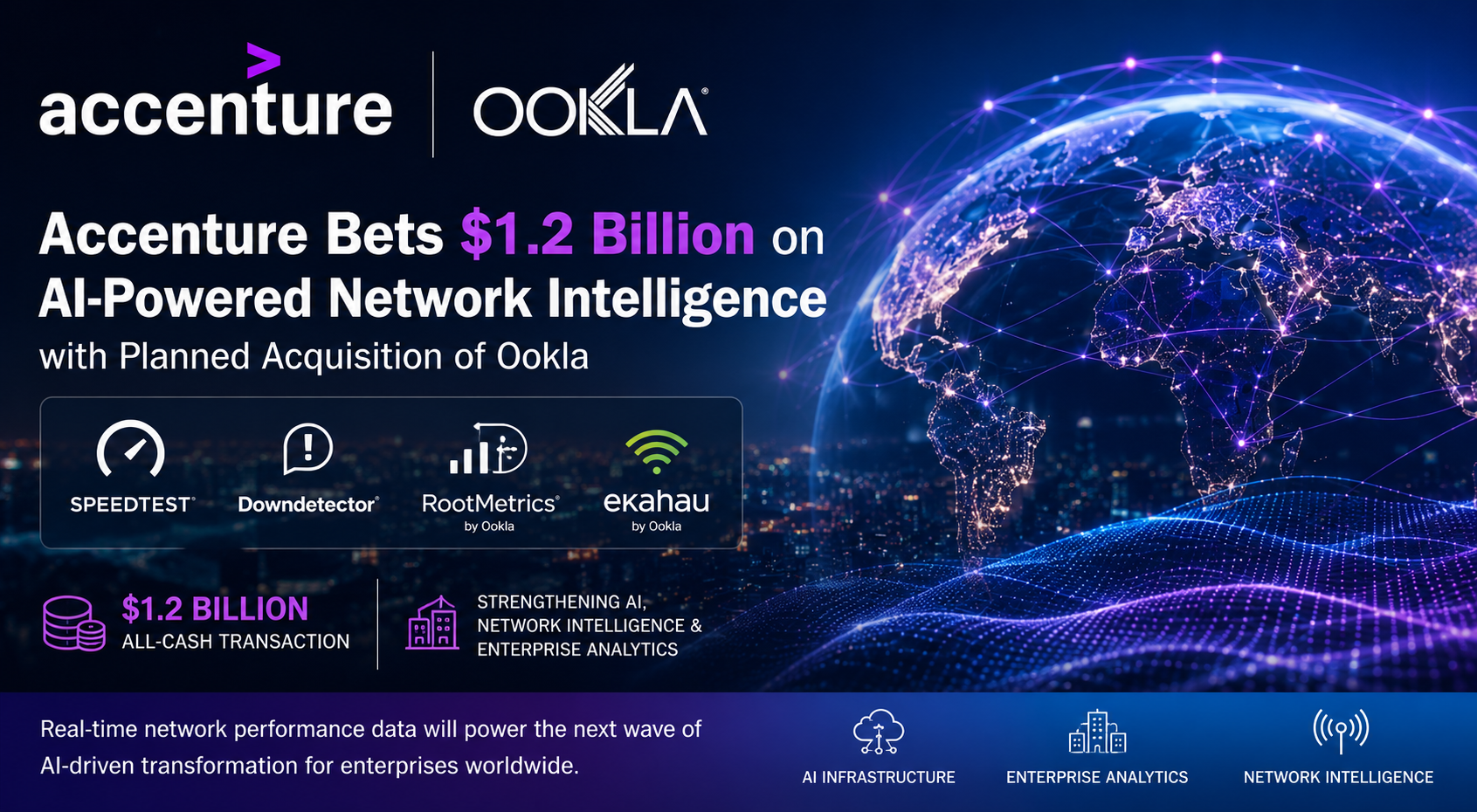
Accenture agreed to acquire Ookla, the Seattle-based network intelligence company behind Speedtest and Downdetector, in a $1.2 billion all-cash transaction from Ziff Davis. At its core, the deal is about one thing: whoever controls real-time network performance data will control a critical input into the AI transformation programmes that every major enterprise is now funding.
What Is Ookla and Why Does It Matter to Enterprise AI
Most consumers know Ookla as the company that runs Speedtest, the tool people use to check whether their broadband is actually delivering what their provider promised. That is the surface-level product. The business underneath it is considerably more valuable.
Ookla's portfolio includes Speedtest, which defines user experience; Downdetector, which accelerates incident identification; RootMetrics, which provides independent benchmarking; and Ekahau, which drives digital workplace transformation through superior Wi-Fi design.
Ookla's data platform captures more than 1,000 attributes per test and is anchored by over 250 million consumer-initiated tests per month, supplemented by controlled drive, walk, and embedded testing. This blend of quality of service, RF signal, and quality of experience data is increasingly critical as AI workloads, edge computing, and private 5G networks become core to digital business.
That scale of measurement is not something a consulting firm can replicate through model training or vendor agreements. It has to be earned over years of consumer trust and technical infrastructure. Ookla has spent two decades building exactly that.
Who Is Behind the Deal and What Each Side Gains
The transaction is structured as a straightforward purchase from Ziff Davis, Ookla's parent company, which has been rationalising its media and technology assets. For Accenture, the acquisition strengthens its ability to integrate connectivity data into digital transformation programmes.
Accenture's Chief Strategy and Services Officer Manish Sharma was direct about the commercial logic: "With the Ookla portfolio, we will offer end-to-end network intelligence services essential for AI-based transformation. Speedtest and RootMetrics define the experience; Downdetector identifies incidents faster; and Ekahau drives digital workplace transformation through superior Wi-Fi. In an era of omni-channel and agentic access, low-latency, zero-friction connectivity is a competitive necessity."
From Ookla's side, the calculus is about reach. Stephen Bye, CEO of Ookla, noted that joining Accenture will allow the company to scale its network data business across the world's largest enterprises and accelerate its goal of creating better connected experiences.
Ookla's team of approximately 430 experts specialises in software engineering, radio frequency engineering, and data science. That specialist headcount, relatively small for the scale of data they manage, is part of what makes the acquisition economically efficient for Accenture.
Where This Deal Sits in the Broader AI Infrastructure Race
The timing of this acquisition reflects a structural shift in how AI adoption is being understood at the enterprise level. Early AI investment cycles focused on model selection and deployment. That conversation has matured. Organisations are now confronting a harder operational reality.
AI infrastructure investments have accelerated dramatically over the past year as companies discover that model performance depends heavily on the underlying network layer. Microsoft, Google, and Amazon have all significantly expanded their data centre footprints and network capacity to support AI workloads.
Accenture's move is a direct response to that dynamic. The next wave of AI consulting will not just focus on model selection and deployment, but on the foundational network infrastructure that makes AI systems viable at enterprise scale.
In a market where AI is becoming embedded in all processes, this measurement layer adds significant value. Competitors such as Deloitte and McKinsey do not possess a proprietary global dataset of this nature. That asymmetry is precisely what Accenture is purchasing.