


What the AGM Will Reveal and Why the Timing Is Significant
Ambuja Cements, the Adani Group's cement flagship and the world's ninth-largest building materials company by capacity, is heading into its Annual General Meeting with a revised expansion timeline, record-setting volume numbers, and a candid management acknowledgment that its earlier growth commitments need to be recalibrated. The AGM, at which shareholders will vote on the proposed dividend and receive management's forward guidance, comes days after Q4 FY26 results released on May 4, 2026 delivered a headline profit surge alongside a normalised earnings decline that reveals the complexity behind the topline figures.
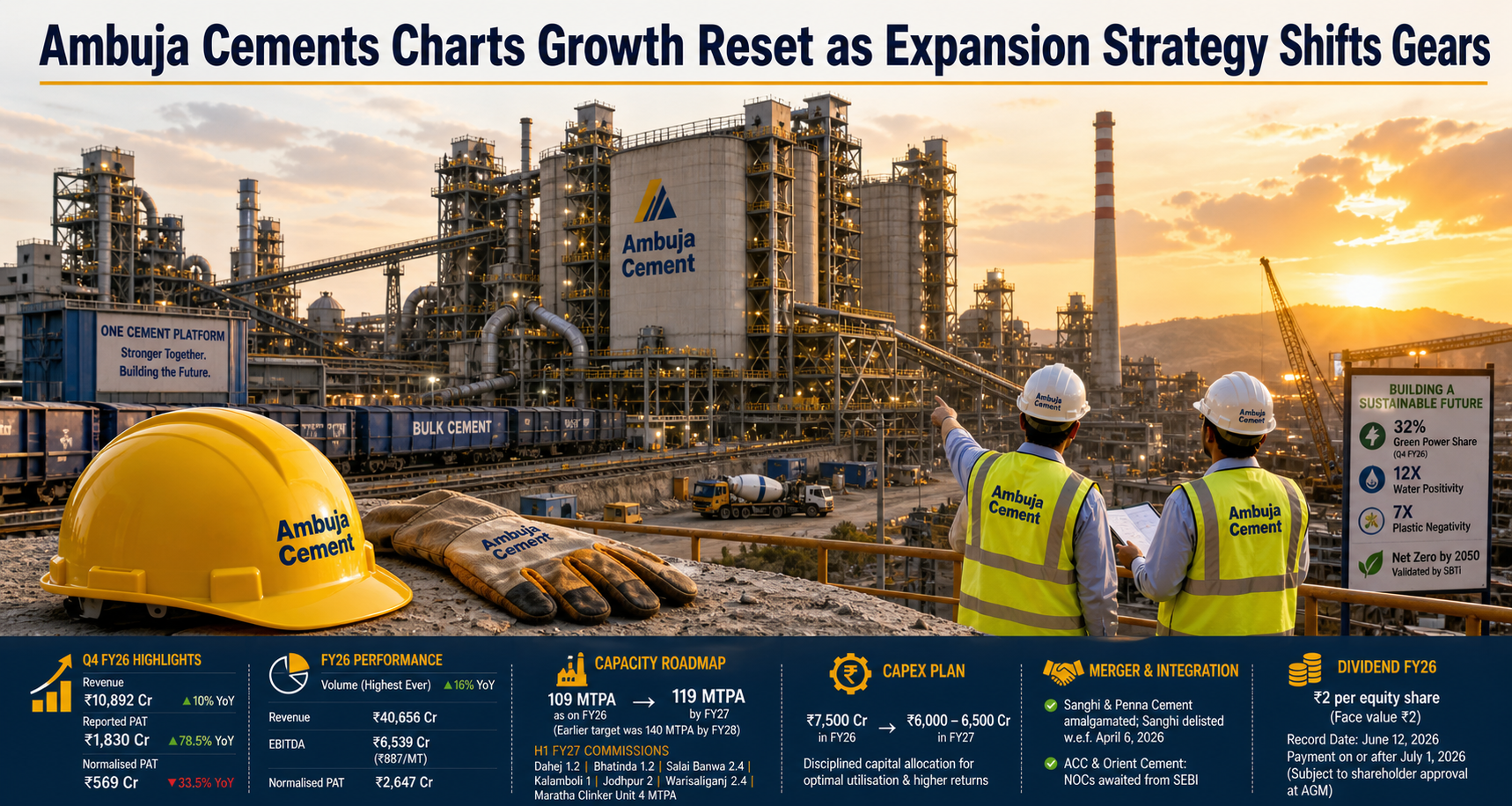
Ambuja Cements has fixed June 12, 2026 as the record date to determine shareholders eligible to receive the dividend for FY26. The said dividend, if declared by the shareholders at the ensuing AGM, shall be paid on or after July 1, 2026. For investors tracking the AGM agenda, the dividend approval is the procedural anchor. But the strategic substance of the meeting will centre on where 119 MTPA goes from here, and how management explains the deceleration in its previously stated 140 MTPA by FY28 target.
What Ambuja Cements Reported for Q4 FY26 and the Full Year
The Adani Group-owned Ambuja Cements reported a consolidated net profit of Rs 1,830 crore in Q4 FY26, marking a growth of 78.5% from Rs 1,025 crore during the same period last year. Its revenue from operations for the quarter ended March 31, 2026 increased 10% to Rs 10,892 crore as against Rs 9,894 crore in the year-ago period.
Those headline numbers require disaggregation. The Q4 FY26 reported PAT was boosted by one-off tax-related adjustments, including a net deferred tax credit of Rs 604 crore and an income-tax provision reversal of Rs 761 crore. Adjusting for these and other exceptional items, normalised profit stood at Rs 569 crore against the reported PAT of Rs 1,857 crore. On a normalised basis, the company's PAT for Q4 FY26 declined 33.52% year-on-year from Rs 856 crore in the year-ago quarter.
The full-year picture, however, is materially stronger than any single quarter suggests. Ambuja Cements delivered a resilient performance for the year with the highest ever annual volume of 73.7 MnT, revenue of Rs 40,656 crore, EBITDA at Rs 6,539 crore at Rs 887 per metric tonne, and normalised PAT of Rs 2,647 crore.
Who Drove Volume Growth and Which Segments Led the Expansion
The company achieved 16% volume growth in FY26, reaching 73.7 MnT, outperforming the industry. Despite quarterly market volatility, the company delivered a robust annual EBITDA of Rs 887 per tonne.
India's second-largest cement producer reported the highest-ever quarterly volume at 19.9 million tonnes in Q4 FY26, an increase of 10% year-on-year, amid higher focus on trade sales and premium cement. Higher volumes, along with an improved share of premium products in trade sales at 36%, as against 35% in Q4 FY25, aided Ambuja's topline.
Within lending segments, SME led growth and in Ambuja's case, the premium product segment is performing an analogous role: sustaining realisations when commodity pricing is under pressure. At 36% premium product share, the company is demonstrating a deliberate mix shift that protects per-tonne margins even as input costs remain elevated.
What the Capacity Expansion Roadmap Looks Like After the Timeline Revision
This is the most consequential data point heading into the AGM. Ambuja's cement capacity as of FY26 stood at 109 million tonnes per annum. It aims to achieve a capacity of 119 MTPA by FY27. Earlier, Ambuja had guided for 140 MTPA capacity by FY28.
Projects to be commissioned in H1 FY27 include grinding capacities at Dahej (1.2 MTPA), Bhatinda (1.2 MTPA), Salai Banwa (2.4 MTPA), Kalamboli (1 MTPA), Jodhpur (2 MTPA), Warisaliganj (2.4 MTPA) and an additional clinker unit at Maratha (4 MTPA). The total capacity is expected to increase to approximately 119 MTPA. Capacity expansion plans are being recalibrated in line with the recent railway policies on bulk cement terminals, with additions pursued more gradually after achieving optimal utilisation levels. This approach reflects disciplined capital allocation and a steadfast commitment to maximising return on capital employed.
The railway policy reference is significant. Bulk cement terminals are critical logistics nodes in Ambuja's distribution network, and changes to how these are permitted and operated directly affect the economics of new capacity additions in specific geographies.
What Karan Adani Said About the Timeline Revision and What It Means
The most closely watched management statement in the Q4 results announcement came from Karan Adani, non-executive non-independent director. Karan Adani said, "Partially, there is a reset. We are not moving away from the target, but the timeline. That is to do with, we know that we are not delivering in terms of what we have, what we had committed. And so, it definitely makes sense to step back, to look back and to see where we are going wrong and to course correct."
That statement is unusual in its directness. Corporate communications from large industrial groups rarely acknowledge execution gaps this plainly. The willingness to reset and course correct rather than defend an unreachable schedule is, analytically, a more credible signal for long-term investors than an unchanged target would have been.
Ambuja spent Rs 7,500 crore in capex in FY26. It aims to spend Rs 6,000 to Rs 6,500 crore in FY27. Adani said, "Until we are able to deliver on what we are promising, it does not make sense to make more capital investments, because you do not generate the returns on that capital either."
What the Merger Pipeline Means for the One Cement Platform Strategy
Amalgamation of Sanghi and Penna Cement with Ambuja Cements was completed, and Sanghi got delisted with effect from April 6, 2026. ACC and Orient Cement filed the necessary applications with BSE and NSE. Companies are currently awaiting no-objection certificates from SEBI.
The integration of recent acquisitions, including Orient Cement, continues to progress as part of the unified 'One Cement Platform' strategy.
The consolidation of Sanghi and Penna into Ambuja's legal and operational structure removes the complexity of managing separate balance sheets, compliance calendars, and procurement frameworks. Once the ACC and Orient NOCs come through, the full One Cement Platform will operate as a unified entity, which materially simplifies capital allocation decisions and creates the procurement scale needed to absorb input cost volatility.
What Cost Pressures Are Affecting Margins and What Management Plans to Do
Ambuja's EBITDA slipped 19% to Rs 1,441 crore from Rs 1,781 crore in the same period of the previous fiscal year. The EBITDA per metric tonne in Q4 stood at Rs 735, substantially below the full-year average of Rs 887, signalling that Q4 absorbed disproportionate cost pressure.
Cost pressures from fuel, diesel, packaging bag supply constraints, and rupee depreciation impacted this quarter and the impact is expected to continue in H1 FY27. The company is actively strengthening cost-mitigation measures through fuel mix optimisation, higher renewable energy usage, reducing logistics costs via rail and sea, and disciplined production and inventory management.
Cement demand remained strong through FY26. However, demand growth for FY27 is expected to remain soft at approximately 5%, factoring in early forecasts of a below-normal monsoon, which could adversely impact agricultural output and housing demand, as well as ongoing West Asia conflicts leading to fuel price volatility.
What the Sustainability and Green Power Data Shows
The share of green power increased by 6 percentage points year-on-year to 32% in Q4 from 26% a year ago.
Ambuja Cements is accelerating its decarbonisation journey through investments in 1 GW of renewable energy (solar and wind), 376 MW of Waste Heat Recovery Systems by FY28, and a strategic partnership with Coolbrook to deploy zero-carbon RotoDynamic Heater technology. Ambuja Cements has achieved 12 times water positivity and 7 times plastic negativity. It is committed to net-zero by 2050, being among the four large-scale building materials companies in the world with its near-term and net-zero targets validated by the Science Based Targets initiative.
The 12 times water positivity figure is particularly relevant in the context of India's climate risk calendar, given management's own forecast of a below-normal monsoon for FY27. A company that replenishes twelve times the water it consumes is not operationally vulnerable to water scarcity in the way a water-neutral peer would be.
What the Dividend Data Tells Investors About Capital Allocation Priorities
Ambuja Cements' board recommended a dividend of Rs 2 per equity share (face value Rs 2 each) for FY 2025-26, subject to approval of shareholders at the AGM.
At Rs 2 per share, the dividend is unchanged from the prior year's Rs 2 payout on the same face value, maintaining continuity in shareholder returns despite the normalised profit decline. The decision to hold the dividend steady while reducing capex guidance from Rs 7,500 crore to Rs 6,000 to Rs 6,500 crore reflects a conscious capital allocation shift: returning to utilisation optimisation before committing to the next tranche of capacity additions.