

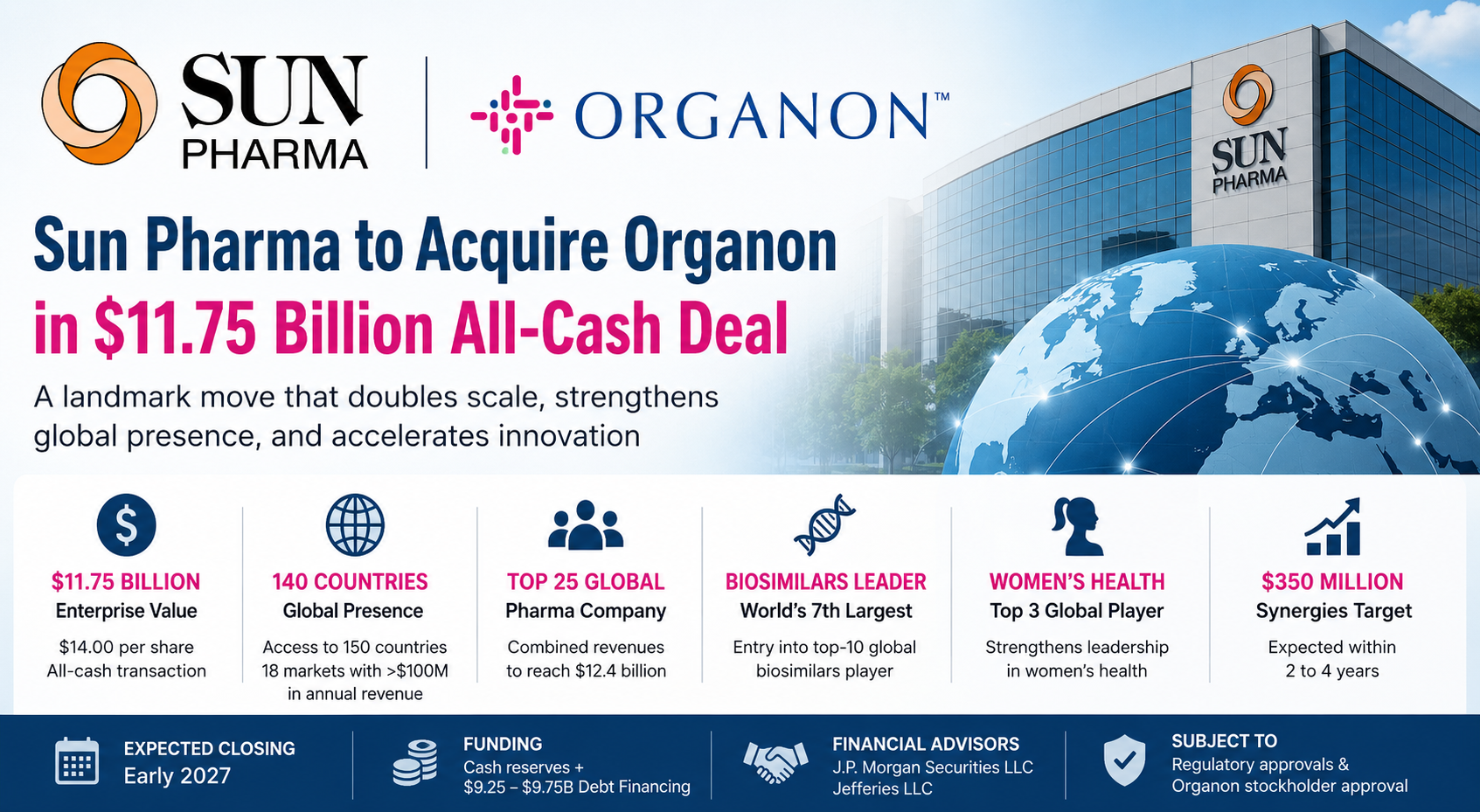
India's pharmaceutical sector has produced a defining moment. Sun Pharmaceutical Industries and Organon & Co. have entered into a definitive agreement under which Sun Pharma will acquire all outstanding shares of Organon for $14.00 per share in an all-cash transaction with an enterprise valuation of $11.75 billion. The move is not simply a corporate transaction. It is a structural statement about where the global pharmaceutical hierarchy is heading and how quickly it is getting there.
What the Organon Deal Actually Represents for Sun Pharma
Already the largest biopharma company in India, Sun Pharma has effectively doubled in size with this acquisition, picking up a drugmaker that matched the $6.2 billion in sales that it generated in 2025.
That symmetry is worth pausing on. Two companies of near-identical revenue are merging, which means this is not an acquisition of a distressed or smaller asset. It is a merger of commercial equals, financed entirely by one side, which carries both strategic audacity and significant financial consequence.
The acquisition will lift Sun Pharmaceutical's revenues to $12.4 billion, ranking it among the top 25 global pharmaceutical companies. For a company that built its reputation on affordable generics, that is a remarkable repositioning in a remarkably short window.
Why Organon Was the Target
Organon is a global healthcare company formed through a spinoff from Merck in 2021. The company's portfolio includes more than 70 products across Women's Health and General Medicines, including biosimilars, commercialized across 140 countries
The biosimilars angle is particularly significant. The deal grants Sun Pharma access to Organon's biosimilars arm, which Sun Pharma says will make it the world's seventh-biggest biosimilar company. Biosimilars represent one of the most contested and economically consequential frontiers in modern medicine. As biologics lose patent protection globally, the companies positioned to supply lower-cost equivalents stand to capture substantial market share. Sun Pharma just bought a front-row seat at that table.
The deal also enables Sun Pharma's entry into biosimilars as a top-10 global player and positions the combined company as a top-3 player in global women's health, creating a commercial platform for future growth.
The Strategic Fit in Innovative Medicines
Sun Pharma's innovative medicine products currently cover dermatology, ophthalmology, and onco-dermatology. In the financial year ending March 2025, the innovative medicine segment accounted for 20% of its total sales, but with the acquisition, it will contribute 27% to the topline.
That seven-percentage-point shift in revenue composition reflects a deliberate transition from volume-driven generics toward higher-margin specialty therapeutics. It is a transition every major generic-to-specialty pharmaceutical company has attempted, and few have executed at this scale in a single move.
The Financial Architecture: Bold but Leveraged
No serious analysis of this deal can avoid the debt question. It is the most consequential variable in whether this acquisition creates or destroys long-term value.
Sun Pharma plans to fund the acquisition using cash reserves and substantial debt financing, estimated between $9.25 billion and $9.75 billion. This significant leverage, combined with Organon's existing debt of approximately $8.6 billion, creates a considerable debt burden for the combined entity.
Post-transaction net debt-to-EBITDA is projected at 2.3x. That figure is management's own projection and represents the optimistic scenario. Analysts tracking the deal will be watching whether integration costs, revenue synergies, and debt servicing align with that forecast across the next 24 to 36 months.
Management expects synergies of $350 million within two to four years. Whether those synergies materialise on schedule depends on execution quality across two very different corporate cultures and geographies, which is historically one of the most underestimated risks in large pharmaceutical mergers.
What Organon Brings: Assets and Liabilities Together
Organon's revenue stood at about $6.2 billion in 2025, with its established brands generating the largest share. Despite this strategic alignment, the company reported a 3% revenue drop in 2025, with earnings trending down. Furthermore, Organon has reported significant weaknesses in its financial controls related to Nexplanon sales practices.
Organon still offers strategic value through its established product base and experienced workforce. The company traces its origins to 1923 in the Netherlands and now markets more than 70 medicines across approximately 140 countries, supported by manufacturing operations at six sites in Europe.
The governance risks are real, and Sun Pharma's leadership will need to address them promptly after close. A company with acknowledged internal control weaknesses requires active remediation, not just post-merger optimism.
How This Deal Fits the Wider 2026 M&A Landscape
This acquisition does not exist in isolation. It is part of a wave of large-scale consolidation that has accelerated across the pharmaceutical sector in early 2026.
The deal is the largest in the industry so far this year, topping Eli Lilly's recent buyouts of Centessa Pharmaceuticals and Kelonia Therapeutics, which were for headline values of $7.8 billion and $7 billion respectively. Also within the last five weeks, Merck put up $6.7 billion to acquire Terns Pharmaceuticals, Biogen picked up Apellis for $5.6 billion, and Gilead purchased Tubulis for a headline value of $5 billion.
The pattern is clear. Large pharmaceutical companies are using a window of relative capital availability to consolidate pipelines, acquire commercial infrastructure, and lock in therapeutic adjacencies before competition intensifies further. Sun Pharma's move is the most aggressive expression of that strategy this year.
India's Pharma Sector Takes a Global Step
Sun Pharma, historically known for its generics portfolio, has been steadily building its specialty business in dermatology, ophthalmology, and oncology-dermatology through targeted acquisitions, including Concert Pharmaceuticals in 2023 for $576 million and Checkpoint Therapeutics in 2025 for $418 million.
The Organon deal is an order of magnitude larger than either of those. It signals that Sun Pharma's leadership believes the company has reached sufficient scale, financial strength, and operational maturity to absorb and integrate a global commercial organisation of this complexity. That is a significant judgement call, and markets have initially responded with cautious approval.
With the agreement, which is expected to close by early 2027, Sun's stock increased by 7%, while Organon's jumped by 17%.
What Analysts Are Saying
Bhavesh Shah, managing director and head of investment banking at Mumbai-based Equirus Capital, said that such acquisitions can be value accretive over the medium to long term if they strengthen the company's portfolio or market reach and add scale, but added that in the near term, such deals can lead to higher leverage, integration costs, and execution risks.
Analyst Umer Raffat of Evercore ISI noted that Organon brings "excellent people from Merck" and an "excellent set of legacy Merck brands."
The consensus view is one of strategic logic tempered by financial caution. Nobody is questioning the rationale for the combination. The questions centre on price, debt load, and management's ability to deliver on an ambitious synergy target while simultaneously managing Organon's pre-existing operational challenges.
The Path to Close and What Comes Next
The transaction is expected to close in early 2027, subject to customary conditions, including regulatory approvals and Organon stockholder approval. Sun Pharma plans to fund the acquisition through a combination of available cash resources and committed financing from banks.
Kirti Ganorkar, managing director of Sun Pharma, emphasised plans for disciplined integration and business continuity. Both companies have emphasised business continuity as an immediate priority.
The regulatory path will span multiple jurisdictions given Organon's commercial presence across 140 countries. Antitrust review in the United States and European Union will be the most scrutinised processes. Given that Sun Pharma and Organon have limited therapeutic overlap in their core portfolios, significant regulatory obstacles are not widely anticipated, though this remains a variable that could extend the timeline.