

What the FY2026 Numbers Say About Kotak Mahindra Bank's Trajectory
India's private banking sector has delivered a mixed picture in FY2026, shaped by the Reserve Bank of India's rate cut cycle, deposit competition, and evolving credit demand across retail and institutional segments. Within that context, Kotak Mahindra Bank's full-year results present a bank that has maintained discipline on asset quality, expanded its balance sheet at a healthy pace, and outperformed analyst earnings estimates, even as margin compression and a sharply reduced dividend created divergent signals for investors.
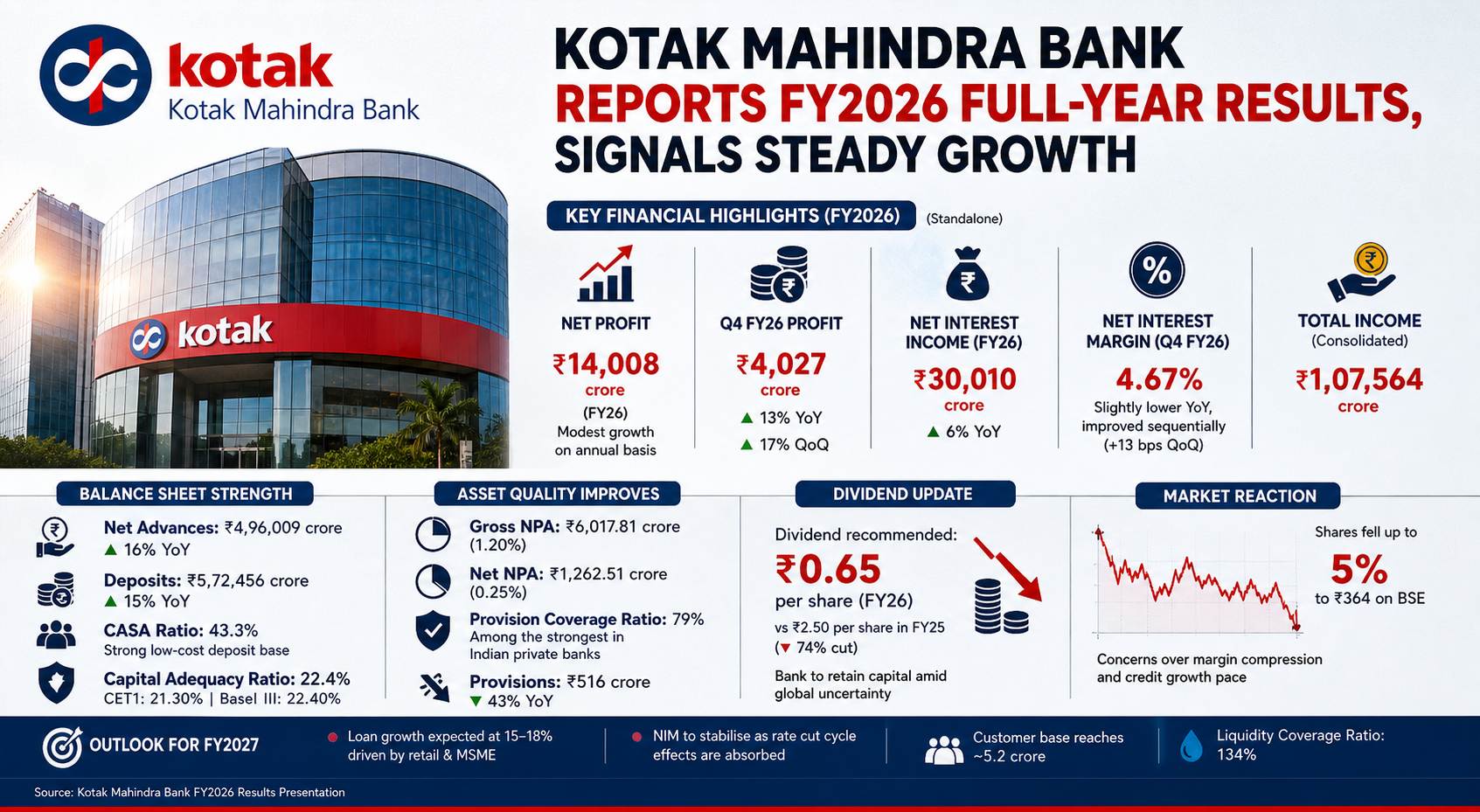
Kotak Mahindra Bank delivered a solid performance in the fourth quarter of FY26, reporting a standalone profit after tax of Rs 4,027 crore, marking a 13% increase compared to the same period last year and a 17% rise sequentially from the previous quarter. For the full financial year, the bank posted a profit of Rs 14,008 crore, reflecting modest growth on an annual basis.
On a consolidated basis, the net profit after tax for the group stood at Rs 19,287.89 crore for the fiscal year ending March 31, 2026, with consolidated total income reaching Rs 1,07,563.70 crore.
These are not headline-grabbing growth figures. They are, however, structurally sound ones, and the distinction matters when reading a bank whose historical premium valuation has always rested on the quality of its book rather than the velocity of its growth.
Who Drove the Quarterly Earnings Beat and What the Provisioning Data Reveals
The Q4 FY26 result beat analyst consensus by a meaningful margin. PAT came in at Rs 4,027 crore, well above analyst estimates of Rs 3,700 to Rs 3,782 crore. Provisions fell 43% year-on-year to Rs 516 crore as asset quality improved.
Provision releases are among the cleanest indicators of underlying credit health. A 43% fall in provisioning is not a cosmetic improvement. It reflects actual loan performance, declining slippages, and an improving recovery environment. Slippages moderated to Rs 1,018 crore from Rs 1,605 crore in Q3 FY26 and Rs 1,488 crore in Q4 FY25. That is a sequential decline of nearly 37% in fresh bad loan formation, which is a materially positive signal for the bank's retail and SME credit underwriting.
What the Net Interest Income and Margin Data Show for FY2026
The bank's net interest income rose 8% year-on-year to Rs 7,876 crore during the quarter. On an annual basis, NII reached Rs 30,010 crore, representing a 6% increase. Net interest margin stood at 4.67% for the quarter. While slightly lower compared to the previous year, it showed improvement on a sequential basis, indicating some stabilisation in margin trends.
The sequential NIM recovery of 13 basis points is important context. The bank's management indicated a more gradual decline in margins going forward, as deposit repricing begins to pick up in the second half of the year. For analysts monitoring the NIM trajectory as the primary valuation driver, that commentary sets a cautiously constructive tone for FY27.
The year-on-year NIM compression of 30 basis points from 4.97% to 4.67% reflects the broader rate environment rather than bank-specific deterioration. As the RBI rate cut cycle filters through liability repricing, banks with strong CASA franchises are structurally better positioned to defend margins than peers relying on bulk borrowings.
How Strong Is Kotak Mahindra Bank's Balance Sheet as of March 2026
Kotak Mahindra Bank continued to expand its balance sheet, with net advances growing 16% year-on-year to Rs 4,96,009 crore. Deposits also saw healthy growth, rising 15% to Rs 5,72,456 crore. The CASA ratio stood at 43.3%, reflecting a strong base of low-cost deposits, which is crucial for maintaining profitability in a competitive banking environment. The bank's capital adequacy ratio remained robust at 22.4%, providing a strong buffer to support future growth and absorb potential risks.
A capital adequacy ratio of 22.4% is substantially above the regulatory minimum. The bank's CET1 ratio stands at 21.30% and Basel III ratio at 22.40%, well above regulatory requirements, meaning the low dividend payout is a choice, not a compulsion.
Within lending segments, SME led growth at 19% year-on-year, followed by the corporate book at 22% year-on-year, consumer banking at 14% year-on-year, and commercial banking at 8% year-on-year. The SME and corporate growth rates indicate that Kotak is not simply harvesting its retail franchise. It is deepening institutional relationships, which tends to improve fee income and cross-sell revenue over time.
What the Asset Quality Improvement Means for Credit Risk Investors
As of March 31, 2026, the bank maintained robust asset quality metrics. The standalone Gross NPA was reported at Rs 6,017.81 crore, while the Net NPA stood at Rs 1,262.51 crore. These figures represent a Gross NPA ratio of 1.20% and a Net NPA ratio of 0.25%, reflecting the bank's disciplined approach to credit risk management.
The bank continued its trend of improving asset quality, reporting some of the lowest non-performing asset ratios in the industry. The provision coverage ratio stood at a comfortable 79%.
A provision coverage ratio of 79% means that for every rupee of gross bad loans, the bank has already set aside Rs 0.79 as a provision. That level of coverage provides a substantial buffer against unexpected credit losses and is among the most conservative PCR readings in the Indian private banking sector.
Why the Dividend Cut Is the Most Contested Element of These Results
The result that divided market opinion most sharply was not the earnings beat. It was the dividend. The board recommended a dividend of Rs 0.65 per share for FY26, against Rs 2.50 in FY25, a 74% cut.
CEO Ashok Vaswani on the Q4 earnings call indicated the bank is closely monitoring the West Asia conflict's impact and prefers to retain capital in an uncertain environment. That explanation will reassure some investors and concern others. Retaining capital during geopolitical uncertainty is a defensible strategic posture for a bank with long-dated liability commitments. However, for income-oriented investors and institutional holders with yield mandates, the cut materially changes the return calculus.
Kotak Mahindra Bank did a 1:1 bonus share issue in November 2025, which halved the per-share metrics. Adjusting for the bonus issue, the comparable FY25 dividend base is effectively Rs 1.25 per share. The FY26 dividend of Rs 0.65 still represents a cut on that adjusted basis, though less dramatic than the headline 74% figure suggests.
What Management Said About the Corporate Book Dip in Q4
One data point that drew attention was the sequential decline in the corporate loan book despite a 22% year-on-year increase. On the corporate book's sequential dip, Paritosh Kashyap, whole-time director at Kotak Mahindra Bank, said: "In Q4, interest rates typically rise towards the end of the year. Considering the credit quality of our corporate customers, to whom we can lend, it needs to make commercial sense for us to continue doing so."
That is a clear statement of credit discipline over volume maximisation. It also suggests the bank is not under pressure to chase loan growth at the cost of margin quality, which is consistent with its historical underwriting culture.
How the Stock Market Responded to the FY2026 Results
Shares of Kotak Mahindra Bank fell as much as 5% to Rs 364 on the BSE on Monday, even as the lender reported a better-than-expected performance for the March quarter of FY26, highlighting a divergence between headline earnings and investor concerns around future growth and margins. Despite these positives, brokerage firms pointed to emerging concerns around margin compression and the pace of credit growth, which weighed on sentiment.
The Kotak Mahindra Bank share price has declined 12% over the past year against a Sensex that is broadly flat. That relative underperformance reflects valuation derating rather than fundamental deterioration. The bank's operating metrics have continued to improve even as the premium the market once assigned to its franchise has moderated.
What Analysts Expect from Kotak Mahindra Bank in FY2027
For the Kotak Mahindra Bank share price to re-rate toward the Rs 420 to Rs 450 range, the market needs to see NIM sustaining above 4.8% for two or three consecutive quarters in FY27.
Following the Kotak Mahindra Bank Q4 results FY26, analysts expect the bank to sustain 15 to 18% loan book growth in FY27, driven by retail and MSME segments. NIM is expected to stabilise as rate cut cycle effects are absorbed.
The customer base expansion provides an additional long-run growth indicator. The bank's customer base expanded to approximately 5.2 crore, reflecting its growing reach across retail and institutional segments. Additionally, the liquidity coverage ratio remained strong at 134%, indicating adequate liquidity to meet short-term obligations.