

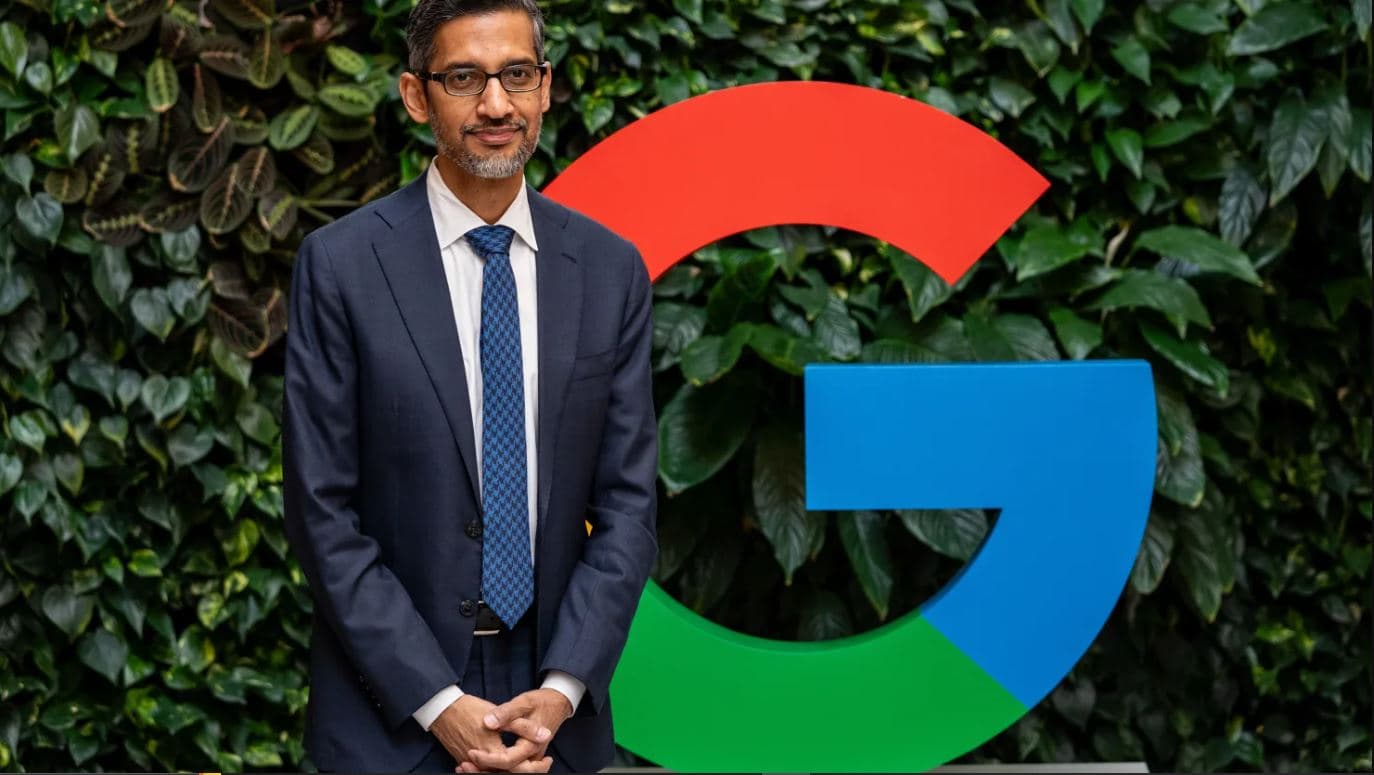
Sundar Pichai was born as Pichai Sundararajan on June 10, 1972, in Madurai, Tamil Nadu, in southern India. He was raised in a modest, middle-class household in Ashok Nagar, Chennai. His father, Regunatha Pichai, worked as an electrical engineer for the British conglomerate GEC, while his mother was a stenographer before she became a homemaker.
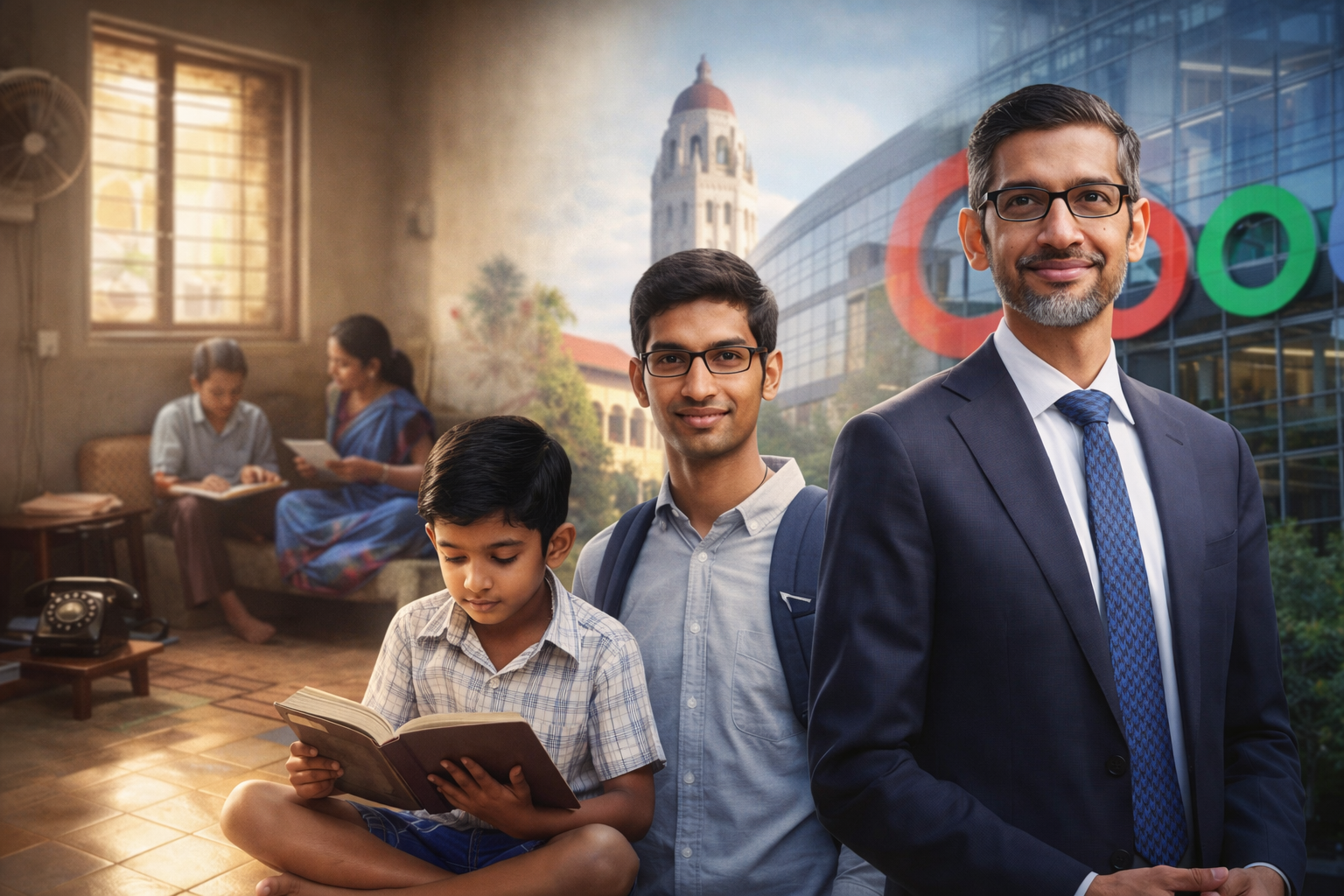
From a reputation analysis standpoint, Pichai's origin story is one of the most powerful in corporate history, not because it was manufactured, but because it is verifiably true and verifiably extraordinary. The distance between a two-room apartment in Ashok Nagar with no telephone until age twelve and the chief executive office of one of the world's most powerful corporations is not merely geographical. It is a credibility asset that no crisis communications team could have invented, and it has formed the bedrock of public trust in Pichai for two decades.
Early Life and the Foundations of a Credible Brand
Growing Up in Chennai: Scarcity as Credibility
As a boy growing up in Madras, now Chennai, Pichai slept with his brother in the living room of the cramped family home, but his father, an electrical engineer at the British multinational GEC, saw that the boys received a good education. At an early age Pichai displayed an interest in technology and an extraordinary memory, especially for telephone numbers.
The Pichai family lived in a two-room apartment, and they did not even own a telephone until Sundar was 12. Sundar attended Jawahar Vidyalaya, a CBSE school in Ashok Nagar, before moving to Vana Vani School, located inside the campus of the Indian Institute of Technology Madras. He excelled in academics from an early age, with a particular affinity for mathematics and science.
In reputation analysis, authenticity is the scarcest and most valuable currency a public figure can possess. Pichai's childhood story requires no embellishment. The detail of a family that did not own a telephone until the future CEO of Google was twelve years old is not merely poignant. It is a narrative anchor that makes every subsequent achievement structurally more credible to mass audiences globally, particularly in emerging markets where Google operates at scale.
Education: Building Institutional Authority
Sundar Pichai pursued a degree in Metallurgical Engineering from IIT Kharagpur, one of India's most prestigious institutions. His professors quickly recognized his talent and encouraged him to apply to universities in the United States. After graduating from IIT Kharagpur with distinction, Pichai earned a scholarship to Stanford University, where he completed his MS in Materials Science and Engineering. Following his master's, Pichai enrolled in the Wharton School of the University of Pennsylvania to pursue an MBA, where he was named both a Siebel Scholar and a Palmer Scholar, honours reserved for the top-performing students.
The educational trifecta of IIT Kharagpur, Stanford, and Wharton is not simply impressive. From a brand credibility standpoint, it represents three independently verified signals of intellectual capacity. Each institution carries its own reputational weight. Together they constitute the strongest possible institutional authority base for a technology executive. When Pichai speaks on AI policy, antitrust regulation, or climate technology, he speaks with the backing of credentials that most of his peers cannot match.
The Google Years: Building a Product Reputation
Joining Google in 2004: The Chrome Bet That Made a Career
He joined Google in 2004, where he first worked on the Google Toolbar. He later led the development of the Google Chrome browser, which became the most widely used web browser in the world. Rising through the ranks, he played a key role in overseeing products such as Gmail, Android, Google Drive, and Chrome OS.
Pichai joined Google in 2004, where he led the product management and innovation efforts for a suite of Google's client software products, including Google Chrome and ChromeOS, as well as being largely responsible for Google Drive. He went on to oversee the development of other applications such as Gmail and Google Maps. On November 19, 2009, Pichai gave a demonstration of ChromeOS. The Chromebook was released for trial and testing in 2011, and released to the public in 2012.
The Chrome story is the foundational chapter of Pichai's product reputation. When Pichai championed the Chrome browser internally, it was a deeply contested proposition. Microsoft's Internet Explorer held dominant market share and many inside Google believed the company should focus on search rather than building its own browser. Pichai's willingness to back Chrome, his ability to build and maintain the team that created it, and the subsequent market outcome, Chrome becoming the world's most widely used browser, established his reputation as a product leader with both technical depth and commercial instinct.
Rising Through the Ranks: From VP to Product Chief
In 2008, Pichai was promoted to Vice President of product development. In this position he started appearing more often at Google presentations and continued rising up the ranks. By 2012, he had become the Senior Vice President of Chrome and apps. In 2013, Andy Rubin, the creator of Android, left to work on a different project. Larry Page then made Pichai in-charge of Android as well. His influence continued to increase and he was made the Product Chief in October 2014.
The addition of Android to Pichai's portfolio in 2013 was the decisive signal that Larry Page had identified him as the successor. Android was, and remains, the most widely used mobile operating system in the world. Placing Pichai in charge of both Chrome and Android gave him responsibility for the two most important software platforms Google had built outside of search. His ability to manage both simultaneously, without visible internal conflict or product degradation, solidified his reputation as the most effective product executive in the company.
The Microsoft Offer and the Retention Decision
In 2011 Pichai reportedly was aggressively pursued for employment by microblogging service Twitter, and in 2014 he was touted as a possible CEO for Microsoft, but in both instances he was granted large financial packages to remain with Google.
From a reputation standpoint, the Microsoft episode is significant. Being identified as the leading external candidate for the chief executive role of one of the world's largest technology companies, while still a vice president at another company, sent a powerful signal to the market about Pichai's perceived leadership ceiling. It also placed Google in the position of having to actively retain him, which strengthened his internal standing and accelerated his path to the top role. The individual who Microsoft eventually chose was Satya Nadella. The parallel careers of Pichai and Nadella, two Indian-born executives who rose to lead the two largest software companies in the world within a year of each other, has become one of the defining narratives of twenty-first century corporate leadership.
The CEO Appointments: 2015 and 2019
Named CEO of Google: August 2015
Pichai was selected to become the next CEO of Google on August 10, 2015, after previously being appointed Product Chief by CEO Larry Page. On October 24, 2015, he stepped into the new position at the completion of the formation of Alphabet Inc., the new holding company for the Google company family.
The manner of Pichai's appointment deserves reputational analysis. He did not claim the role. He was selected for it. The distinction matters in the court of public opinion. Larry Page and Sergey Brin chose Pichai over other capable internal candidates because of his track record, his temperament, and his ability to represent Google externally without generating unnecessary controversy. That selection rationale has shaped how Pichai has been perceived ever since: as a leader chosen for competence and character rather than ambition or aggression.
Named CEO of Alphabet: December 2019
In December 2019, Pichai became the CEO of Alphabet Inc. Page and Brin stayed on Alphabet's board with majority voting power as shareholders, while Pichai ran daily operations across the entire Alphabet portfolio.
The Alphabet appointment made Pichai responsible for one of the most complex corporate structures in global business, overseeing not just Google's core products but also Waymo, DeepMind, Verily, and numerous other subsidiaries. The reputational challenge of running an organisation this large, with this many public-facing products and this many regulatory fronts, is unlike anything most corporate leaders face.
“From a two-room home in Chennai to leading Google, Sundar Pichai proves that true power isn’t where you start it’s how consistently you build, adapt, and lead with purpose.”
Compensation, Controversy, and the Reputation Under Pressure
The $200 Million Pay Package and the Layoffs
His compensation from the company topped $200 million in 2022, which many employees criticised in light of large-scale layoffs that Google undertook in 2023.
This is the most significant domestic reputational challenge Pichai has faced during his tenure. The juxtaposition of a $200 million compensation package alongside the largest layoffs in Google's history, approximately 12,000 employees cut in January 2023, created a credibility gap that his careful brand management had previously avoided. The criticism was structurally difficult to refute because the numbers were public, the human cost was documented, and the contrast was stark.
His 2024 earnings dropped to approximately $905 million according to Alphabet's 2025 Proxy Statement. Alphabet spent significantly on his personal security in 2024, up 22 percent from 2023. The company sees this as a business necessity given his high-profile position.
Congressional Testimony and Political Scrutiny
On December 11, 2018, Sundar Pichai was questioned by the United States House Judiciary Committee on a range of Google-related issues such as possible political bias on Google's platforms, the company's alleged plans for a censored search app in China, and its privacy practices.
Pichai's Congressional testimony performance is widely assessed by reputation professionals as a textbook example of composed crisis navigation. He answered questions with precision, acknowledged what he could acknowledge, and declined to speculate on what he could not confirm, all while maintaining a demeanour that was neither defensive nor dismissive. The contrast with the more combative Congressional performances of some of his contemporaries strengthened rather than weakened his public standing.
Project Nimbus, the Employee Protests, and the Workplace Culture Question
In April 2024, after 28 Google employees were fired for protesting against Project Nimbus, Pichai stated that the office is not a place to fight over disruptive issues or debate politics, and warned against using the company as a personal platform.
Project Nimbus, Google's cloud computing contract with the Israeli government worth approximately $1.2 billion, generated sustained internal opposition from employees who believed the contract conflicted with Google's stated values. The decision to terminate 28 employees for participating in a sit-in protest was the most contentious internal management decision of Pichai's tenure. It drew sharp criticism from labour advocates and free speech organisations while being defended by shareholders and board members as a necessary assertion of management authority. The reputational damage was real but contained, largely because Pichai positioned the decision as a governance question rather than a political one.
DEI Policy Reversal in 2025
In 2025, Google issued a response to Donald Trump and Elon Musk's initiatives to cease DEI programmes by removing their annual cultural events such as Pride Month, Black History Month, and Holocaust Remembrance Day.
The decision to scale back diversity, equity, and inclusion commitments in early 2025 placed Pichai in the position of many major corporate leaders navigating the post-election political environment in the United States. The reputational calculus was complex. Maintaining DEI commitments risked regulatory and political friction with the incoming administration. Rolling them back risked alienating the substantial portion of Google's workforce and user base that had been attracted by those commitments. Pichai's approach, calibrated reduction rather than outright elimination, reflected his characteristic preference for managing the temperature rather than resolving the underlying tension.
The AI Era: The Biggest Reputational Test of Pichai's Career
The Gemini Launch and the ChatGPT Challenge
Back in 2016, Pichai stated that Google would become an AI-first company, a strategic shift that shapes the company's path today. Google I/O 2025 saw Pichai show three major AI-powered initiatives including Google Beam, formerly Project Starline.
The emergence of OpenAI's ChatGPT in late 2022 created the most serious public reputational challenge of Pichai's tenure, not because Google lacked AI capability, but because Google was perceived to have been caught flat-footed by a competitor in a domain Google had pioneered. The subsequent rushed launch of Bard, which gave an incorrect answer about the James Webb Space Telescope in its first public demonstration, cost Alphabet approximately $100 billion in market capitalisation in a single day and represented the most damaging single event in Pichai's tenure as CEO.
The recovery through Gemini, Google's large language model suite, has been substantial. But the episode permanently complicated the narrative of Pichai as the unassailable steady hand. It demonstrated that even the most carefully managed reputational brand is vulnerable to a single high-visibility product failure at the wrong moment.
Awards, Recognition, and Soft Power
Pichai was included in Time's annual list of the 100 most influential people in 2016 and 2020. He was also included in the Time 100 AI list in 2024. He was awarded the 2021 Asia Game Changer Award by the Asia Society. In 2022, Pichai received the Padma Bhushan in the category of Trade and Industry from the Government of India, the country's third-highest civilian award.
The Padma Bhushan is particularly significant from a reputational standpoint. It represents the Indian government's formal recognition of Pichai as a figure of national importance, not just a successful emigrant. For an executive whose brand is built partly on the universality of his origin story, receiving India's third-highest civilian honour reinforces the authenticity of that narrative at the highest institutional level.
Personal Life and the Authenticity Premium
Sundar Pichai's personal life is anchored in his relationship with his wife, Anjali Pichai, whom he met during his undergraduate studies at IIT Kharagpur. The couple's bond, formed in the corridors of academia, has withstood the test of time and the pressures of Sundar's meteoric rise in the tech world. They have two children, and despite his demanding role, Pichai is known to be a dedicated family man, emphasising the importance of spending time with his loved ones and maintaining a balance between his personal and professional life.
Sundar Pichai and Anjali Pichai have two children, a son named Kiran and a daughter named Kavya.
Those close to Pichai describe him as humble, thoughtful, and approachable, traits not always associated with the leaders of major global corporations. Pichai is also a connoisseur of reading, particularly non-fiction and biographies, which he believes provide insights into different perspectives and life experiences.
In an era when the personal conduct and private values of technology executives are increasingly subject to public scrutiny, Pichai's personal life has been notably free of the controversies that have damaged the reputations of several of his contemporaries. His marriage to a woman he met as an undergraduate student, his emphasis on family, and his consistently reported personal humility contribute to a reputation for private integrity that reinforces his public brand.
The Reputation Scorecard: Where Pichai Stands in 2026
After twelve years of tracking technology executives' reputational trajectories, the Pichai profile presents a rare combination of sustained institutional credibility and managed vulnerability. His reputation for technical competence is essentially unassailable. His reputation for ethical leadership has faced genuine challenge through the layoffs, the Project Nimbus firings, the Bard launch failure, and the DEI reversals. His reputation for global statesmanship, earned through Congressional testimony, international regulatory engagement, and the Padma Bhushan, remains largely intact.
The AI transition represents both the greatest opportunity and the greatest risk for Pichai's long-term reputational legacy. If Alphabet navigates the AI era successfully and Google's products remain the dominant platforms through which billions of people access information, Pichai will be remembered as the executive who guided the most important information technology company of the early twenty-first century through its most consequential transformation. If the AI transition produces significant societal harms, regulatory failures, or competitive displacement, the same biography will read very differently.
Sundar Pichai's story is a remarkable example of global success through education, hard work, and vision. From a modest upbringing in Chennai to leading one of the world's most powerful tech empires, his journey inspires millions around the world. He is credited with transforming Google's core products into global platforms, driving responsible AI development, and maintaining the company's core values in a fast-changing digital world.