

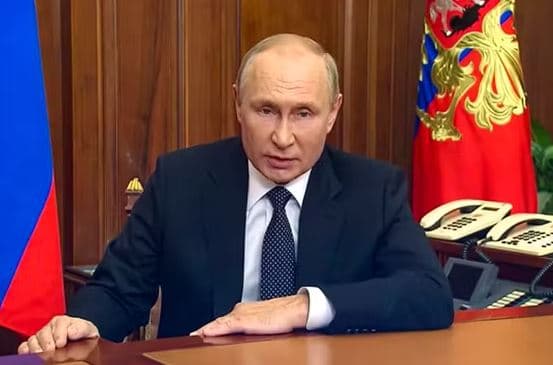
For more than two decades, Vladimir Putin has remained at the center of Russian power, surviving economic crises, international sanctions, political challenges, and one of the most consequential wars in modern Europe.
Few world leaders have inspired such sharply divided opinions. To supporters, Putin restored stability to a country still reeling from the collapse of the Soviet Union. To critics, he has overseen the concentration of political power, the weakening of independent institutions, and an increasingly confrontational foreign policy.
What is not disputed is his influence. Since first entering the Kremlin in 1999, Putin has shaped Russia's domestic politics and international standing more profoundly than any leader since Joseph Stalin.
A Childhood Shaped by Scarcity
Long before he occupied the Kremlin, Putin lived in conditions familiar to many post-war Soviet families.
Born in Leningrad on October 7, 1952, he grew up in a communal apartment shared with several families. Resources were limited, privacy was scarce, and memories of World War II remained fresh.
His father, a veteran wounded during the Siege of Leningrad, rarely spoke publicly about the war. Yet historians often point to those family experiences as a factor that influenced Putin's emphasis on resilience, national strength, and security.
Former classmates have described a young Putin as determined rather than naturally gifted—a student who compensated for limitations through discipline and persistence.
The KGB Years
Putin's career trajectory changed dramatically after graduating from Leningrad State University in 1975.
Instead of pursuing a conventional legal career, he entered the KGB, the Soviet Union's powerful intelligence agency.
His posting to Dresden, East Germany, during the final years of the Cold War would later become one of the defining periods of his life.
Political analysts frequently reference a story Putin himself has told about the collapse of East Germany in 1989. As protests intensified outside Soviet facilities, he reportedly sought guidance from Moscow but received none.
Whether symbolic or literal, the incident became central to Putin's worldview. In speeches over the years, he has repeatedly described the collapse of the Soviet Union as a geopolitical disaster that weakened Russian influence globally.
The Unexpected Rise to Power
Few observers predicted Putin's rapid ascent.
When he arrived in Moscow during the 1990s, he was largely unknown outside political circles. Yet within a remarkably short period, he moved from bureaucratic roles inside the Kremlin to leading Russia's intelligence services.
By August 1999, President Boris Yeltsin appointed him Prime Minister.
Just months later, on New Year's Eve, Yeltsin unexpectedly resigned, naming Putin acting president.
The transition would alter Russian politics for generations.
Building the Putin Era
During his first years in office, Putin benefited from rising global energy prices, which fueled economic growth across Russia.
Living standards improved. Government revenues increased. The Kremlin regained authority after years of political instability.
These successes helped establish Putin's reputation as a leader capable of restoring order.
Yet the same period also saw growing concerns among human rights groups and international observers regarding media freedoms, political competition, and the expanding influence of security institutions.
The duality of Putin's leadership—economic recovery alongside increasing political centralization—remains one of the most debated aspects of his presidency.
Ukraine and the Defining Test of His Legacy
If Putin's early years were defined by consolidation of power, the conflict in Ukraine may ultimately define his historical legacy.
Russia's annexation of Crimea in 2014 dramatically reshaped relations with the West.
The full-scale invasion launched in February 2022 elevated those tensions further, triggering extensive sanctions, diplomatic isolation, and one of Europe's largest security crises since World War II.
Supporters within Russia argue the actions were necessary to protect national security interests.
Western governments, Ukraine, and numerous international organizations strongly dispute that position and have condemned the invasion.
The outcome of this conflict will likely influence how future historians assess Putin's place in global history.
The Mystery of Putin's Wealth
Perhaps no topic generates more speculation than Putin's personal fortune.
Official disclosures portray a leader with relatively modest assets.
Independent investigations, however, have frequently alleged that wealth connected to individuals within Putin's inner circle may ultimately benefit him.
Definitive proof remains elusive, which is why estimates vary dramatically—from millions to well over one hundred billion dollars.
For journalists and researchers, separating fact from speculation remains an ongoing challenge.
A Leader Who Defies Political Timelines
Most world leaders operate within predictable political cycles.
Putin does not.
He has outlasted multiple American administrations, numerous European governments, and nearly an entire generation of Russian political figures.
Whether admired or criticized, his ability to maintain influence for more than twenty-five years is one of the most remarkable political stories of the modern era.
As Russia confronts economic uncertainty, demographic challenges, and geopolitical tensions, one question continues to dominate international analysis:
What will Russia look like after Vladimir Putin?
The answer may determine not only Russia's future, but the future balance of global power itself.