

What Is the IMF Warning About AI and Cybersecurity?
The International Monetary Fund has warned of the risks to global financial stability posed by cyberattacks powered by advanced artificial intelligence tools, calling for greater international cooperation on the issue. The alert, issued in a formal IMF report, marks one of the most direct statements yet from a major multilateral institution on how rapidly evolving AI capabilities are reshaping the threat landscape for banks, payment systems, and financial markets worldwide.
Why Does AI Make Cyberattacks More Dangerous to Financial Systems?
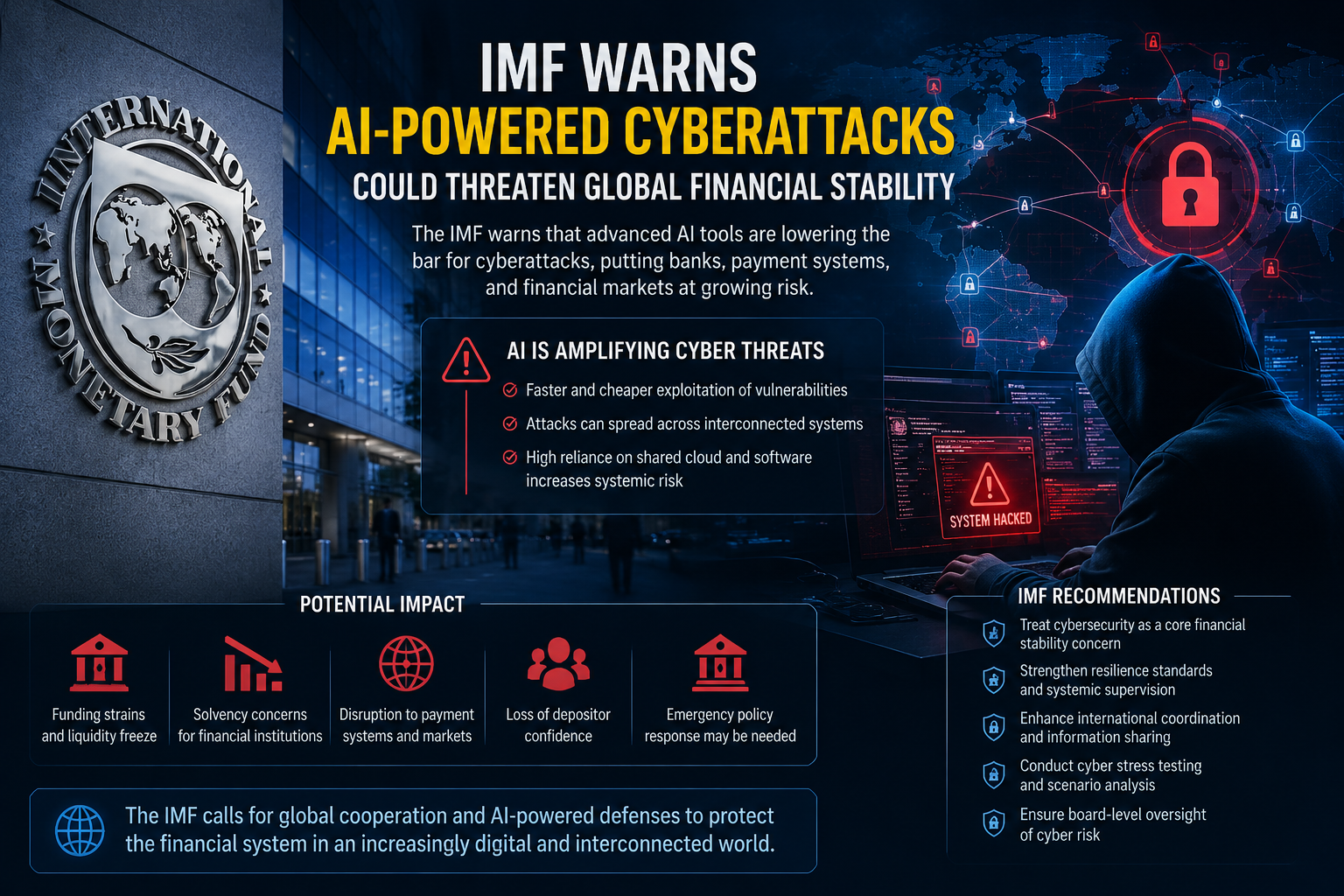
Artificial intelligence is transforming how the financial system copes with vulnerabilities and reacts to incidents, yet it is also amplifying cyber threats that can undermine financial stability when the offensive capabilities of intruders outpace defenses. At the heart of this concern is the structure of the global financial system itself. The financial system relies on shared digital infrastructure that is highly interconnected, including software, cloud services, and networks for payments and other data. Advanced AI models can dramatically reduce the time and cost needed to identify and exploit vulnerabilities.
The IMF cautioned that AI may further concentrate risk across the financial system, with a single exploited weakness capable of rippling across many institutions simultaneously. Heavy reliance on a small number of cloud providers and software networks compounds this concern.
Who Is Most at Risk?
Emerging and developing economies, which often have more severe resource constraints, may be disproportionately exposed to attackers targeting regions with weaker defenses. This is not simply a rich-world problem. Any nation whose banking infrastructure runs on widely shared digital platforms faces compounding exposure as AI tools become cheaper and more accessible to malicious actors globally.
How Could This Affect Markets and Financial Institutions?
The IMF analysis suggests that extreme cyber-incident losses could trigger funding strains, raise solvency concerns, and disrupt broader markets. In practical terms, a coordinated AI-powered attack on a major payment network or central clearing system could freeze liquidity, destroy depositor confidence, and force emergency policy responses from central banks at a scale regulators have not previously planned for.
What Are Policymakers Being Asked to Do?
The IMF urged policymakers to treat cybersecurity not as a technical or operational matter but as a core financial stability concern, prioritizing resilience standards, systemic supervision, and international coordination to contain breaches before they spread. Cyber stress testing, scenario analysis, and board-level oversight of cyber risk are becoming indispensable components of financial stability frameworks.
IMF Managing Director Kristalina Georgieva has been direct in her own public statements. She warned that the global financial system was not ready for the cybersecurity threats posed by AI, telling CBS News that the IMF was keen to see more attention given to the guardrails necessary to protect financial stability in a world of AI.
What Triggered the Urgency Behind This Report?
AI tools, including Anthropic's Claude Mythos Preview, are dramatically lowering the bar for cyberattacks, enabling even less skilled actors to exploit vulnerabilities across major systems. The model was particularly efficient at identifying vulnerabilities that developers and users had been previously unaware of. These buffers are likely to erode quickly as model training expands, capabilities diffuse, and leaks occur, meaning temporary containment is unlikely to substitute for durable defenses.International Monetary Fund (IMF)