

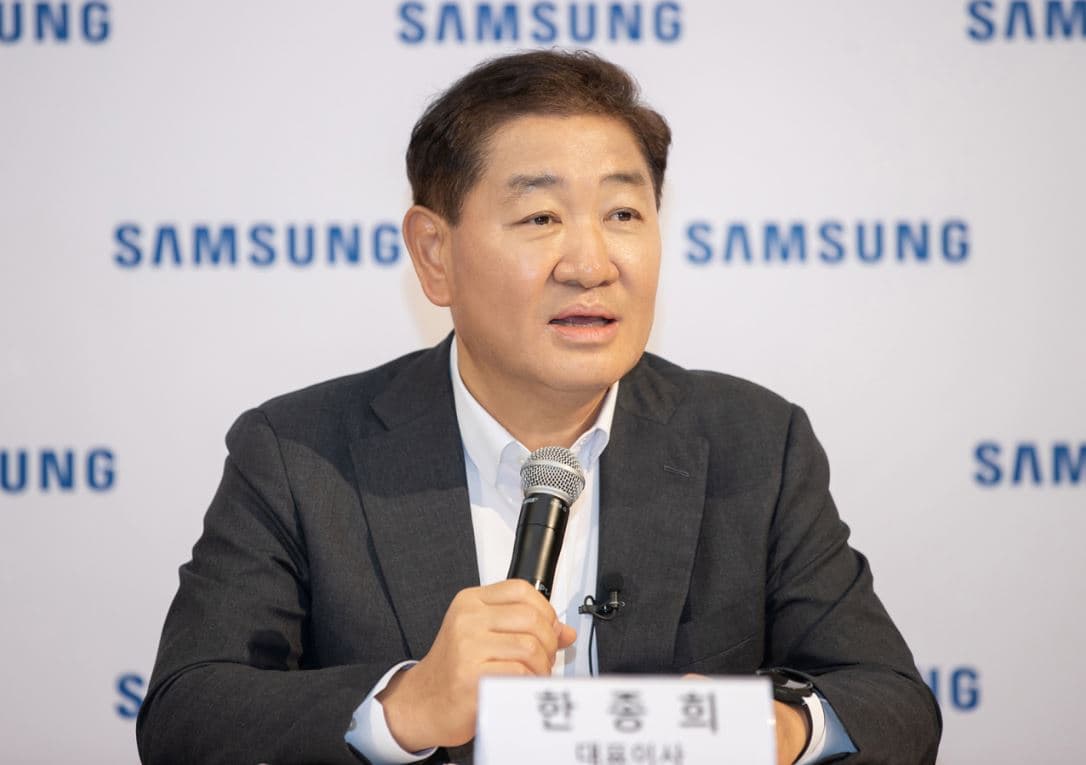
Han Jong-hee did not inherit power. He built it, quietly, methodically, over nearly four decades inside one of the most demanding corporate environments on earth. His story is not one of boardroom drama or overnight disruption. It is the story of an engineer from South Korea who understood screens, signals, and supply chains better than almost anyone alive, and who used that understanding to shape a company worth hundreds of billions of dollars.
When Samsung confirmed his death from cardiac arrest on March 25, 2025, the technology industry did not just lose a chief executive. It lost the man who had arguably done more than any single person to make Samsung the world's dominant force in consumer display technology.
Who Was Han Jong-hee?
Han Jong-hee was the Vice Chairman and co-Chief Executive Officer of Samsung Electronics, responsible for overseeing the company's Device eXperience (DX) Division. He managed Samsung's consumer electronics and mobile devices division while his co-CEO, Jun Young-hyun, oversaw the company's semiconductor business.
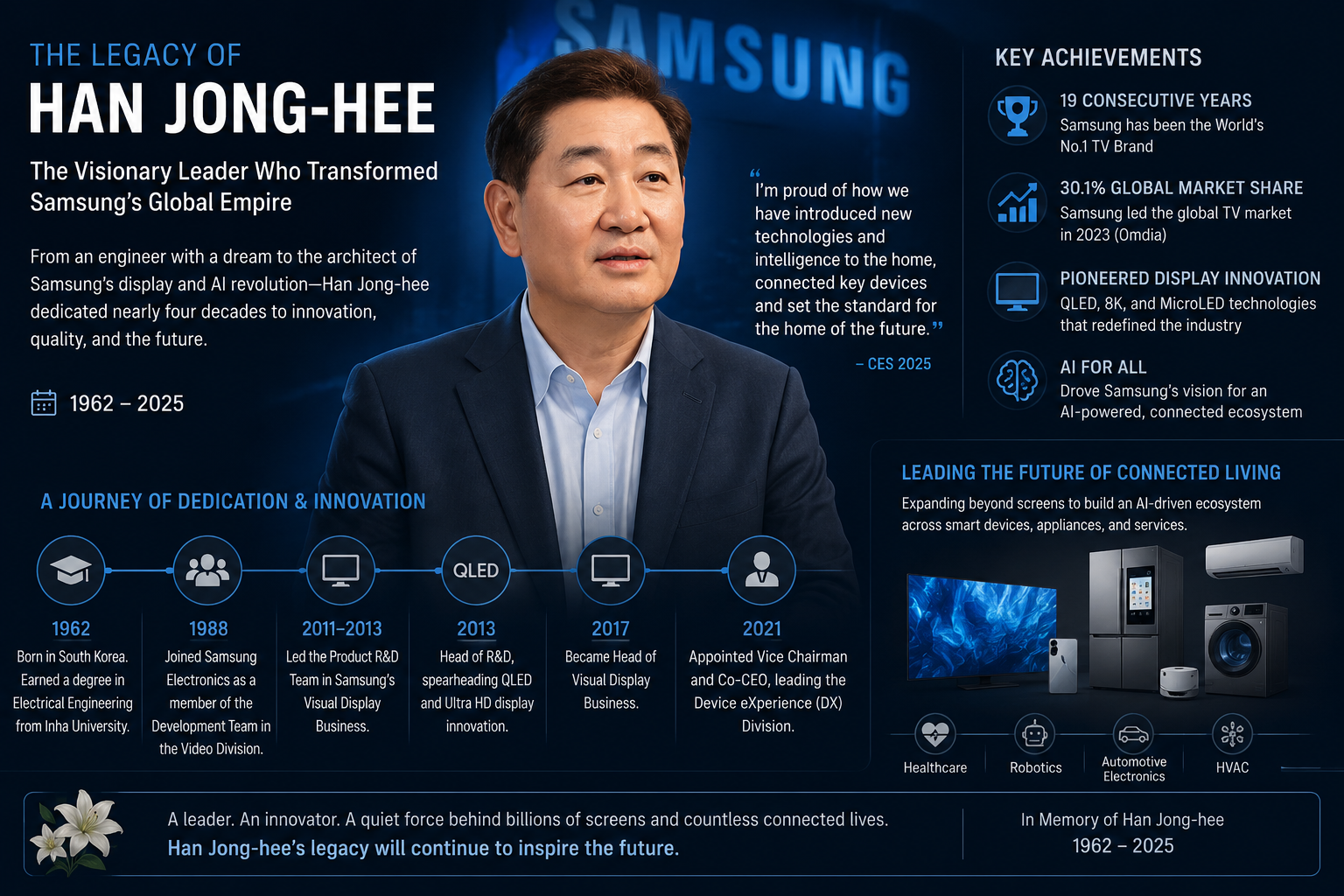
Born in 1962 in South Korea, Han Jong-hee earned his bachelor's degree in electrical engineering from Inha University. He graduated from Cheonan High School before earning that engineering degree, and after joining the development team of Samsung Electronics' Visual Display Division, he focused on TV research and development, serving as head of the LCD TV Lab, development team leader, and development group leader.
He was 63 years old at the time of his passing.
Where Did Han Jong-hee Grow Up and What Drove His Early Ambitions?
Han Jong-hee was born in 1962, in a South Korea still recovering from the devastation of the Korean War, which had ended just a decade earlier. Growing up in that era of rapid national reconstruction, where engineering and technology were seen as the surest paths to both personal advancement and national progress, his interests aligned naturally with the country's priorities.
He showed interest in technology and engineering from an early age, earning a degree in electrical engineering from Inha University in Incheon, South Korea. This education informed both his technical expertise and appreciation for innovation, providing the foundation for him to drive major advancements in the electronics industry.
That foundation proved decisive. Unlike executives who move laterally through industries, Han Jong-hee chose depth over breadth. He committed himself entirely to one company and one core area: display technology.
How Did Han Jong-hee Build His Career Inside Samsung?
Han started his career at Samsung Electronics in 1988 as a member of the Development Team in the Video Division. That entry point was not glamorous. It was technical, granular, and removed from corporate strategy. But it was exactly where an engineer who wanted to understand the product would choose to begin.
From 2011 to 2013, Han led the Product R&D Team in Samsung's Visual Display Business. Later, in 2017, he became the head of the Visual Display Business. Samsung then appointed him as Vice Chairman and CEO in 2021.
In 2013, Han advanced rapidly within Samsung, becoming Head of the R&D team in the Visual Display Business. During these years he strengthened Samsung's position as a leader in the industry while driving innovation. One highlight from this period was the development and commercialization of QLED technology and ultra HD displays, which were big successes for Samsung's television business.
Faced with challenges in achieving the desired display quality during the development of a flagship TV model, Han made the bold choice to delay the product's release, prioritizing Samsung's high standards over meeting tight deadlines. This decision proved successful, as the TV was eventually released to widespread acclaim, and Han's decision-making was applauded.
That episode reveals something important about his leadership philosophy. In an industry where quarterly earnings pressure dominates, Han Jong-hee held the line on quality. That is not a trivial thing.
What Technologies Did Han Jong-hee Pioneer at Samsung?
Han Jong-hee was widely regarded as the architect of Samsung's success in the global TV market. He was instrumental in pioneering advanced display technologies, including QLED, 8K resolution, and MicroLED displays.
QLED (Quantum Dot Light Emitting Diode) and MicroLED display technologies completely redefined the television and display industries. Offering superior picture quality, energy efficiency, and durability, these innovations catapulted Samsung into its status as a world leader in television manufacturing. Samsung has maintained this leadership since 2006, with market research firm Omdia reporting Samsung had a 30.1% share of the global TV market in 2023.
Colleagues at Samsung described Han as a forward-thinking and meticulous strategist who balanced ambition and humility, playing a crucial role in maintaining Samsung's competitive edge in the global electronics market.
Beyond screens, his ambitions expanded. At the helm of the company's Device eXperience (DX) division, Jong-hee helped implement manufacturing transformation strategies that incorporated AI into both production processes and the products themselves. "I'm proud of how we have introduced new technologies and intelligence to the home, connected key devices and set the standard for the home of the future," he shared at CES 2025.
What Was Han Jong-hee's Role in Samsung's AI Strategy?
Recognising the transformative potential of AI and IoT, Han expressed his desire to build an "AI-driven company," spearheading efforts to embed cutting-edge technologies into Samsung's product line.
Samsung's smart TVs now suggest content based on user preferences using advanced algorithms, making entertainment more personalised and engaging. Additionally, Samsung's home appliances like refrigerators and washing machines have been equipped with sensors and connectivity features, enabling them to adapt to user behaviours and optimise energy consumption. Han's vision was to create a seamless connected ecosystem of device communication, providing users with a cohesive and intuitive experience.
At CES 2025 in Las Vegas, Han unveiled Samsung's "AI for All: Everyday, Everywhere" vision on January 6, showcasing Samsung's commitment to making AI accessible and beneficial to everyone.
That vision was not simply a marketing slogan. It represented a strategic repositioning of Samsung from a hardware manufacturer into an AI-integrated platform company, a shift with enormous long-term revenue implications.
What Was Han Jong-hee's Net Worth and Compensation?
Han Jong-hee was a salaried executive, not a founder-billionaire. His financial position reflects the compensation structure of a career corporate leader at the apex of one of the world's largest companies.
According to reports, Han Jong-hee's estimated net worth was around $971,291 as of November 2024, with an annual salary of 6.90 billion South Korean Won, approximately $4.83 million USD.
That net worth figure is strikingly modest by the standards of American technology executives, and it requires context. Samsung's governance structure, deeply shaped by the founding Lee family, concentrates ownership-based wealth at the top of the conglomerate hierarchy. Career executives, even at the co-CEO level, draw substantial salaries but do not accumulate equity stakes comparable to founder-led companies in Silicon Valley. Han Jong-hee's compensation reflected his role as a professional manager of extraordinary capability inside a family-controlled empire, not a co-owner of it.
What Was Samsung's Business Position Under Han Jong-hee's Leadership?
In 2021, Samsung underwent a large restructuring, merging the consumer electronics and IT and mobile communications units. This left the company with two divisions: Device Experience and Device Solutions, prompting a reshuffle in leadership from three CEOs to two. Han Jong-hee was appointed CEO of the Device Experience, which included his former unit, the Visual Display Business, along with the Digital Appliances Business, Health and Medical Equipment Business, MX Business, and Networks Business.
He was dedicated to innovating AI-powered home appliances and actively investing in four key new business areas: healthcare, robotics, automotive electronics, and HVAC.
The DX Division under his watch was not simply a continuation of existing product lines. It was a deliberate expansion into adjacent markets where Samsung's manufacturing scale and supply chain dominance could generate durable competitive advantages.
What Challenges Did Han Jong-hee Face in His Final Year?
In a shareholder meeting last week before his death, Han told investors that 2025 would be a tough time for the company as they would have to adjust their global supply chains and factories to handle the 25% tariffs imposed earlier in 2025 by US President Donald Trump.
Han apologised for the performance of Samsung stock and warned of a difficult 2025 because of uncertainties around economic policies. He assured investors that the company planned to pursue mergers and acquisitions to drive future growth.
The macroeconomic headwinds he described were genuine and structural. Tariff exposure across Samsung's global manufacturing footprint, intensifying competition in the smartphone market from Apple and Chinese rivals, and the pressure to maintain semiconductor competitiveness alongside an entirely separate CEO division all created a complex leadership environment.
How Did Samsung and the World React to Han Jong-hee's Death?
Samsung paid tribute to Han in an internal message sharing that he had dedicated more than 37 years of his life to the company and led Samsung's TV businesses to emerge as the market leader. He was also credited for the company's growth as head of electronics and appliances businesses amid a "challenging business environment." The statement expressed the company's condolences: "Our deepest condolences are with his family and loved ones during this difficult time."
Despite the news, Samsung Electronics' stock remained stable in morning trading.
Han Jong-hee is survived by his wife and three children.
What Is Han Jong-hee's Legacy in the Global Technology Industry?
The truest measure of a technology executive is not the products they launched in a single year but the institutional capabilities they built over a career. By that measure, Han Jong-hee's legacy is substantial.
Under his leadership, Samsung maintained its position as the world's number one TV brand for 19 consecutive years. He oversaw the transition from LCD to QLED to MicroLED, each shift requiring enormous capital investment, supply chain reconfiguration, and consumer education at scale.
His career spanning nearly four decades was marked by significant advancements in mobile display technology, the integration of AI and IoT into consumer electronics, and the growth of broader industry sustainability.
He did all of this without the name recognition of a Steve Jobs or a Jensen Huang. He operated inside a conglomerate structure, answerable to a founding family, subject to Korea's demanding corporate culture, and largely invisible to Western media consumers who buy Samsung products without knowing the name of the man who shaped them.
That invisibility was perhaps the most quietly remarkable thing about him. Han Jong-hee spent nearly four decades changing how billions of people watch television, communicate on smartphones, and run their homes, and he did it from inside a system rather than above it.