

On the morning of March 31, 2026, tens of thousands of Oracle employees around the world opened their inboxes to find a cold, five-line email from a sender listed as Oracle Leadership. There was no prior warning from a manager. No call from human resources. No meeting, no conversation, no transition plan. Just a single message informing them that their role had been eliminated and that the day of the email was their final working day. System access was cut off almost immediately after.
Oracle began executing what analysts believe could be the largest layoff in the company's history on Tuesday, March 31, 2026. Employees across the United States, India, Canada, Mexico, and other countries received termination emails from Oracle Leadership at approximately 6 a.m. local time, with no prior warning from HR or their direct managers. What followed was a flood of posts on Reddit, LinkedIn, and the anonymous professional forum Blind as affected workers tried to make sense of what had just happened.
How Many Jobs Has Oracle Cut?
The Global Scale of the Cuts
Oracle has not confirmed the total number of people affected, but investment bank TD Cowen has estimated the cuts will hit between 20,000 and 30,000 employees, roughly 18% of Oracle's global workforce of approximately 162,000 people. The cuts appear to be part of Oracle's fiscal 2026 restructuring plan, first valued at up to $1.6 billion in September 2025 and later raised to $2.1 billion in March. A screenshot and Reddit posts purporting to show internal Slack user counts suggested a drop of approximately 10,000 users overnight, giving some indication of the immediate scale of the terminations.
The India Dimension
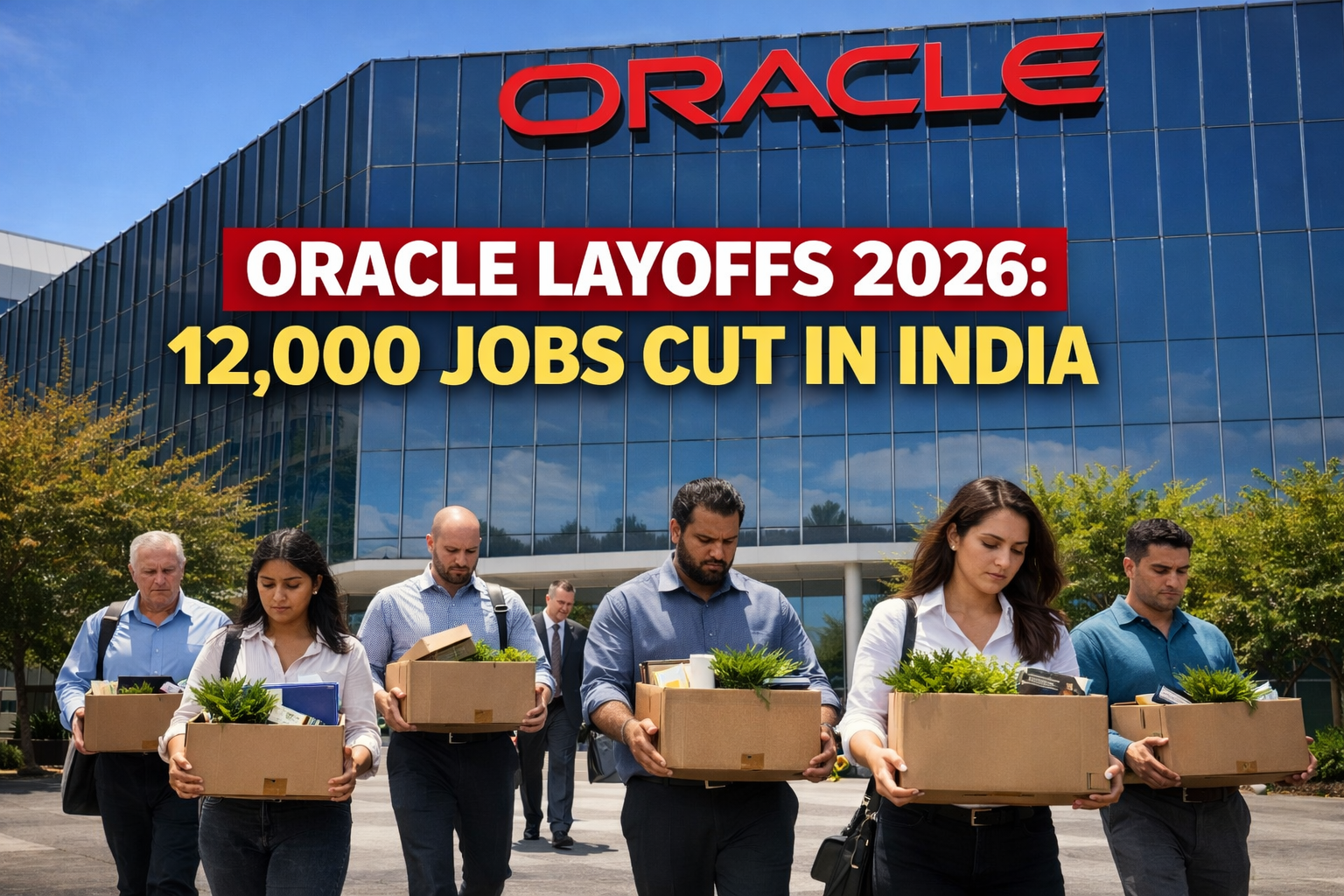
India has taken the largest single-country share of the cuts. With roughly 30,000 total employees in the country before the cuts, the 12,000 layoffs represent a 40% contraction of Oracle's India workforce in a single sweep. The roles affected span engineers, architects, database administrators, ERP implementation specialists, cloud infrastructure professionals, and operations staff. The company is also expected to carry out another round of layoffs within a month, according to PTI. That prospect has intensified anxiety among the employees who survived the first wave.
Why Is Oracle Laying Off So Many Workers?
The AI Infrastructure Bet
The financial logic is not difficult to follow, but it requires understanding the scale of the bet Oracle has placed on artificial intelligence. Oracle committed to a massive AI infrastructure buildout that its current balance sheet cannot comfortably fund. Capital expenditure for fiscal year 2026 is around $50 billion, which is $15 billion more than the company told Wall Street just a few months ago, and the number keeps climbing every quarter as more AI contracts stack up.
In September 2025, Oracle disclosed that its remaining performance obligations, a measure of contracted revenue that has not yet been recognized, jumped 359% to $455 billion following an agreement with OpenAI worth over $300 billion. That backlog is the engine driving the cuts. Oracle has the contracts. It needs the cash to build the infrastructure to fulfill them. TD Cowen analysts estimated in a January note that cutting 20,000 to 30,000 employees could generate $8 billion to $10 billion in incremental free cash flow. That cash is earmarked directly for data centers, GPU clusters, and cloud infrastructure for clients including OpenAI, Meta, and Nvidia.
A Company in Revenue Growth, Not Revenue Distress
This is not a company bleeding money. Oracle posted a 95% jump in net income last quarter, reaching $6.13 billion, and its remaining performance obligations stood at $523 billion, up 433% year over year. This is not a company in revenue distress. It is a company making a capital-intensive bet on AI infrastructure that its current balance sheet cannot comfortably sustain, and eliminating tens of thousands of employees to close the gap.
Oracle has been leaning on the debt market to fund its buildout. In January 2026, the company announced plans to raise $50 billion in debt and equity. During earnings last month, executives said there were no more plans to raise debt in 2026. With debt markets effectively closed as a near-term funding tool, reducing payroll became the primary lever available to the company.
How Did Oracle Notify Employees?
The 6 AM Email
The mass job cut was executed through termination emails sent at 6 AM IST in India and 3 AM Pacific in the US on March 31. The email itself was brief and impersonal. Business Insider viewed a copy shared by employees, which stated that after careful consideration of Oracle's current business needs, the decision was made to eliminate their role as part of a broader organizational change, and that the day of the email was their last working day. Employees were then directed to sign separation documents via DocuSign and told severance details would follow. Those who had vested restricted stock units were told they would retain them. Unvested RSUs were forfeited immediately upon termination.
Which Teams Were Hit
The layoffs were not confined to a single product line. Reports from Reddit and the professional forum Blind pointed to cuts across Revenue and Health Sciences, with at least a 30% team reduction, SaaS and Virtual Operations Services with similar cuts of 30% or more, the NetSuite India Development Centre covering engineers, product managers, and managers across multiple levels, as well as cloud, engineering, enterprise, and operations teams spread broadly across functions.
An employee who was not affected by the cuts but shared details publicly on LinkedIn noted that senior engineers, architects, operations leaders, program managers, and technical specialists were among those affected. The widespread nature of the cuts and their scale make clear this was not the result of poor performance by individuals but rather a deliberate structural reduction across the organization.
What Severance Are Affected Employees Receiving?
US Severance Terms
US employees are eligible for four weeks of base salary plus one additional week of severance pay for every year of service, up to a maximum of 26 weeks. Severance is taxed as supplemental income at 30%. Some employees reported April 3 as their formal last working day, with a garden leave period of approximately one month following that date.
India Severance Terms
For employees in India, the severance structure follows a standard formula known as N+2, where N equals the number of years worked, paid out in months. The package also includes notice pay, leave encashment, gratuity where applicable, and an additional two-month salary top-up, though that top-up is reportedly contingent on voluntary resignation rather than being paid automatically.
WARN Act Concerns
A WARN Act filing confirms that separations in the United States are expected by June 1, 2026. If Oracle skipped the required 60-day notice that the WARN Act demands for mass layoffs at qualifying sites, affected employees may be owed 60 days of back pay on top of whatever severance was offered. Employment attorneys have already begun reviewing individual cases, and class action firms are reportedly examining the situation closely.
What Does This Mean for India's Tech Job Market?
India's tech job market is already under pressure heading into the second quarter of 2026. Amazon, Meta, Pinterest, and Epic Games have all announced layoffs this year. The absorption of thousands of senior Oracle professionals will depend heavily on hiring activity at competing firms, and that activity, for now, remains subdued.
The Oracle cuts are not happening in isolation. Data from TrueUp.io reveals that so far in 2026 there have been 208 layoffs at tech companies impacting more than 85,000 people, at a rate of nearly 1,000 people per day. Over 20% of layoffs in 2026 have been explicitly linked to AI, and 61% of tracked companies have cited AI as a major factor in their workforce decisions. For the 12,000 Oracle employees in India who received that early morning email, those aggregate figures offer little immediate comfort. The roles being eliminated are mid-to-senior level positions requiring deep enterprise technology expertise that a strained job market cannot absorb quickly.
What Is Happening to Oracle Stock?
Oracle shares are down more than 25% year to date as of the time of the layoffs. The stock experienced a gain of over 4% during the trading session on March 31 following the layoff news, a reaction investors interpreted as a signal that Oracle is serious about funding its AI buildout even at significant human cost. That gain came despite the stock having shed nearly half its value over the prior six months.
Wall Street remains broadly bullish on the longer-term outlook. Of 41 analysts covering Oracle, 31 carry a strong buy rating, with an average price target suggesting significant upside from current levels if Oracle can successfully convert its contracted backlog into revenue while managing a growing debt load. Whether that plays out depends on execution at a scale Oracle has never before attempted.