

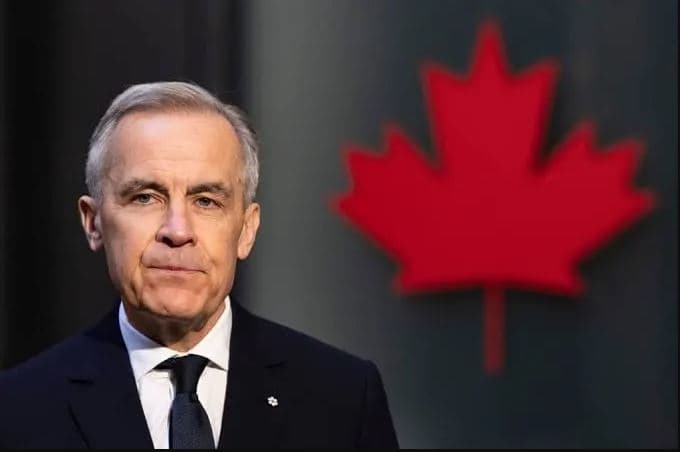
Early Life and Formative Years
Mark Joseph Carney was born on March 16, 1965, at St. Ann's General Hospital in Fort Smith, Northwest Territories, making him the first Canadian prime minister to have been born in any of the country's territories rather than its provinces. He was the third of four children, raised in a household where both parents were educators. His father, Robert J. Carney, served as a high school principal and later as a Professor of Educational Foundations at the University of Alberta. His mother, Verlie Margaret, was a stay-at-home parent who kept the family grounded in community values.
When Carney was six years old, the family relocated to Edmonton, Alberta's Laurier Heights neighbourhood. It was here, in one of Canada's most politically vibrant cities, that his character and interests took shape. He attended St. Francis Xavier High School in Edmonton, where he excelled academically and developed a deep love for ice hockey, playing the position of goaltender. That choice of position, requiring composure under pressure and responsibility for final outcomes, would prove something of a metaphor for the career that followed.
Carney's father had contested the 1980 federal election as the Liberal candidate for Edmonton South, giving the family a lived familiarity with public service and democratic politics. The household's ethos of education, community responsibility, and public engagement left a lasting imprint. Carney won a scholarship to study in the United States, which set in motion one of the most academically and professionally distinguished careers in Canadian public life.
Education: Harvard and Oxford
Carney arrived at Harvard University, where he enrolled in the economics programme. He played competitive ice hockey for Harvard, serving once again as a goaltender, and graduated with a Bachelor of Arts in Economics in 1988. At Harvard, his intellectual formation was shaped in part by lectures from the distinguished Canadian-born economist John Kenneth Galbraith, an experience that deepened his commitment to applying economic thinking to real-world governance.
Following graduation, Carney pursued postgraduate studies at the University of Oxford. He earned a Master of Philosophy in Economics in 1993 and completed his Doctor of Philosophy in Economics in 1995. His doctoral research examined economic policy and institutional design. It was during his time at Oxford that he met Diana Fox, a British economist who would become his wife. The couple have four children together: Cleo, Tess, Amelia, and Sasha.
His academic background combined rigour in macroeconomics, monetary theory, and international finance, precisely the intellectual toolkit that would define the crises he would later navigate. He is the second Canadian prime minister in history to hold a doctoral degree, the first being William Lyon Mackenzie King.
Goldman Sachs: Thirteen Years in Global Finance
Before entering public service, Carney spent thirteen years at Goldman Sachs. His time there took him across multiple global offices, including London, Tokyo, New York, Boston, and Toronto. He rose progressively through positions of increasing seniority, eventually becoming Managing Director of Investment Banking. His roles gave him exposure to sovereign risk, emerging debt capital markets, and complex international financial transactions.
His work at Goldman Sachs was not confined to well-functioning markets. Carney was involved in two of the most consequential financial episodes of the 1990s. He contributed to South Africa's post-apartheid reintegration into international bond markets, a commercially and politically sensitive undertaking that required both technical precision and diplomatic judgement. He was also involved in Goldman's work during the 1998 Russian financial crisis, gaining firsthand experience of how sovereign debt crises unfold and how financial contagion spreads across borders.
These experiences proved formative. They gave Carney something that no classroom could fully provide: an instinctive understanding of how global capital markets behave under stress, how central banks and governments interact, and what separates technical competence from genuine crisis leadership. By 2000, Goldman Sachs transferred Carney back to Canada, and three years later he made the decisive move from the private sector to public service.
Governor of the Bank of Canada: Steering Through the Great Recession
Appointment and Early Tenure
In 2003, Carney joined the Bank of Canada as Deputy Governor. In November 2004, he was seconded to the Department of Finance Canada, where he served as Senior Associate Deputy Minister and the country's G7 deputy for three years. During this period, he implemented a significant policy change: taxing income trusts at source, a structural reform that reshaped Canada's corporate tax landscape.
Carney returned to the Bank of Canada in November 2007 and assumed the role of Governor on February 1, 2008, becoming the institution's eighth governor. Within months of his appointment, the global financial system would face its most severe crisis since the Great Depression.
Crisis Leadership During the 2008 Financial Crisis
When the 2007 to 2008 global financial crisis erupted, Carney moved with a decisiveness that distinguished Canada's response from that of most other major economies. He reduced interest rates by 0.5 percentage points months before most other countries followed suit. In April 2009, he made an unprecedented commitment to hold rates at their low level for at least twelve more months, providing businesses and credit markets with the forward guidance needed to sustain confidence.
He also took exceptional steps to improve liquidity for Canada's major banks, working to stabilise the financial system without the catastrophic bank failures that struck the United States and the United Kingdom. He played a central role in forging a consensus with the United States, France, and the United Kingdom for an emergency coordinated interest rate cut. Canada's then-Finance Minister James Flaherty later described the G7 summit at which this occurred as the most dramatic weekend of his career.
The results were measurable. Canada's economy recovered more quickly than any other G7 nation, returning to pre-recession levels of output and employment ahead of its peers. Carney's institutional credibility grew rapidly, and he became an internationally recognised figure in central banking circles, earning a reputation for communicating clearly with markets and acting decisively in uncertainty.
International Responsibilities
Beyond his domestic mandate, Carney accumulated significant international responsibilities during his time at the Bank of Canada. In 2010, he chaired the Committee on the Global Financial System at the Bank for International Settlements. In 2011, he was appointed as the second Chair of the Financial Stability Board, based in Basel, Switzerland, a role he would hold for two terms through 2018. His appointment to this role confirmed his standing as one of the most respected central bankers of his generation.
Governor of the Bank of England: A First for British Financial History
Breaking Precedent
In November 2012, then-UK Chancellor of the Exchequer George Osborne announced that Carney had been selected to succeed Mervyn King as the 120th Governor of the Bank of England, the first time in the institution's 319-year history that a non-British citizen had been appointed to the position. Carney took up the role in July 2013. He served simultaneously as Chair of the Monetary Policy Committee, Chair of the Financial Policy Committee, and Chair of the Board of the Prudential Regulation Authority.
Brexit and the Economic Challenge
Carney's tenure at the Bank of England unfolded against the backdrop of Britain's most consequential political decision in decades. Before the June 2016 referendum on European Union membership, Carney was forthright in warning that a vote to leave the EU could trigger a recession and significant disruption to the UK economy. His warnings were controversial, with some Brexit supporters accusing him of overstepping the boundaries of a central banker's mandate. He stood firm in his assessments.
When the Leave vote prevailed, Carney moved quickly to stabilise financial markets and reassure investors. The Bank of England cut interest rates and launched a package of quantitative easing measures. His management of the financial implications of the Brexit referendum reinforced his reputation for performing under political pressure.
He left the Bank of England in March 2020 after nearly seven years in the position, having also overseen the bank's early response to the economic shock caused by the COVID-19 pandemic. He remains the only person in history to have served as governor of both the Bank of Canada and the Bank of England.
Post-Central Banking: Climate, Finance, and Public Influence
United Nations Special Envoy on Climate Action and Finance
In March 2020, Carney was appointed United Nations Secretary-General's Special Envoy on Climate Action and Finance. In this capacity, he worked to align the global financial system with the goals of the Paris Agreement, arguing that private capital must be mobilised at scale to fund the transition to a net-zero economy.
He co-chaired the Glasgow Financial Alliance for Net Zero, launched at COP26 in Glasgow in November 2021, which brought together banks, insurance companies, and asset managers representing trillions of dollars in assets to commit to net-zero emissions targets. He was also appointed as finance adviser to the UK presidency of COP26 in January 2020.
Private Sector and Advisory Roles
Alongside his UN responsibilities, Carney served as Vice Chair at Brookfield Asset Management, Chair of Bloomberg L.P., and co-chair of the World Bank's private sector investment lab. He joined the board of fintech company Stripe in February 2021 and served as an advisor to climate tech company Watershed from 2022.
During the early phase of the COVID-19 pandemic in 2020, Carney served as one of several informal advisors to then-Prime Minister Justin Trudeau on the government's economic response. In September 2024, Trudeau named Carney to chair the Liberal Party's Task Force on Economic Growth, a role that positioned him closer to the centre of Liberal policy thinking ahead of the expected federal election.
Entry into Politics: The 2025 Liberal Leadership Contest
The Collapse of the Trudeau Government
In December 2024, Finance Minister Chrystia Freeland resigned from cabinet hours before she was scheduled to deliver the government's economic statement, citing disagreements with Trudeau over fiscal strategy. The resignation was a public rupture at the top of the Liberal Party. Trudeau's minority government, already trailing badly in the polls, could not survive the shock.
On January 6, 2025, Justin Trudeau announced his resignation as both Liberal Party leader and Prime Minister of Canada. With the party trailing the Conservative Party under Pierre Poilievre by double-digit margins, a new leadership contest was called.
The Leadership Campaign and Landslide Victory
On January 16, 2025, Carney formally declared his candidacy for the Liberal leadership. He resigned from all executive, board, and advisory positions to focus on the campaign. The contest resolved quickly into a two-candidate race between Carney and Freeland. The contest was notable for the absence of personal acrimony between the two candidates.
On March 9, 2025, Carney won the Liberal leadership on the first ballot with 85.9 percent of the vote, winning every one of the party's 343 electoral districts. His margin of victory surpassed that of Justin Trudeau's own 2013 leadership win.
On March 14, 2025, five days after winning the leadership election, Carney was sworn in as Canada's 24th Prime Minister by Governor General Mary Simon. He became the first Canadian prime minister born in a territory rather than a province, the first prime minister to hold a doctoral degree since William Lyon Mackenzie King, and the first prime minister in Canadian history to have never previously held elected office at any level of government.
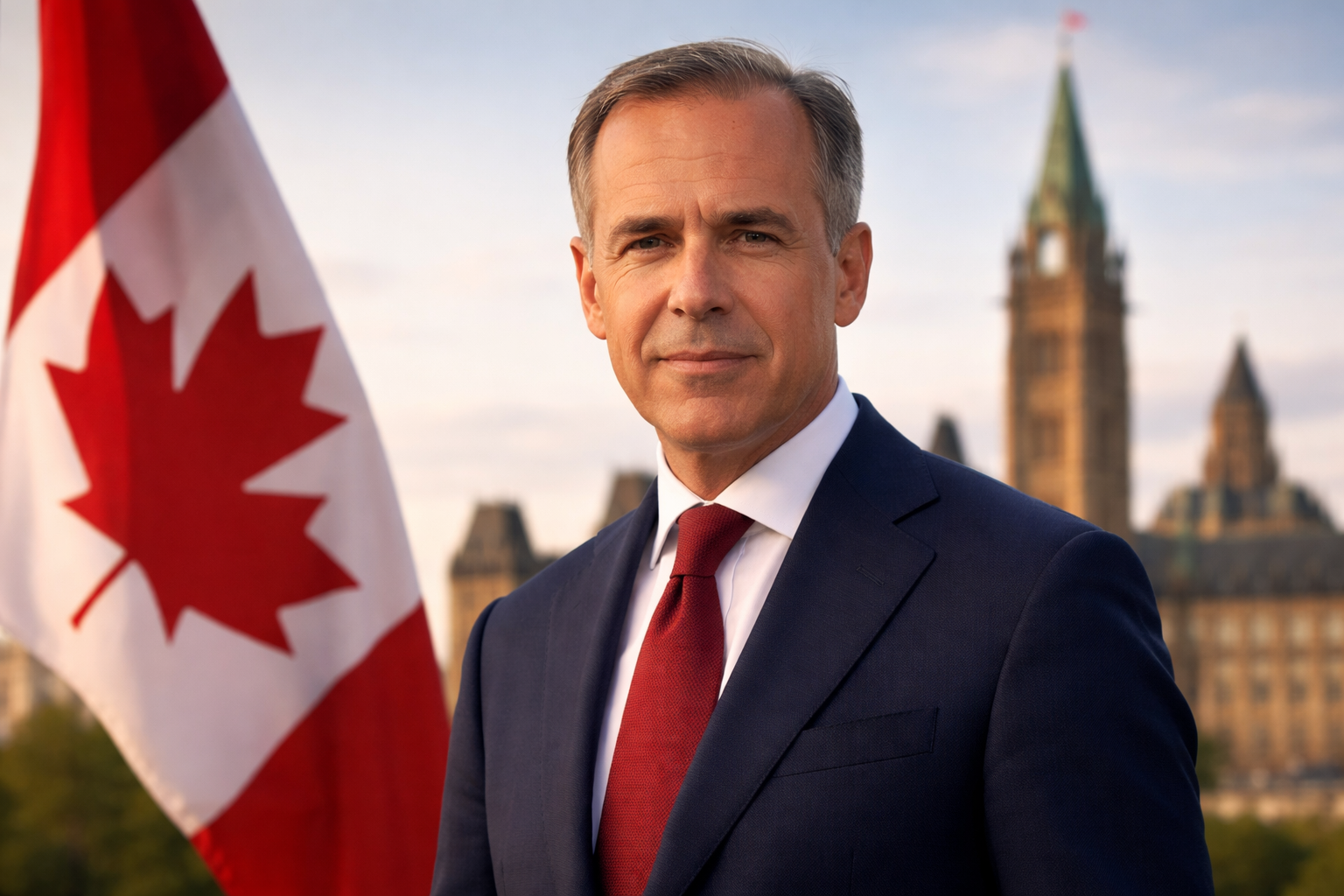
Prime Ministership: Governing Through Crisis
First Acts in Office
Carney moved with notable speed in his opening days in office. His first act as Prime Minister was to sign a directive eliminating the federal consumer carbon tax with effect from April 1, 2025. In breaking with one of the signature environmental policies of the Trudeau era, Carney demonstrated that he would govern by his own judgement rather than by loyalty to the positions his predecessor had defended.
His first foreign trip as Prime Minister departed from a long-standing tradition. Rather than travelling to Washington to meet the US president, Carney visited France and the United Kingdom on March 17, 2025. The contrast with Canada's fracturing relationship with the United States under President Donald Trump was deliberate and pointed.
The Trump Factor and Canadian Sovereignty
Trump's imposition of sweeping tariffs on Canadian exports, including a 25 percent duty on Canadian steel, aluminum, cars, and car parts, combined with his provocative statements about making Canada the 51st state of the United States, ignited a wave of Canadian nationalism that fundamentally reshaped the political landscape.
What had appeared in January 2025 to be an impending Conservative landslide was transformed within weeks. Carney positioned himself as the leader best equipped to defend Canadian sovereignty and manage the economic disruption caused by the trade war. His background as a central banker who had navigated the 2008 financial crisis and the Brexit referendum gave his warnings about the tariff threat credibility that no career politician could easily claim.
The campaign phrase he adopted, elbows up, drew on the ice hockey lexicon familiar to every Canadian voter. He promised to build Canada into an energy superpower in both clean and conventional energy and to reduce the country's dependence on the United States as a trading partner by diversifying toward Europe and Asia.
The 2025 Federal Election Victory
On April 28, 2025, Canadians went to the polls in what many commentators described as one of the most consequential federal elections in decades. The Liberal Party won 168 seats in the 343-seat House of Commons, forming a minority government. The Conservative Party took 144 seats. Pierre Poilievre, the Conservative leader, lost his own seat in the election.
Carney himself, running for the first time as a candidate, won the riding of Nepean in suburban Ottawa at age 60. In his victory speech, Carney declared that President Trump was attempting to break Canada so that America could own it, and that this would never happen.
Leaders including UK Prime Minister Keir Starmer, French President Emmanuel Macron, Ukrainian President Volodymyr Zelenskyy, Indian Prime Minister Narendra Modi, and NATO Secretary General Mark Rutte offered congratulations. Trump himself telephoned Carney to congratulate him, with the Prime Minister's office confirming the two leaders had agreed to work together as independent sovereign nations.
Governance and Key Policy Directions
Economic Policy and Internal Trade
A central feature of the government's economic agenda is the commitment to build a single Canadian economy by removing internal trade barriers that currently fragment the country's 13 provincial and territorial jurisdictions. On defence, Carney has committed to increasing Canada's core defence spending to 3.5 percent of GDP within ten years, alongside an additional 1.5 percent for infrastructure that serves dual military and civilian purposes.
Climate and Energy Policy
The consumer carbon tax was abolished. The oil and gas emissions cap policy was effectively shelved. The electric vehicle mandate requiring all new car sales to be zero-emission was scrapped. A tax credit for the development of liquefied natural gas was reinstated. In place of these instruments, the government has pledged to strengthen industrial carbon pricing, invest in clean energy technologies, and position Canada as a global leader in both conventional and clean energy production.
Foreign Policy
Carney's government formally recognised the State of Palestine in July 2025. The government moved to improve diplomatic relations with both China and India, two countries with which Canada's relationship had been significantly strained during the Trudeau years. Strong support for Ukraine in its war against Russia has continued throughout his tenure.
Personal Life and Character
Carney is married to Diana Fox Carney, a British economist whom he met during his postgraduate studies at Oxford. The couple have four daughters: Cleo, Tess, Amelia, and Sasha. He was raised Catholic and has Irish ancestry alongside his Canadian roots.
He held citizenship in Canada, Ireland, and the United Kingdom simultaneously at the point of entering politics. He has since begun the formal process of renouncing his non-Canadian citizenships, stating that as Prime Minister he should hold only one citizenship.
His public persona is one of calibrated seriousness rather than political warmth. He is not a natural retail politician in the traditional sense, and his decision to enter elected politics in the middle of a crisis rather than at a moment of calm says something about both his temperament and his calculation of where he could be most useful. Political analysts characterise him as a centrist, a technocrat, and a Blue Grit Liberal, whose economic instincts lean toward market mechanisms and fiscal discipline within the broader Liberal tradition.