

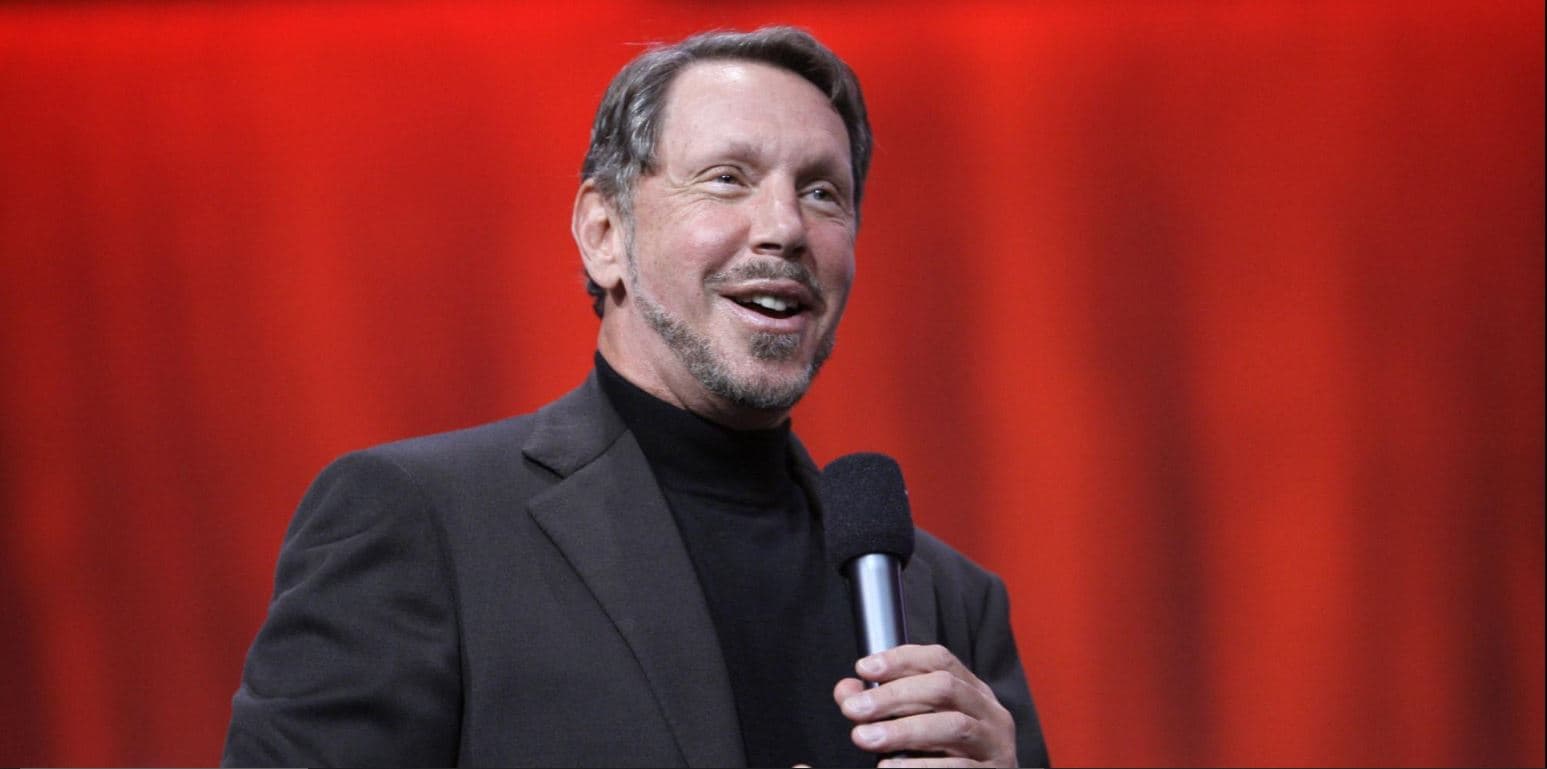
Who Is Larry Ellison and Why Does His Story Matter Beyond the Billions?
Lawrence Joseph Ellison, born on August 17, 1944, in New York City, is an American businessman who co-founded the software company Oracle Corporation and served as its CEO from 1977 to 2014. He now serves as its CTO and executive chairman.
As a reputation analyst, I have spent over a decade studying how public figures build, damage, and rebuild institutional trust. Larry Ellison is one of the most instructive case studies in that discipline. His story is not simply about wealth accumulation. It is about how a man society initially dismissed transformed himself into a brand so powerful that Oracle's stock movements now qualify as global financial events. Understanding his trajectory from a discarded infant in the Bronx to the world's briefly wealthiest person in 2025 reveals every element of what drives lasting brand credibility: resilience, contrarianism, and an almost reckless conviction in one's own vision.
Who Raised Larry Ellison and How Did His Early Life Shape His Identity?
Larry Ellison was born in the New York City borough of the Bronx on August 17, 1944, to single mother Florence Spellman. When he was 9 months old, Ellison came down with pneumonia, and his mother sent him to Chicago to be raised by her aunt and uncle, Lillian and Louis Ellison, who adopted the baby.
Born in the Bronx, he was raised in a modest, two-bedroom apartment on Chicago's South Side by his adoptive parents. From an early age, his life was full of challenges. Known for his rebellious nature, Larry often clashed with his adoptive father.
His adoptive father, a government clerk, believed Ellison would amount to nothing, a sentiment Larry would spend a lifetime disproving.
From a reputation standpoint, this origin story matters enormously. Ellison did not inherit credibility. He built it from a psychological foundation shaped by rejection, low expectations, and the need to prove institutional authority wrong. This is not incidental to his later career. It explains everything from his aggressive acquisition strategy to his public battles with competitors, regulators, and critics.
Who Influenced Larry Ellison's Decision to Drop Out of College?
Despite being a billionaire tech founder, Larry Ellison does not have a college degree. He enrolled at the University of Illinois in 1962 to study science and pre-med. However, he dropped out in his second year after his adoptive mother died.
Later in 1966, he enrolled at the University of Chicago, where he took computer science classes for about a semester before dropping out once more. He then swiftly moved to California and picked up programming skills. From there, he hopped around different jobs from Wells Fargo to tech company Amdahl, where he adapted more programming skills before becoming his own boss at just 33 years old.
The decision to drop out of college twice is widely cited in profiles of Ellison as evidence of his unconventional path. From a public perception standpoint, it later became an asset rather than a liability, positioning him alongside Steve Jobs and Bill Gates as proof that institutional credentials are not prerequisites for institutional dominance.
Who Founded Oracle and How Did the Company Begin?
Who Were the Original Co-Founders?
During the 1970s, after a brief stint at Amdahl Corporation, Ellison began working for Ampex Corporation. His first project included a database for the CIA, code-named Oracle. Ellison was inspired by a paper written by Edgar F. Codd on relational database systems called A Relational Model of Data for Large Shared Data Banks. In 1977, Ellison, Ed Oates, and Bruce Scott joined Software Development Laboratories several months after it was founded by Ellison's supervisor at Ampex, Bob Miner. They invested $2,000, of which $1,200 was Ellison's.
Who Named the Company Oracle?
Ellison, Miner, and Oates set to work developing and marketing a program based on Codd's data-management theory. They received a contract from the Central Intelligence Agency to develop a database, and they began working on a commercial relational database program. In 1979, the company, now called Relational Software, Inc., released Oracle, the earliest commercial relational database program to use Structured Query Language, and the versatile database program quickly became popular. Known for innovation and aggressive marketing, the company, renamed Oracle Systems Corporation in 1982 after its flagship product, grew rapidly throughout the 1980s, going public in 1986. In 1987, Oracle became the largest database-management company in the world.
The CIA contract that gave Oracle its name is one of the most important pieces of institutional credibility in the company's founding narrative. From a brand trust perspective, the association with government intelligence work provided Oracle with an implicit seal of authority at a time when the commercial database market was still being defined.
Who Almost Destroyed Oracle in 1990 and How Did Ellison Survive the Crisis?
However, in 1990 an internal audit conducted in the wake of a shareholder's lawsuit revealed that Oracle had overstated its earnings, and the company's stock plunged dramatically. Ellison restructured Oracle's management, and by the end of 1992 the company had returned to financial health.
Despite facing significant challenges, such as near bankruptcy in the early 1990s due to accounting irregularities, Ellison's resilience and business acumen helped Oracle recover and thrive.
This crisis is the single most important episode in Ellison's reputation history for analysts to study. He did not step aside. He restructured, absorbed the reputational damage, and used the crisis as a catalyst for organizational transformation. This is the defining characteristic of durable personal and corporate brands: the ability to survive a credibility collapse and emerge with stronger institutional architecture.
What Is Larry Ellison's Net Worth Over Time?
This timeline represents one of the most dramatic wealth accumulation stories in the history of global capitalism.
Year | Net Worth | Milestone | Forbes / Bloomberg Rank |
1986 | Multimillionaire | Oracle goes public on NASDAQ | Not yet ranked |
1993 | Billionaire | First appearance on Forbes Billionaires List | Top 10 to 20 worldwide |
2001 | $26 Billion | Ranked fourth on Forbes annual list | 4th globally |
2010 | $28 Billion | Steady climb through major acquisitions | 6th globally |
2011 | $36.5 Billion | Oracle acquisition spree drives growth | 5th globally |
2012 | $44 Billion | Post-PeopleSoft and Sun Microsystems era | 5th globally |
2018 | $54.5 Billion | Cloud transition strategy begins | Top 10 globally |
2020 | $66.8 Billion | Cloud momentum accelerates | 7th globally |
2022 | Approx. $93 Billion | Owns 42.9 percent of Oracle outstanding shares | Top 10 globally |
2024 | $142 Billion | Owns 40 percent of Oracle | 5th globally |
Sept 2025 | $400 Billion+ (peak) | Oracle stock surges 98 percent year to date, jumps 36 percent on September 10 alone after quarterly report | 1st globally (briefly) |
Dec 2025 | Approx. $375 Billion | Post-earnings selloff wipes roughly $25 billion in a single day | 2nd to 3rd globally |
Early 2026 | $201 to $203 Billion | Net worth stabilizes after Oracle stock correction | 6th globally |
Who Did Larry Ellison Build Oracle Into Through Acquisitions?
Ellison's acquisition spree including PeopleSoft in 2005 for $10.3 billion, Siebel in 2006 for $5.8 billion, and Sun Microsystems in 2010 for $7.4 billion swelled Oracle into a $40 billion revenue juggernaut by 2014. He stepped down as CEO that year, handing reins to Safra Catz and Mark Hurd, but retained chairman and CTO roles, steering the cloud pivot.
Ellison's ability to identify and execute high-impact acquisitions has been a major driver of Oracle's success. Throughout the 2000s and 2010s, the company embarked on an ambitious acquisition spree to expand its technological capabilities and market dominance.
Who Is Leading Oracle's AI and Cloud Strategy in 2025 and 2026?
In the 2020s, Oracle shifted its strategic focus from enterprise software toward building large-scale cloud infrastructure to support artificial intelligence. Under Ellison's direction, the company secured more than $300 billion in multiyear contracts with major technology companies, including OpenAI, Meta Platforms, NVIDIA, SoftBank, and xAI. In 2025, Oracle disclosed plans for a $500 billion data center initiative, known as Stargate, intended to provide computing capacity for leading global AI developers.
The 2020s crowned his vision. Oracle's AI bet, including partnerships with OpenAI and Nvidia, ignited 2025's boom, with cloud revenue tripling to $20 billion.
Who Is Ellison Expanding Into Beyond the Technology Sector?
The Ellison name now has a new venture: media. Larry Ellison is 81 and a tech billionaire best known for co-founding Oracle and now moving aggressively into media alongside his son David. The Ellison family's influence over Paramount and CBS has surged because David Ellison's Skydance deal to acquire Paramount Global places him atop the company that owns CBS.
With the help of his father's money, David, the 42-year-old founder and CEO of Skydance Media, the company behind hit films like Top Gun: Maverick and Mission Impossible, has secured an $8 billion deal to purchase Paramount and its subsidiaries including CBS, MTV, and Comedy Central.
From a reputational strategy perspective, the Ellison family's simultaneous dominance of AI infrastructure and mainstream media is a convergence that few analysts anticipated even five years ago. It transforms the Ellison brand from a technology story into a genuine institutional influence narrative spanning data, entertainment, and political access.
Who Did Larry Ellison Count Among His Closest Personal Relationships?
Ellison has been married and divorced four times. In 1967, Ellison married his girlfriend, Adda Quinn, and the marriage lasted seven years and ended in divorce in 1974. In 1977, about the same time he founded SDL, Ellison married Nancy Wheeler Jenkins, and this marriage also ended in divorce a year later. Ellison was married to his third wife, Barbara Boothe, from 1983 to 1986, a union that resulted in two children. Finally, Ellison was married to romance novelist Melanie Craft from 2003 until 2010.
Ellison was close friends with founder of Apple Steve Jobs, as well as other leaders in the technology field.
On December 18, 2003, Ellison married Melanie Craft at his Woodside estate. Ellison's friend Steve Jobs, former CEO and co-founder of Apple, was the official wedding photographer.
Who Has Ellison Faced Legal and Ethical Scrutiny From?
In 2005, Ellison agreed to settle a four-year-old insider-trading lawsuit by offering to pay $100 million to charity in Oracle's name.
Ellison settled an insider-trading lawsuit in the early 2000s related to Oracle stock sales. The matter did not result in criminal charges and had no lasting impact on his ownership or long-term net worth.
From a crisis communication standpoint, the settlement was managed effectively. Directing the $100 million to charity rather than paying it as a fine reframed a legal liability into a philanthropic narrative, demonstrating sophisticated understanding of how reputational damage can be redirected rather than simply absorbed.
What Has Larry Ellison Said About Retirement and His Legacy?
Ellison has stated he has no intention of retiring, calling Oracle the ultimate intellectual adventure.
Ellison is known for favoring science-driven, results-oriented philanthropy over high-profile charitable branding. He has also donated hundreds of millions toward cancer research, particularly at USC and Stanford.
Ellison also donated $200 million to the University of Southern California for a cancer research center and signed the Giving Pledge, a campaign where wealthy individuals commit to giving the majority of their wealth to charity, in 2010.