

Who Is Jensen Huang and Why Does His Story Matter Now?
Jensen Huang is the co-founder, president, and chief executive officer of NVIDIA Corporation, the first company in history to surpass a $5 trillion market capitalisation. His journey from a middle-class family in Taiwan to the seventh-wealthiest individual on earth is not a story about luck. It is a story about reputation built across five decades through consistent technical credibility, institutional trust, and a brand identity that proved more durable than any product cycle.
As a reputation analyst, what makes Huang's public standing exceptional is not the wealth. It is the trust architecture he constructed long before the money arrived.
Who Was Jensen Huang Before NVIDIA?
Jensen Huang was born on February 17, 1963, in Taipei, Taiwan, and grew up in the southern city of Tainan. His father was a chemical engineer. His mother was a schoolteacher who taught her sons ten random English words each day in preparation for a future she was determined to create for them. When Huang was five, the family relocated to Thailand to support his father's refinery career.
At age nine, Huang and his brother were sent ahead to live with their uncle in Tacoma, Washington, while their parents remained in Thailand. Circumstances led to Huang being enrolled at the Oneida Baptist Institute in Kentucky, a school for students from difficult backgrounds. He was assigned dormitory cleaning duties at age nine. He graduated high school at sixteen, having skipped two grades.
That sequence matters from a reputation standpoint. Huang has spoken openly about cleaning toilets at a school that misidentified him as a troubled child. Rather than suppress the story, he uses it to build credibility. Authenticity weaponised as institutional trust is a rare and powerful brand asset.
Who Educated Jensen Huang and What Did He Study?
Huang completed his undergraduate degree in electrical engineering at Oregon State University in 1984. It was there that he met Lori Mills, his future wife and engineering lab partner. He went on to earn a master's degree in electrical engineering from Stanford University in 1992.
His educational path was linear and technically focused. He did not study business. He did not pursue an MBA. The credibility Huang carries in technical and investor audiences alike traces directly to his engineering credentials combined with a management record that spans more than three decades at the same company.
Who Did Jensen Huang Work For Before Founding NVIDIA?
After completing his undergraduate degree, Huang joined Advanced Micro Devices, where he worked on microprocessor design for approximately one year. He then moved to LSI Logic, a semiconductor manufacturer whose products served storage and networking markets. At LSI Logic, Huang progressed from engineering into marketing and then general management, a trajectory that gave him cross-functional credibility unusual for engineers of his generation.
His reputation at LSI Logic proved decisive. When Huang and his colleagues Chris Malachowsky and Curtis Priem decided to build a company around a new kind of processor, it was LSI Logic CEO Wilfred Corrigan who connected them with Don Valentine of Sequoia Capital. Huang's professional reputation opened the door. The idea alone was not enough.
Who Founded NVIDIA and Under What Circumstances?
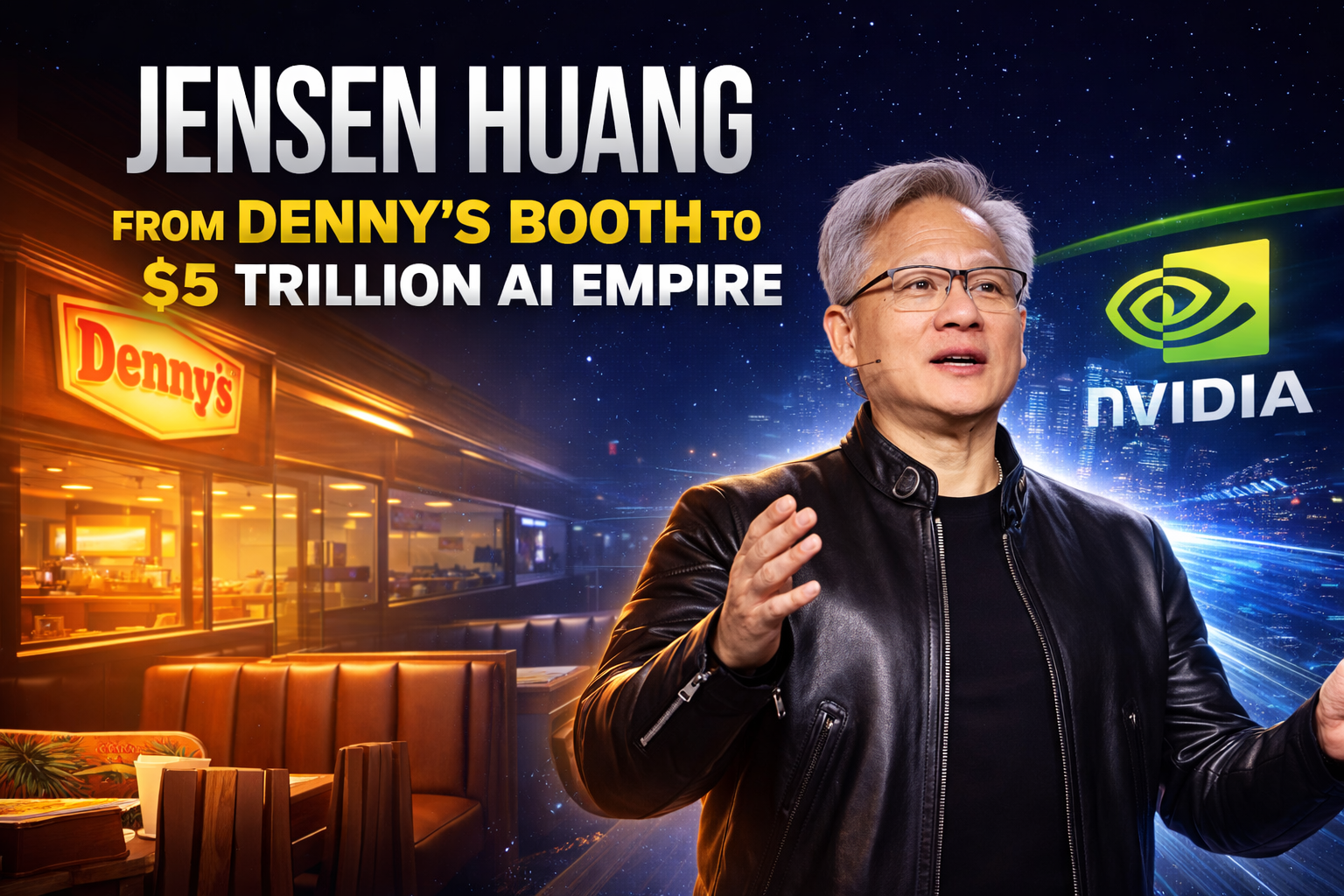
In April 1993, Jensen Huang, Chris Malachowsky, and Curtis Priem co-founded NVIDIA Corporation. The founding conversations took place at a Denny's restaurant in San Jose, where Huang had previously worked as a teenager earning $2.65 an hour as a dishwasher. The symbolic weight of that detail is not lost on Huang, who references it often. It is a deliberate reputational anchor: the man who built the world's most valuable technology company started by cleaning tables at the same chain where he pitched his founding idea thirty years later.
NVIDIA began with $40,000 in initial capital and secured a $20 million early investment from venture capital, facilitated by Huang's professional standing. Malachowsky and Priem selected Huang as CEO on day one, despite being older than him. Their reasoning, according to Priem, was straightforward: Huang knew how to run a company and they deferred to him entirely.
Who Was Jensen Huang During NVIDIA's Near-Bankruptcy Years?
NVIDIA's first product, the NV1, launched in 1995 and failed commercially. The chip did not support the DirectX standard that Microsoft was building into Windows, rendering it incompatible with the direction of the market. The company nearly ran out of money and had to lay off employees. This period is a significant chapter in Huang's reputation history because it demonstrates crisis persistence rather than crisis avoidance.
NVIDIA survived by pivoting fast, partnering with Sega on a short-term contract that provided enough revenue to develop the Riva 128 chip, which launched in 1997 and sold one million units in four months. The recovery was not accidental. It required Huang to manage board relationships, investor trust, and engineering morale simultaneously while the company's core product had just been publicly discredited.
Who Did Jensen Huang Become After the 1999 IPO?
NVIDIA went public on the NASDAQ in January 1999 under the ticker NVDA at $12 per share. Later that same year, NVIDIA launched the GeForce 256, which the company defined as the world's first graphics processing unit. The GPU was a category-defining product. It separated graphics processing from the central processor, creating a new class of hardware with enormous downstream consequences.
When NVIDIA's stock hit $100 per share, Huang marked the moment permanently: he had the NVIDIA logo tattooed on his left shoulder. The gesture may seem minor, but from a public credibility standpoint it signalled something analysts and media have since cited repeatedly. Huang is not a financial manager running a chip company. He is a founder who believes in the institutional identity of the organisation he built.
By 2007, Huang's total compensation reached $24.6 million annually, placing him among the highest-paid technology executives in the United States. That same year, he and his wife Lori established the Jen-Hsun and Lori Huang Foundation with an initial donation of NVIDIA stock valued at $300 million.
Who Became Jensen Huang Between 2010 and 2019: The Invisible Decade That Built Everything
Between 2010 and 2019, Huang made the bets that the market did not yet understand. NVIDIA's GPU architecture, originally designed for rendering video game graphics, was being adopted by machine learning researchers who discovered that the parallel processing structure of the GPU was exceptionally efficient for training neural networks.
Huang did not react to this discovery. He accelerated it. NVIDIA launched CUDA, a software platform that allowed developers to write code for GPU-based parallel computing, and began aggressively positioning NVIDIA as a computing platform rather than a graphics hardware vendor.
In 2017, Fortune named Huang its Businessperson of the Year. In 2019, Harvard Business Review ranked him the number one best-performing CEO in the world. His net worth at this point was estimated at approximately $3 billion to $5 billion, tied almost entirely to his NVIDIA equity stake.
Who Built the Net Worth Timelapse: Jensen Huang's Wealth by Year
Year | Estimated Net Worth | Key Event Driving the Change |
1993 | Negligible | Co-founded NVIDIA with $40,000. Personal assets minimal. |
1999 | Tens of millions | IPO on NASDAQ. Approximately 4 percent stake priced for the first time. |
2007 | Low hundreds of millions | Annual compensation hit $24.6 million. Donated $300 million in NVIDIA stock to his foundation. |
2016 | $2 billion to $3 billion | NVIDIA's market cap is around $30 billion. AI pivot underway but not yet priced at scale. |
2020 | $11 billion to $15 billion | NVIDIA proposed a $40 billion acquisition of Arm Holdings. Market cap surged. |
2022 | $10 billion (briefly) | Stock fell sharply. Post-pandemic chip cycle contracted. NVIDIA's market cap dipped to $300 billion. |
2023 | $40 billion and rising | NVIDIA's market cap crossed $1 trillion in May. ChatGPT triggered an H100 GPU demand surge. |
June 2024 | $100 billion+ | NVIDIA's market cap crossed $3 trillion. Most valuable company in the world at that moment. "Jensanity" entered media circulation. |
July 2025 | $140 billion | NVIDIA became the first company to cross $4 trillion market capitalisation. |
October 2025 | $176 billion to $178 billion | NVIDIA became the first company in history to close above a $5 trillion market valuation. |
January 2026 | $164.1 billion | Forbes estimates. Seventh-wealthiest individual in the world. |
March 2026 | $167 billion | Bloomberg and TheStreet estimates. Wealth stabilised near post-peak levels. |
The Two Numbers That Define This Story
96 percent of Jensen Huang's current wealth was built after 2020.
His fortune grew approximately 60 times between 2016 and 2025, one of the fastest rates of personal wealth accumulation in modern corporate history.
Who Recognises Jensen Huang's Public Authority and Institutional Standing?
The awards record is not background noise. It is evidence of how diverse institutional bodies have assessed Huang's credibility across different dimensions of expertise and public contribution.
In 1999, Ernst and Young named him Entrepreneur of the Year in High Technology. In 2017, Fortune named him Businessperson of the Year. In 2019, Harvard Business Review ranked him the world's number one best-performing CEO. Time included him in its Time 100 list in both 2021 and 2024. In December 2024, he received the VinFuture Prize alongside Geoffrey Hinton, Yoshua Bengio, Yann LeCun, and Fei-Fei Li for contributions to neural networks and deep learning. In February 2025, he received the Queen Elizabeth Prize for Engineering. In December 2025, Time named him one of the Architects of AI in its Person of the Year issue. That same month, the Financial Times named him its Person of the Year. In January 2026, he received the IEEE Medal of Honor.
He has been elected to the National Academy of Engineering and holds honorary doctorates from Oregon State University, Taiwan's National Chiao Tung University, and National Taiwan University.
As of January 2025, YouGov ranked Samsung first in global brand perception. NVIDIA, under Huang's leadership, ranked at the top of AI hardware brand credibility across the same surveys.
Who Manages Jensen Huang's Philanthropic Reputation?
The Jen-Hsun and Lori Huang Foundation, established in 2007 with NVIDIA stock valued at $300 million, had assets exceeding $12 billion by late 2025, placing it among the largest private foundations in the United States. The foundation distributed $123 million in 2024 and is projected to distribute $369 million in 2025.
Key donations include $2 million to the Oneida Baptist Institute in Kentucky in 2019, the school where Huang cleaned dormitory toilets as a child, to fund a dormitory and classroom facility for female students. He donated $50 million to Oregon State University in 2022 to establish the Jen-Hsun and Lori Huang Collaborative Innovation Complex. He donated $30 million to Stanford University to support the engineering school that bears his name. In June 2025, he contributed an additional $60 million in NVIDIA stock to the foundation.
The philanthropic strategy is reputationally coherent. Every major gift connects directly to an institution in Huang's personal history. The narrative is not generic corporate giving. It is a deliberate return to the places that formed him, which is among the most credibility-affirming philanthropic postures available to a public figure.
Who Does Jensen Huang Compete With in the AI Infrastructure Space?
NVIDIA's GPU dominance in AI training infrastructure means that Amazon, Google, Microsoft, Meta, Oracle, and OpenAI are all primary customers simultaneously. Companies ranging from Amazon Web Services to Google DeepMind depend on NVIDIA's H100 and Blackwell GPU families to train and serve their AI models. This is an unusual competitive position: NVIDIA's biggest competitors in the chip space, including AMD and Intel, are simultaneously dependent on the same ecosystem of cloud customers that NVIDIA supplies.
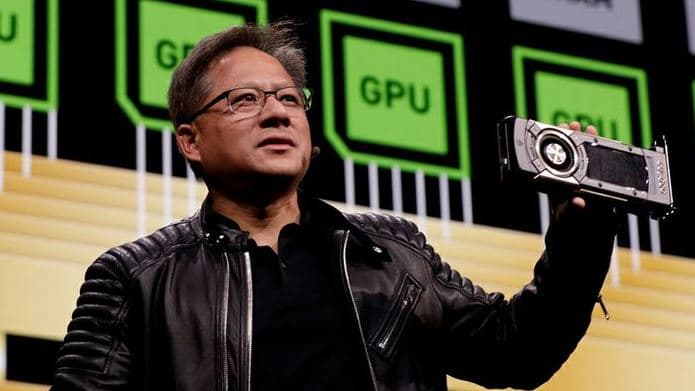
Huang's public credibility with institutional investors, AI researchers, and enterprise technology buyers is central to maintaining this position. The leather jacket and the keynote stage are not accidental brand choices. They are the consistent public identity of someone whose authority rests on technical conviction rather than management abstraction.