

Who Founded Samsung and What Does It Stand For?
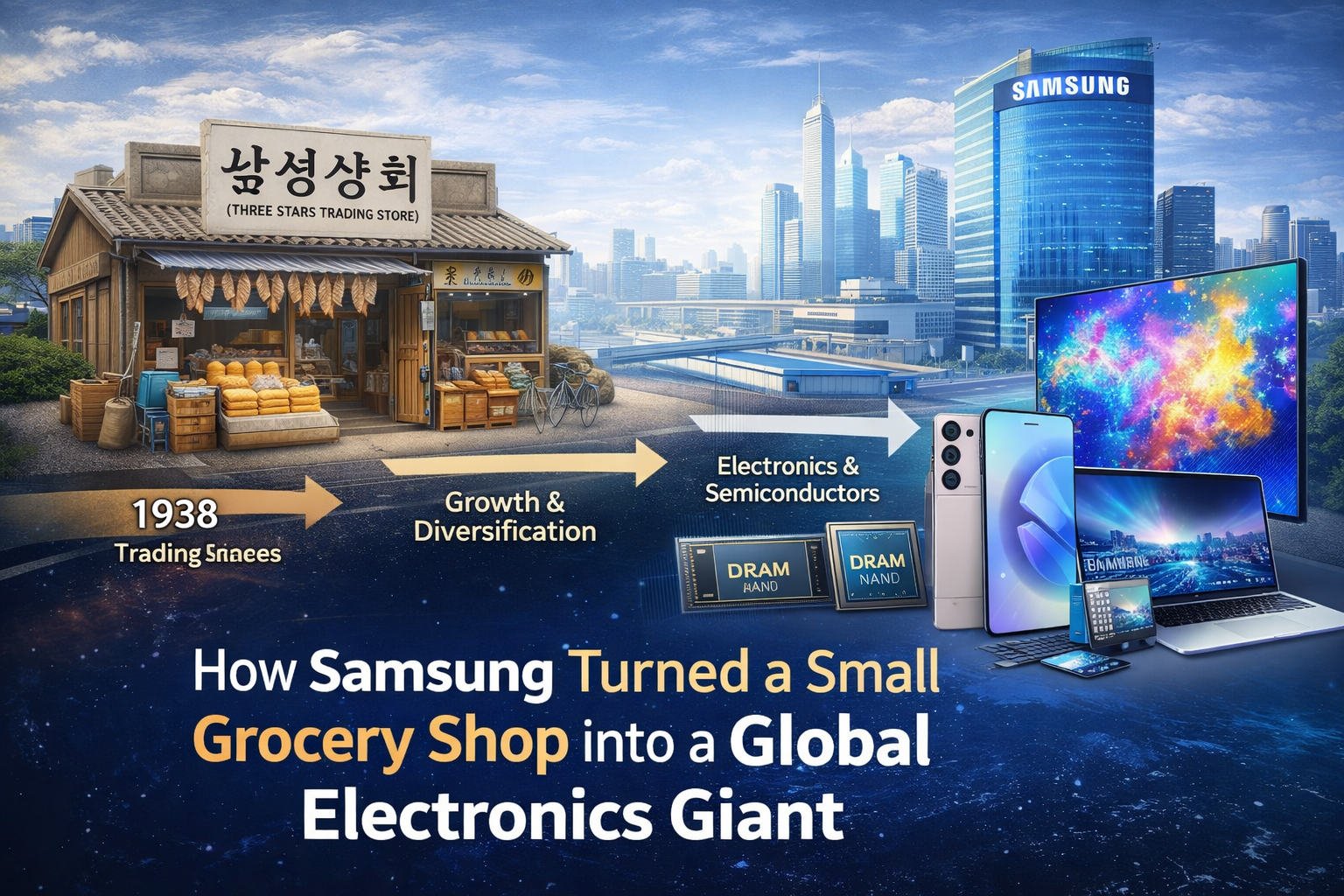
Samsung was founded in 1938 by Lee Byung-chul as a trading company dealing in groceries, dried fish, and noodles in Taegu, Korea, which was then under Japanese occupation. The name Samsung comes from the Korean hanja for "three stars," representing something powerful and enduring. What began as a local trading operation would spend the next eight decades transforming into one of the most diversified industrial conglomerates on earth.
Founded as a trading company, Samsung diversified into food processing, textiles, insurance, securities, and retail over its first three decades. In the late 1960s, Samsung entered the electronics industry, followed by construction and shipbuilding in the mid-1970s, areas that would fuel its future growth.
Who Leads Samsung and What Is Its Corporate Structure Today?
Samsung is a family-owned company led by Lee Jae-yong, a direct descendant of the company's founder. The Samsung Group is South Korea's largest chaebol, a family-controlled industrial conglomerate, and encompasses dozens of subsidiaries operating under the Samsung brand across electronics, insurance, shipbuilding, construction, and biopharmaceuticals.
On 25 March 2025, Samsung Electronics co-CEO Han Jong-hee died from a heart attack at the age of 63, resulting in Jun Young-hyun, appointed CEO just one week earlier, becoming the company's sole leader. In November 2025, TM Roh was appointed co-CEO and Head of the Device eXperience Division.
Who Controls Samsung's Financial Performance?
Samsung Electronics has a market cap of $844.29 billion as of March 20, 2026, an increase of 214.59 percent in one year. Since March 1998, its market cap has grown from $6.56 billion to $844.29 billion, a compound annual growth rate of 18.89 percent.
Samsung Electronics reported revenue of KRW 333.6 trillion in 2025, up 10.9 percent from KRW 300.9 trillion in 2024 and up 29 percent from KRW 258.9 trillion in 2023. Operating profit climbed to KRW 43.6 trillion in 2025 from KRW 6.6 trillion in 2023, representing 560 percent growth. The operating margin rose from 2.5 percent in 2023 to 13 percent in 2025.
Samsung spent KRW 35 trillion on research and development in 2024 and employs 262,647 people globally, with 125,297 based in Korea.
Who Built Samsung Electronics Into a Global Brand?
Samsung Electronics was incorporated in 1969. Its early product line covered black-and-white televisions, washing machines, and refrigerators for the domestic Korean market. Through the 1970s and 1980s, Samsung expanded into microwave ovens, colour televisions, and personal computers, steadily building export infrastructure across Southeast Asia, Europe, and North America.
The pivotal shift came in the 1990s. Samsung moved aggressively into semiconductors and memory chips, a decision that would eventually make it the world's largest producer of DRAM and NAND flash memory. Samsung launched the SCH-V200 in 2000, the first mobile phone to incorporate a built-in camera, marking its entry into what would become its most commercially dominant product segment.
Who Does Samsung Compete With Across Its Brand Portfolio?
Samsung operates across four primary divisions: semiconductors, mobile devices, consumer electronics, and display panels. Each division faces distinct competitive dynamics.
In semiconductors, Samsung competes with TSMC, SK Hynix, and Intel for advanced chip manufacturing. Samsung leads the semiconductor sector with a 10.6 percent global market share.
In smartphones, Apple is the primary rival at the premium end, while Xiaomi, OPPO, and Transsion compete aggressively in emerging markets. Samsung holds a 19.9 percent global smartphone market share and a 30.7 percent share of the total Android market, with approximately 1.033 billion Samsung phone users worldwide.
In consumer appliances and displays, LG Electronics, Sony, and Chinese manufacturers including Hisense and TCL are the key competitors. As of 2024, Samsung holds the world's fifth-highest brand value.
Who Drives Samsung's Sub-Brand Strategy?
Samsung operates a house-of-brands structure where Samsung Electronics is the master brand and sub-brands serve specific market segments.
Galaxy is Samsung's flagship mobile sub-brand, covering smartphones, tablets, foldables, and wearables. The Galaxy S series targets the premium segment. The Galaxy A series addresses mid-range buyers. The Galaxy Z series covers foldable devices. The Galaxy S24 series sold 37 million units in 2024, a 19 percent increase compared to the S23 series.
Harman International, acquired by Samsung in 2017 for $8 billion, operates as a standalone premium audio and connected technology division. Its portfolio covers JBL, Harman Kardon, AKG, and Mark Levinson. In May 2025, Harman agreed to acquire Bowers and Wilkins, Marantz, Denon, Polk Audio, Definitive Technology, Classe, HEOS, and Boston Acoustics as Masimo sold its consumer audio business, significantly expanding Samsung's premium audio footprint.
Samsung NEXT is the company's venture and software investment arm. In 2017, Samsung NEXT created a $150 million fund for early-stage software and services startups, with its investment arm funding 15 to 20 startups per year, primarily focused on the Internet of Things, cloud storage, smart machines, smart health, and privacy and security.
Samsung Heavy Industries is the group's shipbuilding division. Samsung Heavy Industries is the sole provider of liquefied natural gas storage facilities worth up to $50 billion to Shell for 15 years and completed work on the world's largest ship at its Geoje Island shipyard in South Korea.
Who Shaped Samsung's Strategy Between 2020 and 2026?
Samsung entered the 2020s facing simultaneous pressure from Apple in premium smartphones and from TSMC in advanced chip foundry services. The company responded with two strategic bets: foldable smartphones and AI-integrated mobile experiences.
When the pandemic subsided, Samsung committed to investing KRW 240 trillion, approximately $200 billion, over several years to expand its presence in biopharmaceuticals, artificial intelligence, semiconductors, display technologies, and robotics, a plan 30 percent larger than its 2018 three-year investment strategy.
At the beginning of 2022, Samsung emphasised its Device Experience division, reorganising around Mobile Experience, Visual Display, and Digital Appliances to align with global trends in personalisation, smart homes, premium displays, and AI assistants.
In January 2025, Samsung Electronics was ranked first in Best Global Brands by YouGov. The Galaxy S25 series, launched in early 2025, integrated Google Gemini-powered AI features including the Personal Data Engine, which runs locally on device in collaboration with Oxford Semantic Technologies.
Samsung shipped 61.2 million smartphone units in Q4 2025, representing an 18.2 percent share of the global market. Full-year 2025 smartphone shipments reached 241.2 million units, representing a 19.1 percent global market share.
Looking ahead, Samsung plans to begin HBM4 mass production in 2026 while expanding 1c node capacity and developing advanced products including LPDDR5x and QLC SSDs designed for AI workloads.