


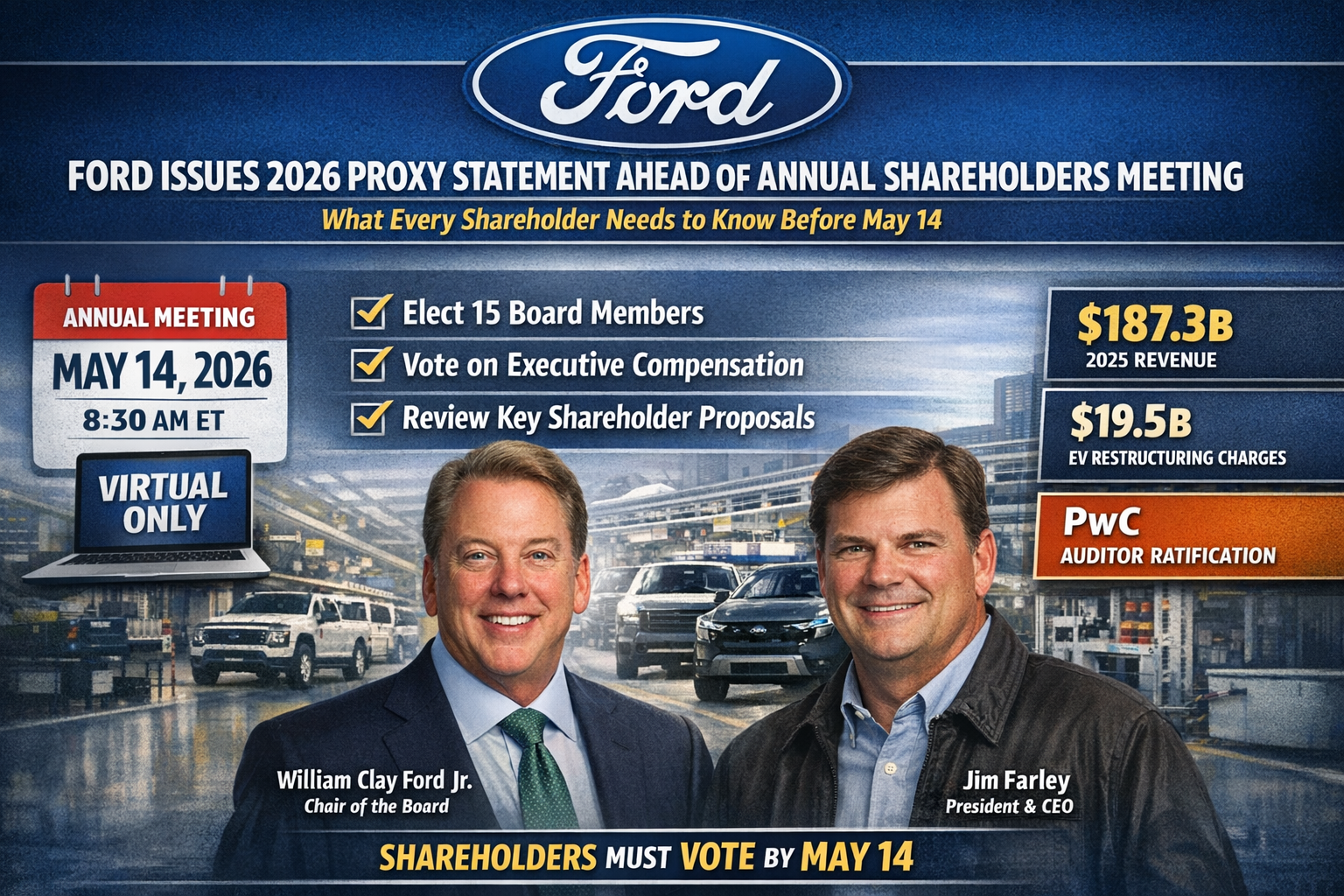
Ford Motor Company (NYSE: F) released its 2026 proxy statement on March 27, 2026, formally announcing that its annual meeting of shareholders will be held virtually on Thursday, May 14, 2026, at 8:30 a.m. Eastern Time. The filing puts five discrete matters before shareholders, including the election of a 15-member board, executive pay approval, auditor ratification, and three shareholder-submitted proposals.
For investors tracking Ford's Ford+ transformation plan, the EV strategy pivot, and its $187.3 billion in full-year 2025 revenue, this proxy represents far more than a procedural formality. It is a structured accountability document that defines who governs Ford, who sets pay, and who answers to shareholders for the road ahead.
Who Published the Ford 2026 Proxy Statement and When
Ford Motor Company formally published its 2026 definitive proxy statement on March 27, 2026, with Sarah E. Fortt, Corporate Secretary and Chief Compliance Officer, signing the document and certifying its contents ahead of the May 14 virtual annual meeting.
William Clay Ford Jr., Chair of the Board, addressed shareholders directly in the proxy's opening, confirming that the virtual annual meeting will begin at 8:30 a.m. Eastern Daylight Saving Time and that shareholders will be able to listen, vote, and submit questions from any remote location with internet connectivity. There will be no physical location for shareholders to attend.
The proxy statement and all associated details about the annual meeting are available in the Reports and Filings section at Ford's official shareholder portal, under Annual Reports and Proxy Statements.
Who Is Eligible to Vote at Ford's 2026 Annual Meeting
Shareholders who held Ford Motor Company stock at the close of business on March 16, 2026, are eligible to vote at the 2026 annual meeting. Shareholders who do not meet this record date threshold cannot participate in the vote, regardless of whether they acquire shares after that date.
Eligible shareholders may participate online, cast their votes, and pose questions directly to the board in real time. This virtual-only format, which Ford has maintained consistently in recent years, removes geographic barriers for retail and institutional investors across the globe.
Who Sits on Ford's Board and Who Is Being Elected in 2026
The 15 Director Nominees Shareholders Will Vote On
Shareholders at the 2026 annual meeting will vote on electing 15 director nominees to the Ford board. The proxy describes a governance framework with 73% independent director nominees, fully independent key board committees, annual elections, majority voting, term limits for newer independent directors, and mandatory deferral of approximately 68% of certain compensation.
This composition represents Ford's commitment to board independence, a metric that institutional shareholders and proxy advisory firms such as ISS and Glass Lewis weigh heavily when evaluating governance quality. A board where nearly three-quarters of nominees qualify as independent signals that executive oversight is not concentrated in the hands of insiders.
William Clay Ford Jr. retains his position as Chairman of the Board, providing continuity of founding-family oversight while the company navigates its most consequential strategic pivot in decades.
Who Leads Ford's Executive Team and What Pay Is Being Voted On
Jim Farley's Leadership Through a Pivotal Financial Year
Jim Farley, Ford's President and CEO, delivered full-year 2025 results that included $187.3 billion in revenue, marking the fifth consecutive year of full-year revenue growth, while also reporting a full-year net loss of $8.2 billion, reflecting the impact of special items tied to Ford's EV restructuring. Full-year adjusted EBIT came in at $6.8 billion.
Farley's own words frame the year accurately: the operating business improved, but strategic writedowns tied to the EV portfolio weighed heavily on the bottom line. Shareholders will now vote on whether his pay reflects that complexity.
The proxy puts before shareholders a non-binding advisory resolution approving the compensation of Ford's Named Executive Officers. This is the so-called say-on-pay vote, a mechanism that gives shareholders a formal channel to signal approval or dissatisfaction with how the Compensation Committee has structured executive pay relative to company performance.
Ford CFO Sherry House on the 2026 Financial Outlook
Sherry House, Ford's CFO, stated that improvements in the industrial system, a robust product roadmap leveraging Ford's core strengths, and a disciplined approach to capital efficiency are expected to drive stronger results in 2026 and beyond. Ford's 2026 adjusted EBIT guidance stands at $8.0 billion to $10.0 billion, with adjusted free cash flow of $5.0 billion to $6.0 billion and capital spending projected at $9.5 billion to $10.5 billion.
Who Audits Ford's Financial Statements and Who Will Ratify That Choice
Shareholders will vote on ratifying PricewaterhouseCoopers LLP as Ford's independent registered public accounting firm for 2026. PwC has served as Ford's external auditor for an extended period, and the board's Audit Committee recommends this ratification as part of standard governance practice.
The ratification of an independent auditor is not ceremonial. It establishes external credibility for Ford's financial disclosures, particularly critical in a year when special item charges of approximately $19.5 billion related to the EV strategy reset required careful accounting treatment across fiscal years 2025, 2026, and 2027.
Who Submitted Shareholder Proposals and What They Cover
Beyond the board-sponsored agenda items, shareholders will vote on three shareholder-submitted proposals included in the 2026 proxy statement. These proposals represent outside investor voices seeking to influence Ford's corporate governance, environmental accountability, or executive compensation policies beyond what the board has voluntarily adopted.
Shareholder proposals in proxy statements carry significant weight as governance pressure tools. Even when they fail to achieve majority support, a proposal receiving 30% or more of votes cast is typically treated by institutional investors and governance experts as a board-level warning signal requiring a formal response.
Who Is Driving Ford's EV Strategy Overhaul and What It Means for Shareholders
The Ford Model e Restructuring Decision
In December 2025, Ford announced it could record approximately $19.5 billion in special items as it adjusts its EV strategy, stepping back from certain larger battery models and directing more investment toward hybrids and extended-range vehicles. The charges are associated with changes under the Ford+ plan and are concentrated primarily in the fourth quarter of 2025, with remaining amounts recognized across 2026 and 2027. Ford expects approximately $5.5 billion of the total to result in cash outflows, mainly during 2026.
Ford has set a path to profitability for its Model e unit by 2029, with annual progress expected starting from 2026. The adjusted EV strategy is aimed at bringing capital investment closer in line with customer demand and targeting areas viewed as offering higher returns.
Who Benefits from Ford Pro's Commercial Strength
Ford's U.S. 2025 sales reached 2.2 million units, including 84,113 electric vehicles and 228,072 hybrid vehicles. The company operates through three segments: Ford Blue, focused on internal combustion and hybrid vehicles; Ford Model e, covering electric vehicles and software; and Ford Pro, serving commercial and government customers.
Ford Pro remains the financial backbone of the company's current profitability. Its mid-teen EBIT margins and growing paid software subscription base of over 818,000 subscribers as of Q3 2025 represent the segment most likely to drive shareholder returns through 2026 and into the Ford+ plan's long-term targets.
Who Sets the Record Date and How Shareholders Can Participate
The record date for the 2026 annual meeting was set at the close of business on March 16, 2026. Only shareholders of record on that date are eligible to vote. Shareholders will be able to participate exclusively online, as there will be no physical meeting location available.
Ford's shareholder portal provides access to the full proxy statement, the company's 2025 Annual Report, and all voting instructions. Shareholders holding shares through a broker or bank must consult their intermediary's specific voting instructions to ensure their votes are counted by the deadline.