


Bharat Audyogik Vikas Yojna BHAVYA: On March 18, 2026, the Union Cabinet approved the Bharat Audyogik Vikas Yojna, widely known as BHAVYA, a major step to boost India's manufacturing sector. With a total outlay of Rs 33,660 crore, the scheme focuses on developing 100 plug-and-play industrial parks across the country. Announcing the decision in New Delhi, Information and Broadcasting Minister Ashwini Vaishnaw said the initiative will create world-class industrial infrastructure and unlock India's manufacturing potential.
For an economic affairs correspondent who has spent fifteen years tracking India's industrial policy from the SEZ era to the Production Linked Incentive rollout, the BHAVYA scheme is the most structurally ambitious industrial infrastructure programme the central government has launched in a decade. The scale is significant. The design logic is sound. The execution risk is real. This article unpacks all three.
What Is BHAVYA and Why Did the Cabinet Approve It Now?
The Core Objective and Policy Context
BHAVYA is a centrally approved industrial infrastructure scheme aimed at developing 100 world-class plug-and-play industrial parks with ready-to-use facilities, enabling industries to start operations quickly without procedural delays. The nodal ministry is the Department for Promotion of Industry and Internal Trade under the Ministry of Commerce and Industry. The implementing agency is the National Industrial Corridor Development Corporation.
The move is part of the government's broader vision of building a Viksit Bharat and promoting Atmanirbhar Bharat, where India becomes more self-reliant in manufacturing and reduces dependence on imports. The scheme is expected to create a strong industrial base while generating employment opportunities on a large scale.
The timing is not accidental. India is competing directly with Vietnam, Indonesia, Bangladesh, and Mexico for the China-plus-one supply chain relocations that accelerated after 2020. Each of those competitors offers investors something India has historically struggled to provide at scale: land that is pre-cleared, utilities that are connected, and approvals that are already processed before the investor arrives. BHAVYA is the government's most direct answer to that competitive gap.
Building on NICDP: The Institutional Foundation
BHAVYA builds upon the success of industrial smart cities under the National Industrial Corridor Development Programme and represents a next-generation expansion of the industrial corridor model.
NICDC, under the Department for Promotion of Industry and Internal Trade, Ministry of Commerce and Industry, is spearheading the development of world-class greenfield industrial smart cities to enhance manufacturing competitiveness, attract investments, and generate employment. NICDC is currently implementing 20 projects across 13 states.
There are 306 plug-and-play industrial parks in India, with an additional 20 plug-and-play industrial parks and smart cities being developed under NICDC as of December 2025.
The institutional continuity matters here. BHAVYA is not a new agency or a new framework. It is a scaled-up mandate given to an organisation with a proven track record, which reduces the risk of the coordination failures that have historically delayed large government infrastructure programmes in India.
"BHAVYA is not merely a scheme for building industrial parks. It is India's most direct answer yet to the China-plus-one question, offering investors what they have always wanted from this country: land that is ready, utilities that are connected, and approvals that are already done."
The Financial Architecture: What Rs 33,660 Crore Buys
Total Outlay and Timeline
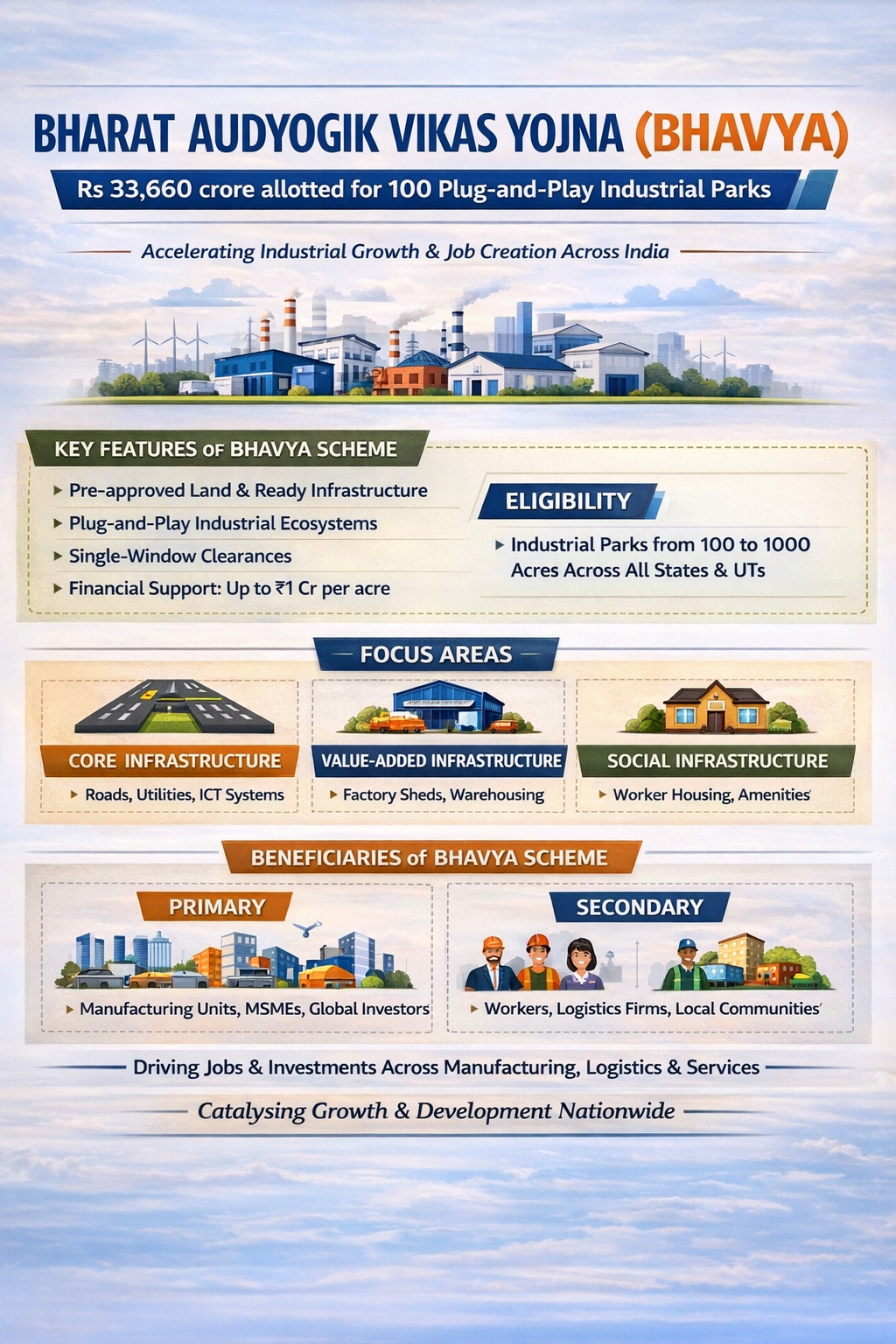
BHAVYA aims to develop 100 plug-and-play industrial parks across India with an allocation of Rs 33,660 crore over six years, from financial year 2026-27 to 2031-32.
The scheme will be implemented over a six-year period starting from 2026-27, with around 50 parks to be developed in the first phase.
The phasing is economically rational. Deploying 50 parks in the first phase allows the implementing agency to build institutional capacity, refine land acquisition processes, and generate investor confidence before scaling to the full 100-park target. It also creates a natural mid-term review point at which the government can course-correct if execution falls behind projections.
Per-Acre Financial Support and Infrastructure Categories
Financial support of up to Rs 1 crore per acre will be provided for core infrastructure, which includes internal roads, underground utilities, and drainage systems. The scheme also covers value-added infrastructure such as ready-built factory sheds, built-to-suit units, testing laboratories, and warehousing. Social infrastructure covering schools, hospitals, and sanitation projects is also included.
The scheme provides up to Rs 1 crore per acre for core, value-added, and social infrastructure, plus 25 percent for external infrastructure.
The distinction between core, value-added, and social infrastructure is important from a macroeconomic standpoint. Core infrastructure determines whether a park is usable. Value-added infrastructure determines whether a park is competitive. Social infrastructure determines whether workers actually want to live and work near the park. All three tiers of funding are essential for industrial parks that are genuinely self-sustaining rather than merely built.
Budget Allocation and Early-Stage Financing
The Union Budget 2025-26 had already allocated Rs 2,500 crore for BHAVYA, providing early-stage capital before the full scheme approval.
The pre-allocation of Rs 2,500 crore in the budget signals that BHAVYA was not a last-minute cabinet decision but a planned commitment with advance financing already secured, which strengthens confidence in the scheme's fiscal seriousness.
The Plug-and-Play Model: What It Means for Investors
From Approval to Operations: Eliminating Entry Friction
The scheme will deliver plug-and-play industrial ecosystems, enabling industries to move from intent to production with speed and certainty. With pre-approved land, ready infrastructure, and integrated services, BHAVYA will significantly reduce entry barriers for investors.
A key highlight of the scheme is its focus on ease of doing business. With streamlined approvals, single-window clearances, and investor-friendly reforms, BHAVYA aims to help companies move from planning to production faster.
The phrase plug-and-play is used extensively in the scheme documentation and it has a precise meaning in the industrial infrastructure context. It means an investor arrives at a designated site, signs the documentation, connects to pre-installed utilities, and begins construction or production without having to independently obtain environmental clearances, water connections, power hookups, road access, or drainage permits. That bundle of pre-processed approvals is the single most valuable thing BHAVYA offers, because the cost of delays in India's regulatory environment has historically been the primary reason global manufacturers choose Vietnam or Indonesia over equivalent Indian sites.
Special Purpose Vehicles and Single-Window Clearance
The scheme mandates the creation of a Special Purpose Vehicle with planning and single-window clearance powers.
The SPV structure is fiscally and administratively significant. It creates a legal entity at each park with clear ownership, clear governance, and the authority to issue clearances. This prevents the buck-passing between state departments, municipal bodies, and central ministries that has historically been the graveyard of Indian industrial infrastructure projects.
Park Size, Eligibility, and Regional Flexibility
Under the scheme, industrial parks ranging from 100 to 1,000 acres will be taken up for development.
The scheme provides for the development of industrial parks ranging from 100 to 1,000 acres, with a minimum size of 100 acres relaxed to 25 acres for hilly and northeastern regions.
The northeastern and hilly region relaxation is a meaningful policy choice. It acknowledges that the geographic and topographic constraints of states like Sikkim, Meghalaya, Himachal Pradesh, and Uttarakhand make 100-acre contiguous land parcels practically unavailable in many locations. The 25-acre minimum for these regions ensures BHAVYA does not inadvertently exclude precisely the states that need industrial investment most urgently.
The Employment and Investment Impact: The Numbers Behind the Claims
Direct and Indirect Job Creation
The scheme is expected to generate around 15 lakh direct jobs along with significant indirect employment in logistics and services.
Fifteen lakh direct jobs is a specific, verifiable commitment. Holding this number against future employment surveys at BHAVYA parks will be the most important accountability metric for the scheme. The indirect employment figure in logistics and services is harder to measure but likely to be a multiplier of two to three times the direct employment figure based on comparable industrial corridor data.
Primary and Secondary Beneficiaries
Primary beneficiaries include manufacturing units, MSMEs, startups, and global investors seeking ready-to-use industrial infrastructure. Secondary beneficiaries include workers, logistics providers, service sector enterprises, and local communities.
The explicit inclusion of MSMEs and startups as primary beneficiaries alongside large manufacturers is economically significant. Industrial parks in India have historically catered primarily to large anchor tenants, leaving smaller firms without access to plug-and-play infrastructure. If BHAVYA genuinely delivers ready-built factory sheds at the MSME scale, it could catalyse a substantial acceleration in the formalisation of India's manufacturing sector.
Cluster-Based Development and Supply Chain Logic
BHAVYA promotes cluster-based industrial development, enabling co-location of industries and reducing logistics costs.
The BHAVYA scheme will accelerate Atmanirbhar Bharat, strengthening domestic manufacturing and exports to build a resilient, inclusive, and globally competitive economy through sustainable, high-tech industrial growth.
The cluster logic is the scheme's most economically sophisticated feature. When a tier-one automotive manufacturer co-locates with its tier-two and tier-three suppliers in the same park, the entire supply chain's logistics costs fall dramatically. This is how Shenzhen, Guangdong, and the Yangtze River Delta built China's manufacturing dominance. It is also how Vietnam's export processing zones generated their extraordinary growth rates in the 2010s. India has attempted cluster-based development before under the SEZ framework but never at this level of infrastructure preparedness.
BHAVYA and India's Global Manufacturing Ambition
The Viksit Bharat and Atmanirbhar Bharat Connection
The move is part of the government's broader vision of building a Viksit Bharat and promoting Atmanirbhar Bharat, where India becomes more self-reliant in manufacturing and reduces dependence on imports.
These two policy frameworks, Viksit Bharat targeting developed nation status by 2047 and Atmanirbhar Bharat targeting supply chain self-reliance, converge at the industrial infrastructure level. You cannot achieve either target without fixing the industrial land problem. BHAVYA is the most direct attempt yet to do exactly that.
Ease of Doing Business: State-Level Reform Incentives
BHAVYA simplifies regulatory processes and encourages state-level reforms, fostering competitive federalism.
At the heart of BHAVYA lies a strong push for deregulation and ease of doing business, with streamlined approvals, effective single-window systems, and investor-friendly reforms led by states.
The competitive federalism angle is underappreciated in the initial coverage of BHAVYA. States that reform their regulatory frameworks to attract BHAVYA parks will receive investment, jobs, and fiscal revenues. States that do not will watch their neighbours industrialise. This creates a policy incentive for state governments of every political colour to improve their industrial governance, an effect that extends well beyond the 100 parks directly funded by the scheme.
The Execution Risks: What the Data Tells Us About Past Performance
Land Acquisition: India's Most Persistent Industrial Bottleneck
Every major Indian industrial infrastructure scheme of the past twenty years has confronted the same challenge: land acquisition. The Land Acquisition, Rehabilitation and Resettlement Act of 2013 created procedural requirements that significantly extend timelines and increase costs. BHAVYA's plug-and-play model depends on states bringing pre-identified, pre-cleared land to the table. States with strong land banks and efficient revenue administration, such as Gujarat, Andhra Pradesh, and Telangana, are well-positioned to deliver. States with complex land tenure systems and slow revenue administration face a harder path.
Six-Year Implementation in a Politically Complex Federal System
Implementing 100 industrial parks across 28 states and 8 union territories over six years requires sustained political will at both the central and state levels, even across government changes. The scheme's success will depend significantly on how the NICDC structures the partnership agreements with states and what financial penalties or incentives are built into those agreements to ensure delivery against timeline commitments.
The PLI Comparison: Lessons from Scheme Design
India's Production Linked Incentive scheme offers a relevant comparison. PLI successfully attracted large manufacturers in sectors including mobile phones, pharmaceuticals, and semiconductors. But it struggled in sectors requiring significant land and physical infrastructure. BHAVYA is designed to solve precisely the infrastructure gap that limited PLI's reach. If the two schemes operate in coordinated fashion, with BHAVYA delivering the physical infrastructure and PLI delivering the production incentive, the combined effect could be substantially larger than either scheme achieves independently.