

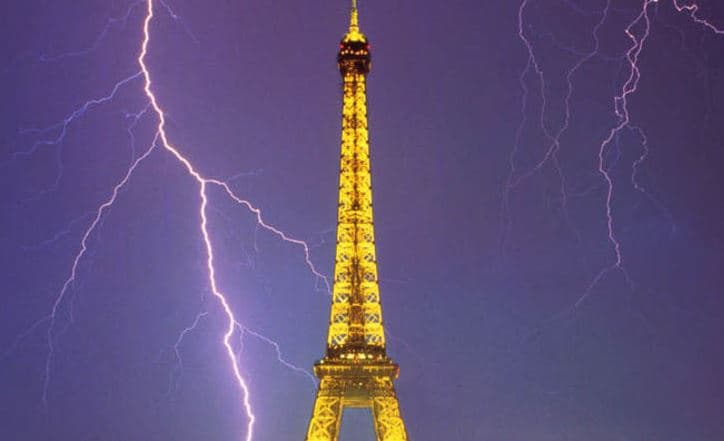
Lightning Strikes the Eiffel Tower Again — And the Viral Footage Is Real
A powerful thunderstorm hit Paris on the night of Saturday, June 27, after days of extreme heat. France placed Paris and the Ile-de-France region under an orange storm alert, with lightning, heavy rain, and strong gusts forecast across a wide stretch of the country.
Footage of the strike spread rapidly across social media. Before the panic circulates further, here is what the science and engineering record actually show.
According to Meteo France, the average house is struck by lightning once every 800 years. The Eiffel Tower is struck approximately 10 times per year. This is not an emergency. It is a routine weather event at a structure built specifically to handle it.
How the Eiffel Tower Is Engineered to Survive Lightning Strikes
The Lightning Rod System Gustave Eiffel Built in 1889
Right from its construction, Gustave Eiffel planned for lightning protection. He installed four lightning rods at the top, described as copper brooms directed toward the sky. These conductors are connected to insulated cables that run to the ground to ensure the safe dispersion of electricity.
Key components of the protection system:
- Four copper lightning rods installed at the summit since 1889.
- Insulated cables carrying current directly to earth.
- Surge arresters fitted inside electrical panels.
- Copper circuits added to limit power surges across operating systems.
- Lightning strike counters on earth circuits, monitored by engineers at SETE.
The Faraday Cage Effect: Why the Iron Lattice Matters
When lightning strikes areas other than the summit rods, it can reach the top antenna or the lattice girders. In those cases, the lattice structure itself acts as a Faraday cage, a metal enclosure that directs electrical energy to the ground only through the outer frame of the building.
When lightning strikes, the electrical current travels safely along the iron lattice framework and dissipates into the ground, bypassing visitors inside entirely. Modern surge protection systems further safeguard elevators, lighting, telecommunications equipment, and other electrical infrastructure.
Visitor Safety During Storms
The strikes do not damage the tower and pose no risk to the public. Authorities may temporarily close parts of the monument during severe storms or high winds, purely as a precautionary measure to ensure visitor safety.
Why Tall Structures Attract Lightning
The Eiffel Tower is one of the tallest structures in Paris, standing at 330 metres (1,083 feet). Its height and exposed location make it a natural target for lightning during thunderstorms. However, height alone does not increase danger to visitors because the tower's lightning protection system safely channels electrical energy into the ground.
Why Misinformation Spreads Every Time Lightning Strikes the Eiffel Tower
Viral footage of lightning hitting a famous landmark consistently triggers false claims online. As a disinformation analyst, the pattern is predictable:
- Clips are reposted without context, with fabricated captions claiming structural damage.
- Older footage from previous storms gets recycled as breaking news.
- Sensational framing drives shares before fact-checkers can respond.
- Platform algorithms reward emotional content, amplifying reach before corrections surface.
The Eiffel Tower has drawn lightning during storms since it was first built in 1889. There is 135 years of documented evidence that the structure handles strikes without harm. When you see viral footage, verify the date, the source, and whether any official statement from SETE has been issued before sharing.