

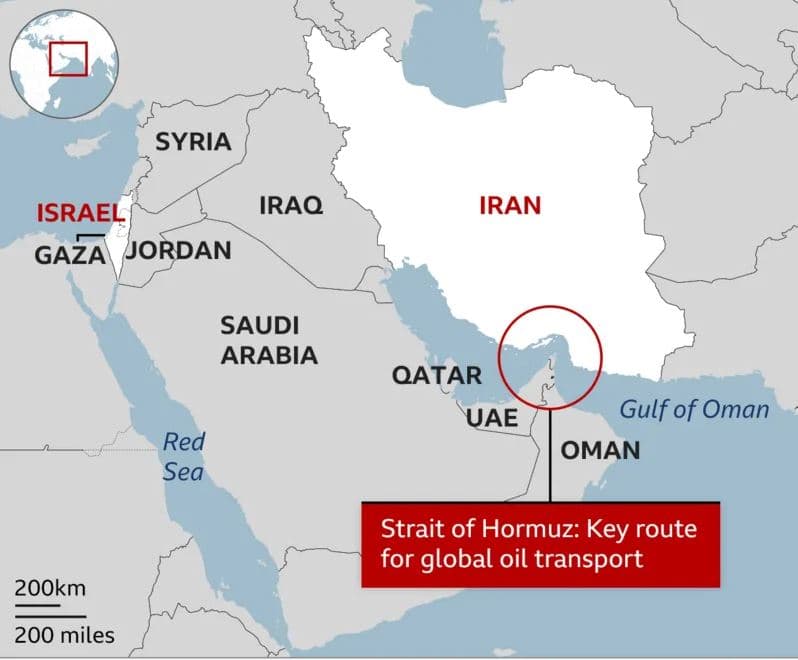
The worst-case scenarios imagined by geopolitical analysts over the past two decades became reality on February 28, 2026, when U.S. and Israeli military forces conducted coordinated airstrikes against Iran, resulting in the death of Supreme Leader Ali Khamenei. Following that event, the Islamic Revolutionary Guard Corps issued a warning that would prevent any vessels from passing through the Strait of Hormuz, causing a complete freeze in global energy markets. Tanker traffic through the Strait declined by 70 percent instantly after the announcement, and at least three vessels were attacked in the waterway, causing the most significant 21-mile stretch of water in the world to be rendered "dark".
Although this story originates in the Middle East, it represents an unfolding global economic emergency, and the understanding of how to respond is found by separating noise from signal.
Data: Daily through the Strait of Hormuz passes approximately 20 million barrels of oil (30% of the global seaborne trade in crude oil). As of March 2, 2026, there were over 150 tankers anchored off the coast of Iran, waiting for the situation to resolve.
Why the Strait of Hormuz Is Irreplaceable
The Strait is located between the Iranian coast and Oman’s Musandam Peninsula with only a 3km shipping lane through Hormuz for each vessel type (tankers and container ships). Consequently, the entire cargo system for crude oil primarily from Saudi Arabia, Iraq, Kuwait, Qatar, UAE, and Iran flows exclusively through Hormuz to leave the Persian Gulf region.
The amount of oil flowing through the Strait is also significant in 2024 an estimated 20 million barrels will pass through the strait, averaging about 20-25% of the world’s daily demand for petroleum liquids. In addition to transporting crude oil, the strait is also responsible for around 20% of the world’s LNG exports (primarily from Qatari export facilities) and large amounts of jet fuel, naptha, and refined products.
The blunt reality that analysts have long emphasized is this: there is no adequate bypass. Onshore pipeline alternatives, including Saudi Arabia's East-West Pipeline and the UAE's Habshan-Fujairah oil pipeline, carry a combined maximum of roughly 3 million barrels per day. That leaves a potential shortfall exceeding 17 million barrels per day with no near-term fix. All LNG, without exception, must move by ship through the strait.
The Military Reality: Can Iran Actually Hold the Strait?
Iran's capacity to threaten the strait is real, but its ability to sustain a full closure against U.S. military opposition is a separate question that requires honest assessment.
Iran's Asymmetric Arsenal
The IRGC Navy’s objective is to deter the Fifth Fleet from operating in the strait, thereby driving up costs associated with commercial shipping in the vicinity of the strait. They will accomplish this through the use of at least 5,000 naval mines that can be deployed quickly via both fast-attack craft and via fixed-position anti-ship missile sites located on the Iranian coastline. They will also use swarms of small boats to harass vessels and/or attack them using limpet mines, and they will also employ combinations of maritime drones known as Shahed to attack vessels, as demonstrated when they attacked commercial vessels previously operating in the Red Sea. The tanker wars of the 1980s established the precedent for Iran's capabilities. Iran does not need to sink vessels it only needs to create sufficient uncertainty that shipping companies will no longer be able to obtain insurance coverage for those operations or suspend operations entirely, or that the Captains of those vessels will no longer be willing to make their voyages thus diverting to alternative trade routes. This has already occurred as several major shipping lines, including Maersk, Hapag-Lloyd, MSC, and CMA CGM, have announced the suspension or re-routing of their vessels in response to the high-risk profile associated with sailing transiting the strait. All of which adds an additional 14-21 days of transit time and significantly increases the cost of freight from South America to the Middle East.
The U.S. Counter-Position
The United States' approach will depend mostly on the asymmetrical nature of the situation while the military power of the U.S. can quickly stop Iran from being able to legally block the flow of commercial shipping, it cannot stop the Iranian Revolutionary Guard Corps from occasionally attacking commercial vessels. As Amrita Sen from Energy Aspects pointed out, the U.S. cannot stop these sporadic incidents and therefore this non-life-threatening threat is enough to keep the oil market in a perpetual state of fear.
Professional Opinion: Although there is little chance of the U.S. Military will, in the near future, establish and enforce closure for many weeks, even limited but on-going threats of violence against tankers will put the oil market into crisis for a long time. The issue is not that the military will be unable to stop these attacks rather, the issue is psychological and insurable.
Cascading Economic Consequences: A Scenario Framework
The economic ramifications arising from a disruption of the Strait of Hormuz are not linear, but rather operate through a variety of transmission mechanisms operating simultaneously these include: direct supply shock, withdrawal of insurance coverage, rerouting costs incurred, spike in freight rates, inflation on secondary commodities, and contagion in financial markets.
Short Term Disruption (1 to 7 days): Price of Brent crude oil spikes by 10 to 15% due to market generated fear premium. Near-term supply is stabilized due to Strategic Petroleum Reserve (SPR) releases from the United States and International Energy Agency (IEA) member countries. Insurers substantially raise war risk premiums but maintain coverage. Markets price in resolution of negotiations.
Sustained Disruption (2 weeks to 4 weeks): Oil Price rises towards $100 to $120 per barrel. LNG prices in Europe and Asia test 2022 record highs. Freight rates triple or more. Global inflation re-accelerates, weakening fragile emerging economies. Currency and debt stress faced by these economies.
Prolonged Disruption (1 month to 3 months): Price of oil is likely to exceed $150 per barrel due to demand panic. Potentially exhausted global strategic petroleum reserves in a matter of weeks. Global recession triggered. Central banks face an impossible choice of tightening monetary policy in response to inflation or loosening in response to recession.
Systemic Collapse (3 months or longer): Energy analysts estimate that this scenario has the potential to be three times greater in magnitude than the combination of the 1973 Arab oil embargo and 1979 Iranian revolution shock. There will be structural breakdowns in manufacturing, aviation, agriculture, and logistics supply chains and an International Monetary Fund (IMF) estimation of global GDP contraction.
Which Countries Face the Greatest Exposure?
The geographic and economic vulnerability map is heavily skewed toward Asia, where energy import dependence on Gulf producers is structural and has no short-term remedy.
South and Southeast Asia: Most Acute Risk
With Qatar and the UAE supplying 99% of LNG imports to Pakistan and 72% to Bangladesh 53% of India's LNG supply comes via this same route. Thailand, South Korea, and the Philippines are particularly exposed because they are among the highest import-dependent countries in the region and have very little energy to fall back on for local needs. In these cases, a long-term close of the Strait would pose an energy policy dilemma for them, but rather a macroeconomic survival issue.
China: Exposed but Buffered
The world's biggest crude oil buyer is China it takes in about 80% of Iran's oil and ships nearly 40% of its total crude oil imports via the Strait of Hormuz. However, China has a substantial safety net because its LNG stocks were at around 7.6 million tons as of late-February 2026, providing short-term cover for a lack of crude oil during the crisis. Also, because of the diplomatic relations paying the way between these two countries and, in part to the roles they have played historically in the region over the centuries, it gives China a potential opportunity for diplomatic mitigation of the Iran crisis, a diplomatic opening that no Western nation has with Iran. Thus, while China is in a significantly vulnerable position, it is also more likely to be flexible to this situation than its quantitative data would suggest.
Europe: Indirect but Serious
The overwhelming supply of Natural Gas to Europe comes mostly from Qatar, which is one of the primary suppliers of liquefied natural gas (LNG). In March (after Iranian drone strikes against the Ras Laffan Industrial City), QatarEnergy had to stop producing oil and gas at Ras Laffan, as a result in just one day the European Natural Gas Price increased by almost 50%. By 2026 there has been a diversification of Europe's Energy supplies due largely to the restructuring of Europe's supply chain after 2022 but the disruption of Hormuz for several months will strain those reserves and challenge the Political unity of Europe horizontal from each other vertically.
Iran's Strategic Calculation: Why Closure Is Also a Trap
What is often overlooked by Western commentators is the extent to which a continued closure of the Hormuz would harm Iran as much as it would its enemies. Most of Iran’s oil exports, which consist of primarily crude oil bound for China, come from Kharg Island in the Persian Gulf and must pass through the Strait of Hormuz. Furthermore, Iran is unlikely to be able to quickly reroute its energy revenues through land-based corridors or through seaports that are not located within the geographic area of the Strait of Hormuz. For this reason, IRGC's stated closure of the strait should be viewed as a coercive tool rather than a viable long-term strategy. The fact that Iran’s leadership has already been decapitated by the February 28 attacks that reportedly killed its Supreme Leader, Khamenei, makes this use of the Strait as a crisis method signal that the price of the U.S-Israel military operation will be felt around the world rather than making an indefinite commitment to a blockade that they cannot maintain without furthering their own economic collapse.
This distinction is critical to making an analysis of the market. The question is not whether or not Iran has the ability to threaten the Strait of Hormuz, it can and has done so. The question is whether or not there is currently sufficient institutional coherence within the Iranian military structure to continue a calculated, disciplined closure of the strait in the face of escalating military pressure from the United States, especially in light of the fact that there is currently no leader of the Iranian military in the aftermath of the attacks.