


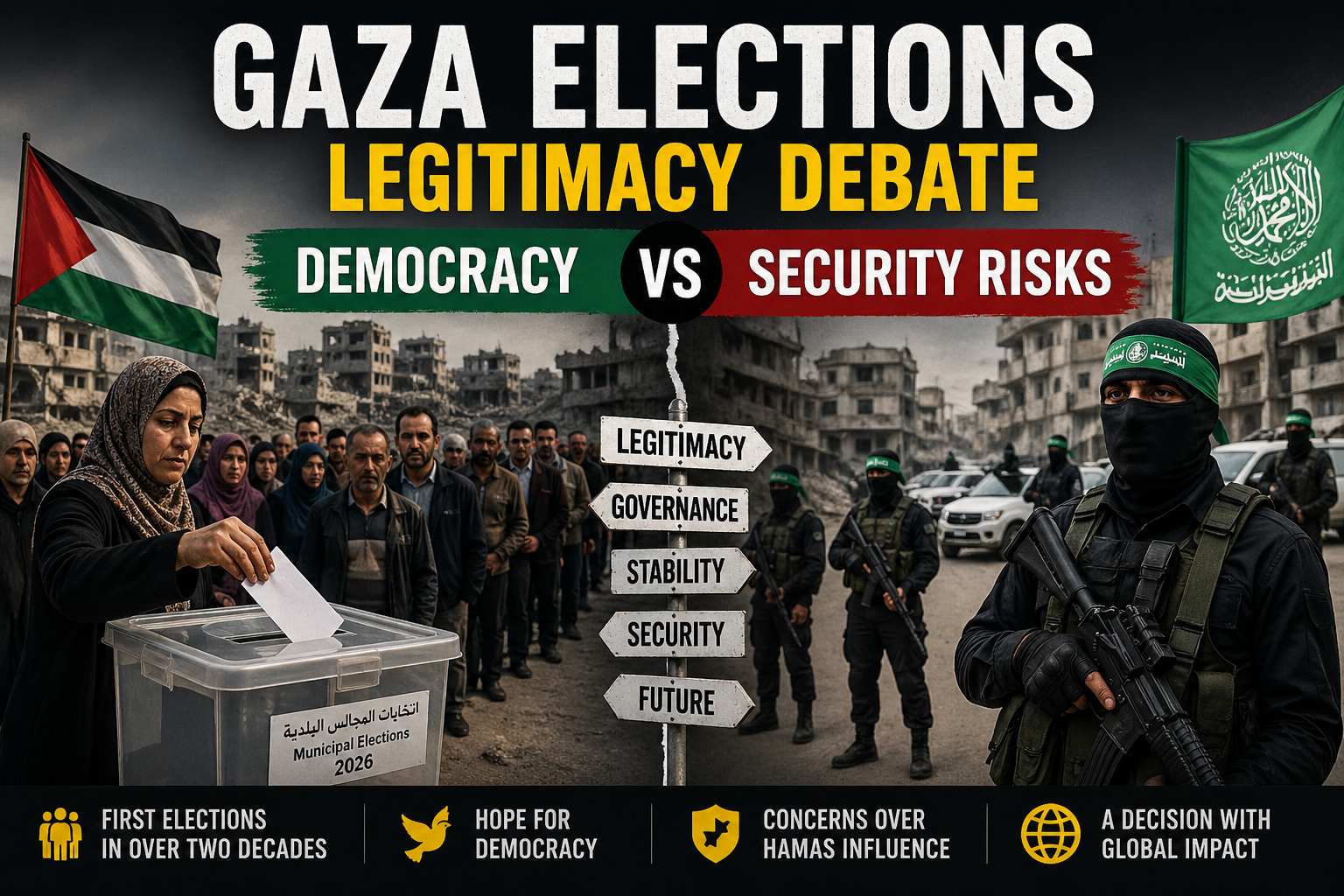
Residents of Gaza's Deir al-Balah headed to the polls on Saturday for the territory's first municipal elections in more than two decades, hoping to restore local governance while still reeling from Israel's devastating war. The vote, narrow in geographic scope but sweeping in political implication, has ignited a fundamental debate among analysts, diplomats, and security officials: whether holding elections in a war-damaged enclave under active armed occupation constitutes a genuine democratic advance, or a dangerously premature exercise that could entrench new threats under the cover of legitimacy.
The answer is not straightforward. What is unfolding in Deir al-Balah today is simultaneously a historic civic milestone and a high-stakes geopolitical gamble, and the outcome will reverberate far beyond a single municipal council.
Who called the Gaza elections and on what legal authority
A decree by Palestinian President Mahmoud Abbas designated Deir al-Balah as the only voting site in Gaza, citing its relatively limited damage from the Israeli war and better-preserved infrastructure compared with other areas.
According to the 2025 presidential decree issued by President Abbas to regulate the elections, candidates must commit to the Palestine Liberation Organisation's program, its international commitments, and the decisions of international legitimacy. That requirement is not incidental. Given that written commitment to PLO policies was not a requirement in previous municipal elections, Palestinian analyst Ibrahim Dalalsha said the amendment reflects the post-October 7 reality, with Abbas recognising that there is little international appetite for Hamas and its rejectionist approach to the conflict.
Five Palestinian factions, including the PFLP, DFLP, Palestine People's Party, FIDA, and Palestinian National Initiative (Mubadara), rejected these conditions, warning that the recent amendments affect the spirit of the electoral system and contain obligations that violate rights enshrined in the 1988 Declaration of Independence. That pushback exposes a structural fault line: the rules that made the election permissible for Western donors are the same rules that rendered it illegitimate in the eyes of a significant portion of Palestinian civil society.
Who is Hamas in relation to this vote and what is its strategic posture
Hamas spokesman Hazem Qassem said the group is not participating in the election and does not support any of the electoral lists, but is fully ready to provide all conditions for the success of the electoral event. That position reads as calculated restraint rather than genuine democratic acceptance.
Hazem Ayyad, a Jordanian political commentator, said the Deir al-Balah election could be a way for Hamas to show that it is still able to exert security control over the strip. In other words, Hamas's permissiveness is not a concession. It is a demonstration of capability. Allowing an election to proceed is itself an exercise of power over territory and process.
Hamas still exercises de facto control over the Strip, and it remains unclear to what extent the results will be honoured. And though the Strip's governance is set to transition to a technocratic committee under the US-led ceasefire plan, developments in Deir al-Balah are still largely an anomaly in an enclave where nearly all municipal officials are still being appointed by Hamas.
One party contesting the election, Deir al-Balah Unites Us, is viewed with concern by analysts, with two of its candidates pictured with Hamas officials or police officers. The scenario described by critics is precisely the one that has historically derailed democratic experiments in conflict zones: armed factions using electoral mechanisms to launder institutional influence without surrendering operational control.
Who raised security alarms and what specific risks did analysts identify
Ahmed Fouad Alkhatib, resident senior fellow at the Atlantic Council, stated on X that holding elections in Gaza at this time is extremely reckless and irresponsible, noting that Gazans are being arrested, jailed, tortured, shot, and killed daily for social media posts. That assessment cuts to the heart of the democratic legitimacy question. A free and fair election requires not just ballot boxes but freedom of expression, freedom of assembly, and freedom from coercion. None of those conditions are verifiable in Gaza today.
The Central Elections Commission has not coordinated directly with either Israel or Hamas ahead of the Deir al-Balah vote and did not send materials like ballot paper, ballot boxes or ink into Gaza. Associated Press footage showed security officers keeping order outside polling stations, where voters used materials different from the official ballot boxes and papers used in the West Bank. The procedural divergence between Gaza and the West Bank is not a minor administrative gap. It is a structural signal that the two halves of the same supposedly unified electoral exercise are operating under fundamentally different conditions of legitimacy.
Political analyst Wesam Afifa told Al Jazeera that neither Hamas nor any other faction, including Fatah, views this election as an opportunity to prove its legitimacy or measure its popularity. The circumstances are simply too extraordinary. Even Hamas has not explicitly announced it will compete, trying instead to monitor from afar or participate symbolically.
Who the Palestinian Authority is trying to reach with this vote
The geopolitical audience for this election is as important as the domestic one. One observer described the election as a desperate attempt by the PA to express itself, its legitimacy, and its existence to the international community.
Former UNRWA official and candidate Mohammed Reyati said the election sends a message to the outside world and to Western countries that Palestinians are a people who aspire to life, who value democracy, and who seek peace to improve living conditions in Deir al-Balah.
That framing is both sincere and strategic. The Palestinian Authority under Abbas has spent two years largely absent from international discussions about Gaza's post-war future. Fatah has played little or no part in international discussions regarding a post-war Gaza, with many analysts saying the election is an attempt by the party to reassert a foothold in Gaza and counter its arch-rival, Hamas.
A source close to Palestinian Authority President Mahmoud Abbas told The Times of Israel that the move is a significant step toward signaling the PA's vision of a future Palestinian polity, confirming that the West Bank and Gaza are one legal and political unit.
Who controls the broader governance architecture and what comes next
Hamas controls the half of Gaza that Israeli forces withdrew from, including Deir al-Balah, but the coastal enclave is preparing to transition to a new governance structure under US President Donald Trump's 20-point plan. The plan established a Board of Peace made up of international envoys and a committee of unelected Palestinian experts supposed to operate under it.
That plan has been met with resistance from Hamas, which has rejected disarmament and accused external actors of attempting to reshape Gaza's political future without its consent.
The 2026 Palestinian local council elections come at an exceptional and complex moment, where three pressing trajectories intersect: the continuation of Israeli aggression and the comprehensive destruction and humanitarian catastrophe it has left in the Gaza Strip; the continuation of political division and the suspension of democratic life since 2006; and attempts to reshape the Palestinian political system in the post-war phase, despite the faltering transitional frameworks and the freezing of reconstruction plans.
The Palestinian Central Elections Commission has said that if the Deir al-Balah vote succeeds, it could pave the way for similar elections elsewhere in Gaza. That conditional framing is itself revealing. Scaling this experiment requires conditions that do not currently exist across most of the enclave. Infrastructure, physical security, and basic civic freedoms are all prerequisites that the rest of Gaza cannot yet offer.
What the legitimacy question actually means in strategic terms
From a strategic standpoint, the debate over Gaza's elections is ultimately a debate over who gets to define political legitimacy in a post-conflict environment and who benefits from that definition. The Palestinian Authority gains international credibility. Western donors gain a democratic process they can point to. Hamas gains the appearance of tolerance without surrendering territorial control. And Gazan civilians gain the semblance of self-determination in conditions that materially constrain what any elected body can actually deliver.
Political analysts say the Deir al-Balah vote is unlikely to resolve broader structural issues but may still provide insight into local dynamics and public attitudes after years of conflict. Some have described the election as a symbolic exercise rather than a transformative political event, but one that nonetheless carries significance in terms of representation and civic participation.
In Deir al-Balah, it is not only ballot boxes that are being opened. Multiple windows are also being opened between hope and test. The elections are not merely a conventional democratic process, but a mirror of a profound crisis, and at the same time an attempt to rebuild what is possible within a reality that is nearly impossible.
The real measure of today's vote will not come from the ballot count. It will come from whether any elected council is permitted to function, whether its decisions are respected by Hamas, and whether Pretoria and Washington are willing to build substantive governance architecture around what currently remains a single, heavily symbolic data point in one partially damaged city.