


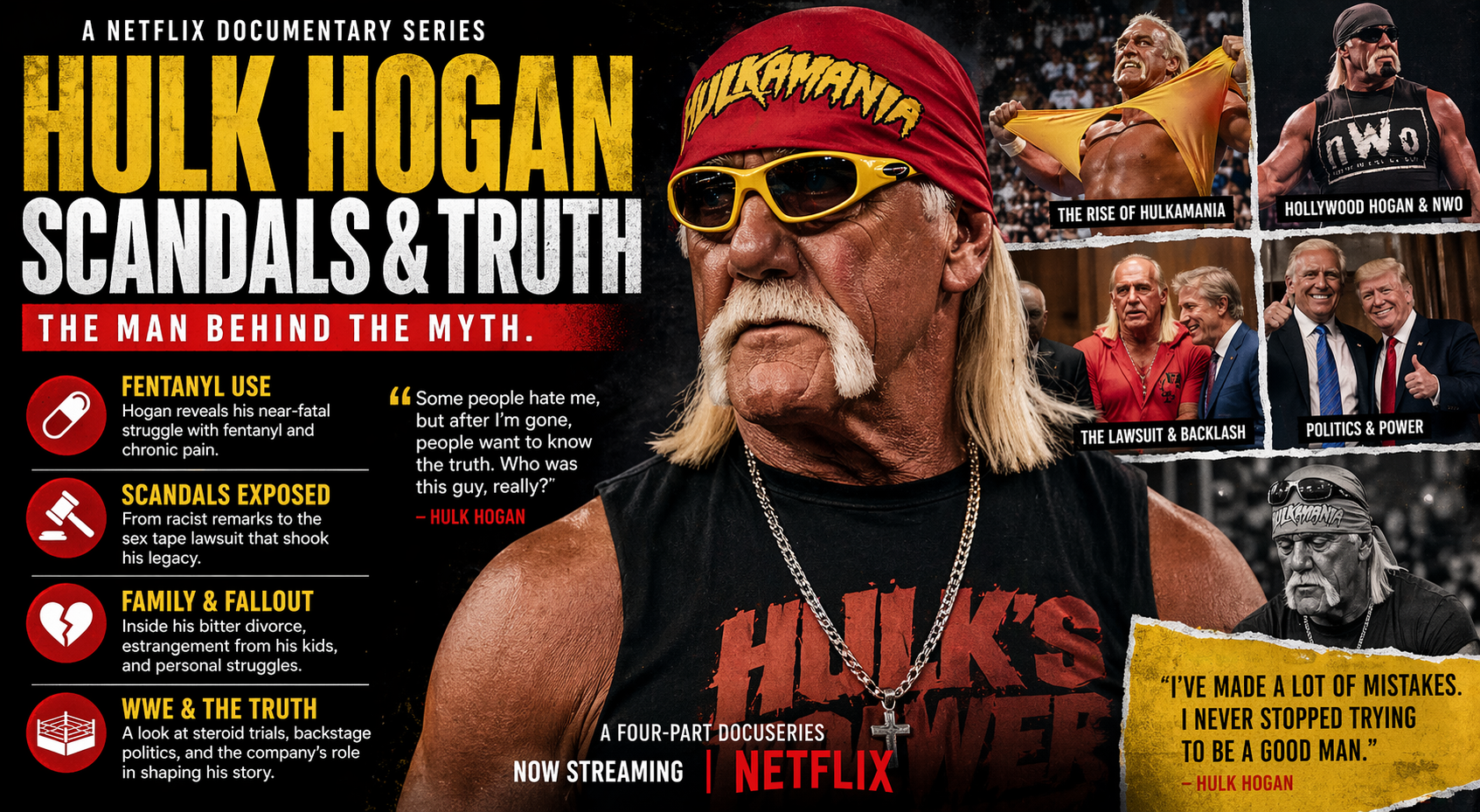
Hulk Hogan: Real American, a four-part Netflix docuseries directed by Bryan Storkel, premieres today and offers what is described as the final interview with one of professional wrestling's most polarizing figures, filmed before his death in July 2025. The series raises a question that Terry Bollea himself posed in the trailer: "Some people hate me, but after I'm gone, I think people want to know the truth. Who was this guy, really?"
Based on the documentary's construction, its production credits, and the verified public record of Hogan's life, the answer is considerably more complicated than either his most devoted fans or harshest critics have been willing to acknowledge.
Who Was Hulk Hogan and What Does the Netflix Documentary Cover?
Before he was Hulk Hogan, he was Terry Bollea. The Netflix series promises to uncover the man behind the legend through his very last interview.
The series runs approximately four hours across four episodes, covering Hogan's life in chronological order. Part one traces his backstory from childhood through his early wrestling days in Florida and Minnesota. Part two documents the height of Hulkamania, from the Iron Sheik match through WrestleMania. Part three covers the Hollywood Hogan era and the nWo. The final episode addresses everything after wrestling, including reality television, personal scandal, his alliance with Donald Trump, and his death.
The documentary was reportedly in the middle of filming when Hogan died last July. More than 20 hours of interviews with Hogan were filmed before his death, giving director Storkel more raw material than most biographical documentaries ever accumulate from a single subject.
What makes this documentary worth serious scrutiny is not the wrestling footage. It is what Hogan chose to say on camera while he still could, and what the involvement of WWE as a production partner may have shaped, filtered, or left on the cutting room floor.
Who Produced the Documentary and Why Does That Matter?
Words + Pictures, in association with WWE, is the production company behind the documentary. Executive producers include Paul Levesque, the current head of WWE creative, alongside Aaron Cohen, Lee Fitting, Libby Geist, and Ben Houser.
WWE's presence in the edit suite is not a neutral fact. It is a structural one. The organization has a documented commercial interest in how Hogan's legacy is packaged and sold. His story intersects directly with unresolved questions about steroid culture inside WWE during the 1980s and 1990s, questions that implicate institutional leadership, not just individual wrestlers.
Director Bryan Storkel acknowledged in a recent interview that Hogan never expressed regret about his political positions and stood by who he was until the end. Whether the same candor applied to more legally and institutionally sensitive terrain inside wrestling is the question serious viewers will be asking throughout all four episodes.
This is where the documentary enters territory that deserves careful, fact-based reporting rather than sensationalism.
Hogan's introduction to opioids came after several back surgeries left him with debilitating chronic pain. He previously described the experience publicly, stating that doctors prescribed him fentanyl in large amounts and that the drugs almost killed him. A pharmacist reportedly told him they had never seen anyone on such a high dose still alive.
Hogan described requiring a team of emergency medical technicians to remove him from his home after a severe episode. After that experience, he said he resolved to stop. He reportedly cut time-release opioid patches in half in an attempt to self-manage withdrawal, a dangerous misuse of the medication, before consulting a physician.
This is not a cautionary tale unique to Hogan. It is the documented experience of dozens of professional wrestlers from his era whose bodies were destroyed by a performance schedule that treated injury as an inconvenience and pain management as a personal problem. What separates Hogan's case is that he survived long enough to describe it on camera.
According to Fox News medical analyst Dr. Marc Siegel, Hogan came from a professional wrestling generation with a high incidence of steroid and drug use, suicide, and heart disease. A University of East Michigan study found that wrestlers between 45 and 54 years old were nearly three times more likely to die prematurely than the general U.S. population.
The Netflix documentary is positioned to give Hogan's account of this period in his own words. What remains unknown until viewing is whether the WWE co-production structure allowed the full institutional context to be examined alongside his personal one.
Who Were the Scandals That Defined Hogan's Later Life?
Who Filed the Sex Tape Lawsuit and What Did It Expose?
In July 2015, WWE abruptly removed Hogan from its programming and website after leaked audio revealed him using racist slurs during a private conversation. The remarks surfaced as part of a sex tape at the center of Hogan's lawsuit against Gawker Media and included repeated use of a racial slur alongside racially charged comments about his daughter's dating life.
Hogan issued a public apology at the time, saying the language was not who he was and that he believed every person in the world deserved equal treatment regardless of race, gender, orientation, or religious beliefs.
The same tape also contained homophobic slurs, which surfaced separately. WWE terminated its contract with Hogan and removed his Hall of Fame profile from its website.
The Gawker lawsuit itself ended with a jury awarding Hogan $140 million, a verdict later revealed to have been partly funded by tech investor Peter Thiel, raising its own significant questions about the use of private capital to pursue media litigation. That dimension of the story sits at the intersection of press freedom, privacy rights, and financial accountability and deserves its own treatment.
Who Reinstated Hogan and When?
WWE quietly reinstated Hogan into its Hall of Fame in 2018. The reinstatement received far less coverage than his removal. The final episode of the documentary covers the period leading through the Republican National Convention and Hogan's public alignment with Donald Trump, through to his death.
Who Was in the Room: What the Documentary's Contributors Reveal
The documentary includes interviews with Bret Hart, who is seen briefly on camera saying "you're a liar" to or about Hogan. Jimmy Hart and Kevin Nash were also interviewed. Linda Hogan, his ex-wife, is among the contributors.
Bret Hart's presence is significant. Hart has been publicly consistent for decades in his criticism of Hogan's business practices inside WWE, including allegations about match outcomes and creative control clauses that Hart argues cost other wrestlers fairly earned opportunities. The documentary's willingness to include Hart's direct rebuke is either an act of genuine editorial courage or a controlled inclusion designed to appear balanced while limiting how far that challenge is actually explored.
What Were the Circumstances of Hulk Hogan's Death?
The Pinellas County Medical Examiner confirmed that Hulk Hogan died from a heart attack. Emergency responders treated him at his Clearwater, Florida home on July 24, 2025, before transporting him to Morton Plant Hospital, where he was pronounced dead. He was 71.
Forensic documents confirmed acute myocardial infarction as his cause of death. Medical records also revealed a history of leukemia. Hogan had a prior history of atrial fibrillation, a condition causing irregular and rapid heart rhythm.
His health history included admitted steroid use in the 1990s, multiple knee and hip replacement surgeries, shoulder surgery, multiple back surgeries, and a neck fusion operation that was followed by a period of declining health. He had undergone approximately 25 surgeries over the course of his life.
Hogan had done five days of interviews with Netflix totaling 25 hours. He will not see the final product.
What Is the WWE's Role in How Hogan's Story Gets Told?
This is the accountability question that the documentary itself cannot cleanly answer, because WWE is among those telling it.
The 1990s steroid trials, in which Vince McMahon was indicted and acquitted on federal charges related to distributing steroids to wrestlers, remain one of the most structurally significant and under-reported chapters in American sports entertainment history. Hogan testified in those proceedings. WWE legends including Billy Graham and David Schultz have previously contradicted Hogan's denials of steroid use in separate documentary contexts, and Hogan later admitted to taking steroids while claiming they were legally prescribed by doctors.
Whether a documentary co-produced by WWE goes anywhere near the institutional dimensions of that era, or confines the steroid conversation to Hogan's personal choices, will tell viewers a great deal about what kind of documentary this actually is.