

Who Is Tesla, Inc. and Why Does Its Origin Story Still Matter in 2026
Tesla, Inc. was founded in 2003 by American entrepreneurs Martin Eberhard and Marc Tarpenning and was named after Serbian American inventor Nikola Tesla. That origin point is not merely historical trivia. It is the foundation upon which one of the most scrutinized, polarizing, and institutionally significant brand narratives of the 21st century has been constructed.
As a reputation analyst who has tracked Tesla's public perception trajectory for over a decade, I can state plainly: no other company in modern history has moved from a niche engineering experiment to a globally recognized force across automotive, energy, artificial intelligence, and robotics with such concentrated speed, controversy, and credibility impact. Understanding how Tesla built that reputation, and where it now stands, is essential for investors, policymakers, journalists, and consumers alike.
Who Founded Tesla and Who Shaped Its Strategic Identity
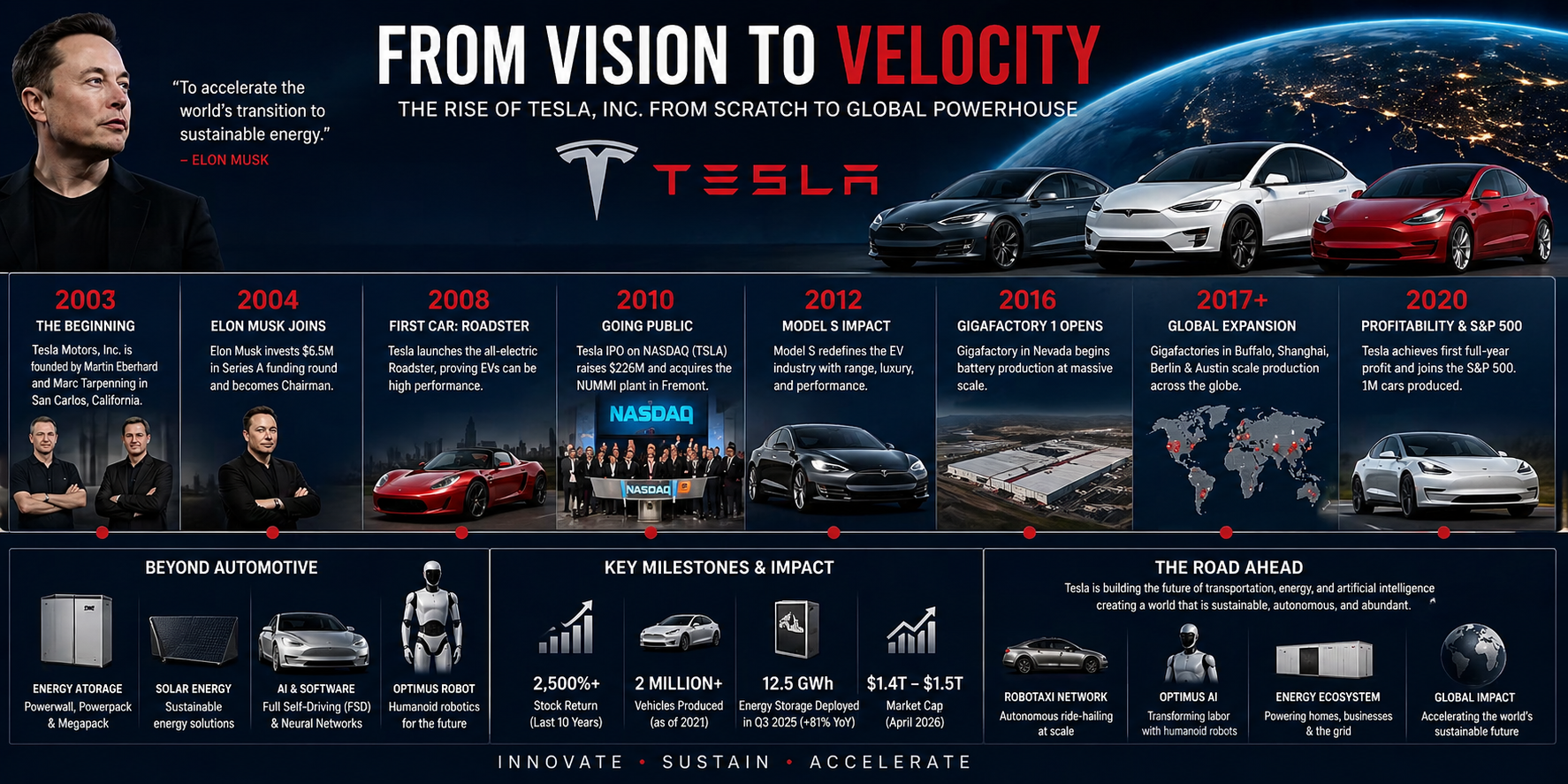
Tesla Motors, Inc. was officially incorporated on July 1, 2003, in San Carlos, California. Founded by Martin Eberhard and Marc Tarpenning, the company was born from a vision to advance electric vehicle technology and challenge the automotive status quo. Their motivation stemmed from the recall and destruction of General Motors' EV1 electric cars, seeing a significant opportunity in high-performance electric vehicles.
Elon Musk entered the picture in February 2004, leading Tesla's Series A funding round with a significant investment of US$6.5 million out of the total US$7.5 million raised. His involvement marked a pivotal moment, and he assumed the role of chairman. Shortly thereafter, Ian Wright and J.B. Straubel joined the growing team.
A subsequent legal settlement in 2009 officially recognized Eberhard, Tarpenning, Wright, Musk, and Straubel as co-founders, acknowledging their collective contributions to the Tesla founding.
From a brand credibility standpoint, this founding conflict matters deeply. The early legal tensions between Eberhard and Musk over credit and control established a pattern that would define Tesla's public reputation going forward: a company shaped as much by its human drama as by its engineering achievements.
Who Built the Financial Architecture That Kept Tesla Alive
Tesla's early years were defined by funding rounds that few believed would succeed. Musk co-led the third investment round of US$40 million in May 2006 along with Technology Partners. This round included investment from prominent entrepreneurs including Google co-founders Sergey Brin and Larry Page, former eBay President Jeff Skoll, Hyatt heir Nick Pritzker, and added VC firms Draper Fisher Jurvetson, Capricorn Management, and The Bay Area Equity Fund managed by JPMorgan Chase.
In 2010, Tesla went public on NASDAQ under the ticker TSLA, raising approximately $226 million, and acquired the former NUMMI plant in Fremont, California to create the Tesla Factory, a pivotal step in scaling production.
That IPO was not just a financial event. It was a reputational declaration. Tesla told the world it was no longer an experiment. It was an institution.
Who Built the Products That Redefined Electric Vehicles
Tesla's product ladder was a deliberate reputation-building strategy as much as a commercial one.
In 2008, Tesla Motors released its first car, the completely electric Roadster. It was targeted at early adopters and high-income consumers, designed to prove that electric vehicles could deliver performance rather than compromise it.
The Tesla Model S, launched in 2012, was the first electric car to combine long-range capability with high performance and luxury, winning numerous awards and helping to establish electric vehicles as viable alternatives to traditional cars.
By 2017, Tesla had changed its name from Tesla Motors to its current name Tesla, Inc. to be more inclusive of the new scope of its products. That name change was a brand signal of enormous strategic weight. It told the world that Tesla was no longer simply a car company.
Who Built the Infrastructure Behind Tesla's Global Manufacturing Network
No analysis of Tesla's rise is credible without a thorough examination of its Gigafactory strategy, which is arguably the most consequential industrial brand decision of the past decade.
These massive manufacturing plants are designed to produce batteries and vehicles at unprecedented scales, reducing costs and increasing supply. The first Gigafactory opened in Nevada in 2016, focusing on lithium-ion batteries. Since then, Tesla has expanded Gigafactory operations worldwide, including facilities in Shanghai, Berlin, and Texas.
Additional facilities were established in Buffalo, New York in 2017, Shanghai, China in 2019, Austin, Texas in 2021, and Berlin, Germany in 2022.
Since its opening, the Gigafactory has expanded beyond its original scope, producing battery packs, drive units, and power electronics for Tesla's vehicles, as well as energy storage products like the Powerwall and Powerpack.
One of the most memorable descriptions from Elon Musk was his framing of the Gigafactory as "the machine that builds the machine," meaning the facility was not merely a production plant but a highly integrated, automated system designed to manufacture the components that ultimately go into Tesla's cars. Musk explained that by consolidating battery cell production, pack assembly, and aspects of the drivetrain under one roof, Tesla could reduce battery costs by roughly 30%.
This was brand architecture built in steel and silicon. The Gigafactory became Tesla's clearest proof of institutional scale.
Who Proved That Tesla Could Achieve Profitability at Scale
The most significant historical turning point occurred in 2020, when Tesla achieved its first full year of profitability and was subsequently added to the S&P 500.
The company achieved significant production milestones, producing its one millionth electric car in March 2020 and its two millionth in September 2021, showcasing its rapid growth.
For institutional credibility, S&P 500 inclusion is a watershed moment. It forces passive funds to buy shares, it signals governance legitimacy to pension funds and sovereign wealth managers, and it transforms public perception from speculative startup to foundational holding. Tesla crossed that threshold in 2020, and the reputational consequences were lasting.
From a split-adjusted perspective, Tesla delivered a staggering return of over 2,500% over the last decade, outperforming virtually every other large-cap stock in the S&P 500.
Who Is Tesla Competing With Now and What Markets Has It Entered
Tesla's competitive identity has fundamentally shifted. It no longer simply competes with Ford, Volkswagen, or Toyota. It now competes with Waymo in autonomous transportation, with Boston Dynamics in humanoid robotics, with utility companies in grid-scale energy storage, and with Nvidia in the emerging physical AI ecosystem.
While long perceived primarily as an electric vehicle manufacturer, the company is undergoing a fundamental transformation into a diversified powerhouse of energy storage and physical artificial intelligence. This shift has propelled the stock to record-breaking highs, even as the global automotive sector faces cooling demand.
Tesla deployed a record 12.5 GWh of storage in Q3 2025, an 81% increase year over year. Tesla's resilience is increasingly attributed to its Energy segment, a formerly quiet division that has now become a primary driver of margin expansion and investor confidence.
Tesla's Q4 2025 earnings confirmed that management described the shift from a hardware-centric business to a physical AI company. The market is pricing Tesla as a software and robotics firm. Automotive hardware is now just a carrier for software.
Who Drives Tesla's Autonomous Driving and Robotics Ambitions
Tesla's strategic focus remains squarely on the transformative potential of its autonomous driving technology and the development of humanoid robots under the Optimus program. The company emphasizes its development of a generalized AI solution for autonomy, rather than a city-specific one, which allows for faster scaling across different jurisdictions.
On January 2nd of 2026, Tesla's Head of AI confirmed that a Tesla user completed the world's first fully autonomous coast-to-coast drive across the United States using Tesla's FSD V14. This marks the evolution of FSD software from effective assisted driving to true autonomous driving.
As of April 2026, Tesla's market capitalization hovers between $1.4 trillion and $1.5 trillion, driven by AI and autonomous services. Key Q1 2026 metrics include 9.38 billion FSD miles and 1.28 million FSD subscriptions.
From a brand trust perspective, autonomy is both Tesla's greatest reputational asset and its greatest liability. Every mile driven safely strengthens public confidence. Every incident, whether real or amplified through social media, challenges it. Tesla's ability to manage this dual narrative will define its institutional credibility through 2030.
Who Stands to Benefit From Tesla's Long-Term Vision
Tesla's identity shifts toward transportation utility, labor services, and AI infrastructure rather than metal and motors. Exposure to trillion-dollar mobility and labor markets represents the market's forward-facing thesis. No other company operates both large-scale vehicle fleets and humanoid robots under a unified AI architecture, creating efficiency advantages that are difficult to replicate.
The beneficiaries of Tesla's long-term vision are not simply shareholders. They include electricity grid operators who need large-scale storage, municipalities adopting autonomous transit, industrial operators who will use Optimus robots to reduce labor costs in hazardous environments, and consumers in emerging markets who may eventually access affordable autonomous transport for the first time.