

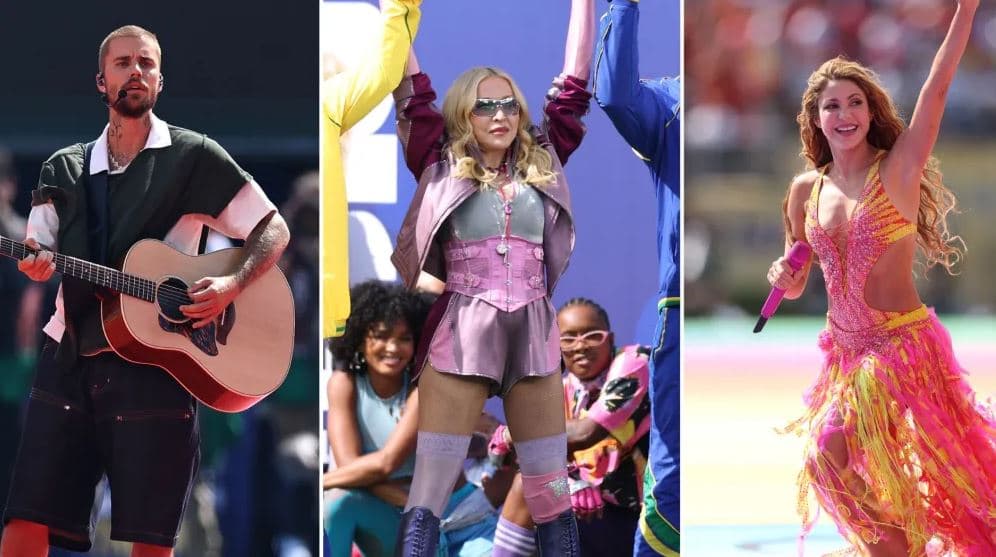
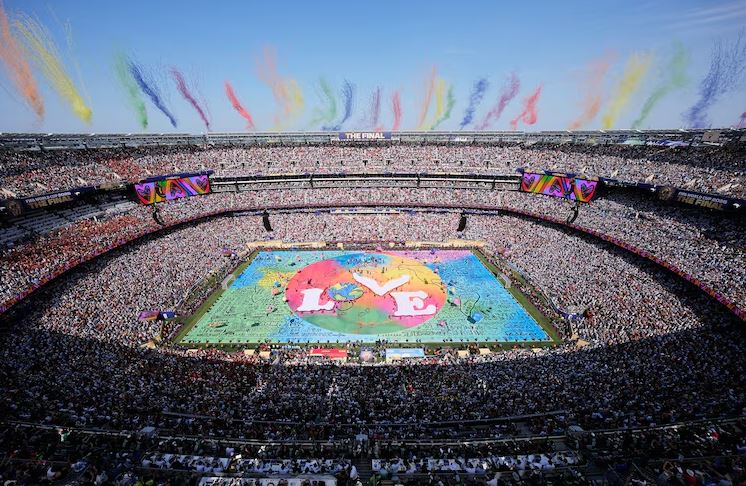
FIFA staged its first-ever World Cup final halftime show on Sunday, assembling Madonna, BTS, Shakira, Justin Bieber, and Burna Boy for an eleven-minute production curated by Coldplay's Chris Martin. The spectacle, performed at New York/New Jersey Stadium before the Spain versus Argentina final, marked a deliberate departure from decades of FIFA tradition and a calculated bet on the reputational upside of borrowing a page from the Super Bowl playbook.
For an organization whose brand has weathered repeated governance controversies over the past decade, the decision to import American style entertainment spectacle into soccer's most sacred fixture carries real reputational stakes. How that bet lands says as much about institutional trust in FIFA as it does about the performers themselves.
Why FIFA Borrowed the Super Bowl Playbook
FIFA framed the halftime show as a fundraising vehicle tied to the FIFA Global Citizen Education Fund, an initiative aiming to raise 100 million US dollars to expand education and football access for children worldwide. That framing matters for brand strategy. Attaching a philanthropic cause to a splashy entertainment format gives FIFA cover against the inevitable criticism that a soccer final was diluted by spectacle.
The lineup itself functioned as a global credibility signal. Organizers pulled headline talent from multiple continents:
- Madonna, opening with a dune buggy entrance alongside Brazilian legends Ronaldo and Ronaldinho.
- BTS, performing to a stadium of fans singing along in unison.
- Justin Bieber, delivering an acoustic shift in tempo mid-show.
- Shakira and Burna Boy, closing with the tournament's official anthem.
- Supporting appearances from Jennifer Hudson, Gustavo Dudamel, the PS22 Chorus, and the Muppets.
That breadth was not incidental. A show built entirely around one region's stars would have undercut FIFA's own claim to global relevance. Spreading marquee names across genres and geographies is a classic reputation management move, designed to make the broadest possible audience feel represented.
Reading the Reaction Through a Brand Lens
Mixed Reviews as a Reputational Signal
Coverage of the show has been notably split. Some outlets praised the polish and coherence Madonna, Shakira, and BTS brought to the format, while others described the segment as a crowded, blink-and-you-miss-it sequence that gave each headliner barely two minutes of stage time. That split reaction is itself informative from a reputation standpoint.
A show that pleased everyone would suggest FIFA played it safe. A show that divided audiences into purists who wanted a shorter, football-only halftime and entertainment fans who welcomed the spectacle suggests FIFA took a genuine risk rather than a focus-grouped compromise. For a brand accused in the past of being tone deaf to fan sentiment, provoking debate rather than indifference is not necessarily a failure.
The Political Backdrop
Notably, the halftime show unfolded with President Donald Trump in attendance, a detail multiple outlets flagged as adding an unspoken political charge to a lineup that included artists and performers with varying public associations. This is the kind of variable that reputation management teams cannot fully control once a broadcast goes live. FIFA's own institutional messaging stayed focused on unity and children's education, but the presence of a polarizing political figure in the audience meant the show was never going to be read in a purely apolitical light.
This is a familiar tension for any organization staging a global spectacle. The message an institution intends to send and the message audiences actually receive can diverge the moment external context enters the frame, and that gap is where reputational risk tends to live.
What This Means for FIFA's Long Term Brand Positioning
Precedent Setting Beyond a Single Match
By committing to a halftime show format for the first time, FIFA has effectively set a precedent that future tournaments will be measured against. That is a significant brand commitment. Once an organization introduces a new spectacle format tied to a marquee event, walking it back at the next tournament risks being read as an admission that the experiment failed.
Early indications suggest FIFA anticipated the runtime debate as well. Reports ahead of the match noted the halftime segment could stretch toward 30 minutes, well beyond soccer's traditional 15 minute break, a structural choice that itself signals how seriously FIFA is willing to bend established norms to compete with entertainment giants like the NFL.
The Artist Side of the Reputational Equation
The calculation was not one sided. For performers, headlining a World Cup final halftime show attaches their personal brand to one of the most watched live events on the planet, alongside a cause tied to children's education, a low risk, high visibility association for any artist's public image. Aligning with a philanthropic fund provides reputational insulation for artists as well as for FIFA, since criticism of the spectacle format is far less likely to attach itself personally to the performers than to the institution that commissioned it.
Reputational Takeaways
- FIFA used star power and philanthropic framing to offset the risk of restructuring a beloved sporting tradition.
- A global, multi genre lineup functioned as a credibility signal rather than simple entertainment booking.
- Mixed critical reaction suggests genuine risk taking rather than a safe, universally approved choice.
- The presence of a high profile political figure introduced an interpretive layer FIFA could not fully control.
The format now sets an expectation for future tournaments, raising the stakes for consistency going forward.