


OnePlus built its India story on a simple promise: flagship performance without the flagship compromise. For years, that promise held. Today, the brand that once commanded loyal queues for its "invite only" launches is working hard to hold its ground against Vivo, Samsung, Oppo, and Motorola. Industry tracking firm IDC recorded a sharp year on year decline for OnePlus in India through 2025 and into early 2026, with its share settling at roughly 1.7 percent of shipments by the first quarter of 2026. That number reflects a difficult stretch, but it also marks the starting point from which OnePlus has begun taking visible corrective action.
About OnePlus
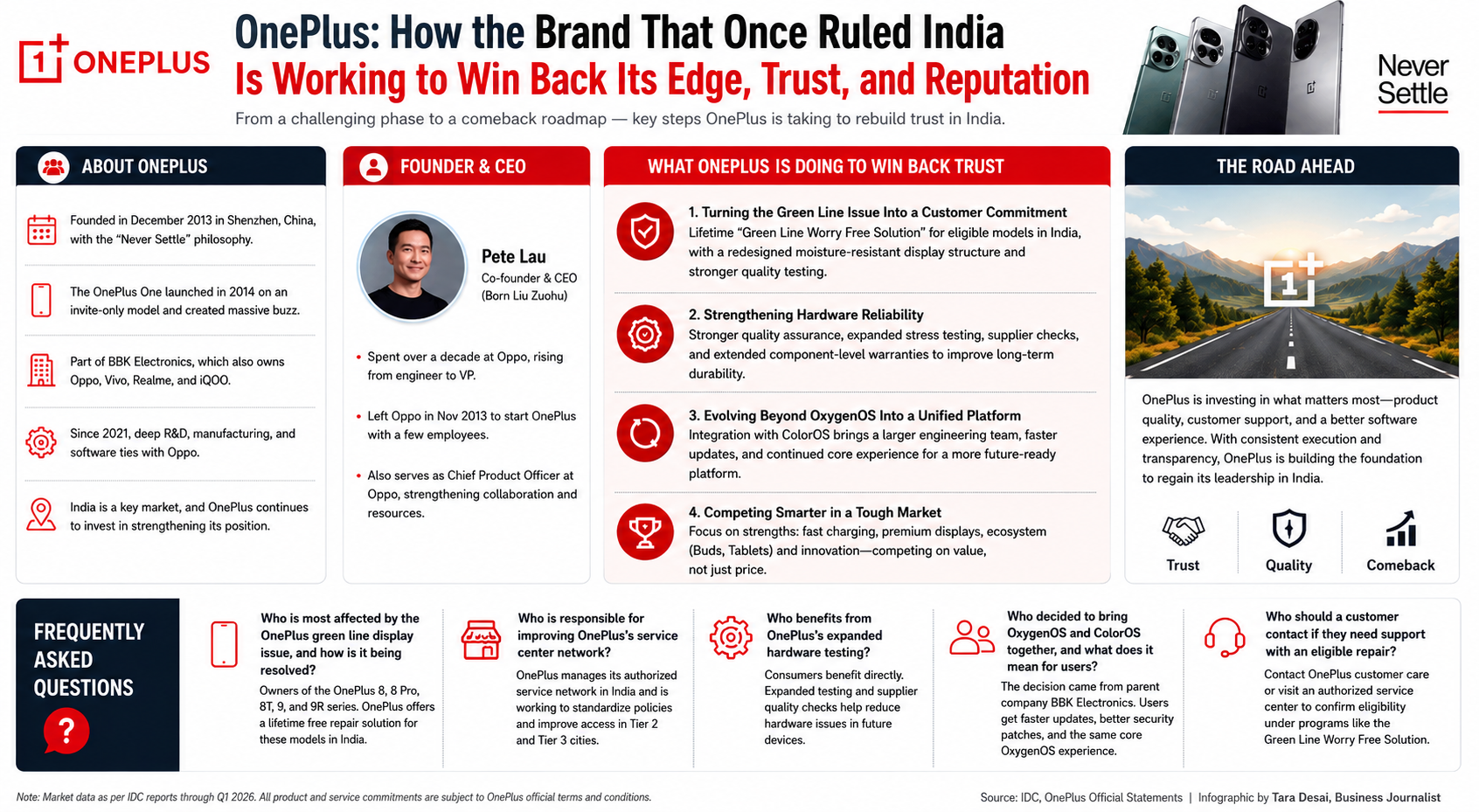
OnePlus is a smartphone manufacturer founded in December 2013 in Shenzhen, China, under the "Never Settle" philosophy of offering flagship level specifications at a lower price than established rivals. Its debut device, the OnePlus One, launched in 2014 on an invite only sales model that generated significant buzz among Android enthusiasts. The company is a subsidiary within the BBK Electronics group, the same conglomerate that owns Oppo, Vivo, Realme, and iQOO. Since 2021, OnePlus has deepened its research, development, and manufacturing ties with Oppo, sharing supply chains, software foundations, and, in India, a large share of its retail footprint. India has long been one of OnePlus's most important markets outside China, and the company continues to invest in strengthening that position.
Founder and CEO
OnePlus was co-founded by Pete Lau, born Liu Zuohu on May 5, 1975, along with Carl Pei, both former Oppo colleagues. Lau spent more than a decade at Oppo, rising from hardware engineer to vice president, before leaving in November 2013 to start OnePlus with just a handful of employees. He continues to serve as OnePlus's chief executive officer and also holds the position of chief product officer at Oppo, underlining how closely the two brands remain linked and how much combined engineering resource now backs OnePlus's roadmap. Carl Pei, the other co-founder, departed OnePlus in 2020 to launch his own company, Nothing.
Turning the Green Line Issue Into a Customer Commitment
The green line display concern, where a permanent line appeared on some AMOLED screens without any drop, crack, or water exposure, was one of the toughest tests OnePlus has faced with its display quality. Thousands of owners across the OnePlus 8, 8 Pro, 8T, 9, and 9R reported the issue, and the company's early response drew criticism for being inconsistent.
OnePlus has since moved to close that gap directly. The company introduced a lifetime "Green Line Worry Free Solution" for Indian customers, covering affected models with free repairs regardless of warranty status, and it redesigned newer panels with a moisture resistant edge bonding layer alongside expanded quality testing during manufacturing. That shift, from inconsistent case by case handling to a standing, no cost commitment, is a meaningful example of a company converting a hardware setback into a long term customer protection policy. It also sends a signal to the wider market that OnePlus is prioritizing display durability as newer models roll out.
Strengthening Hardware Reliability
Beyond the display issue, some users have flagged motherboard, battery, and charging faults on select models. OnePlus's response has increasingly centered on tightening its quality assurance process, expanding pre-launch stress testing, and extending component level warranties to rebuild confidence in long term durability. Reliability has always been core to the OnePlus value proposition, and the company's growing investment in testing infrastructure and supplier quality checks reflects a clear effort to make sure future devices hold up to the standard that built its early reputation. As these measures mature, they position OnePlus to compete on durability just as strongly as it once did on price to performance value.
Evolving Beyond OxygenOS Into a Unified Platform
OxygenOS was long defined by its near stock Android feel, minimal bloatware, and fast performance, a deliberate contrast to heavier skins like Oppo's ColorOS. Long time fans initially worried when OnePlus began integrating its research and development with parent company Oppo in 2021, and again when reports in 2026 pointed to a fuller transition toward a unified ColorOS experience across OnePlus, Oppo, and Realme devices.
Viewed from a resourcing standpoint, this consolidation gives OnePlus access to a far larger shared engineering team, a broader update pipeline, and faster security patch cycles than it could sustain alone. Most of the features loyal users valued, speed, customization, and a clean interface, continue to carry forward, now backed by the scale of a combined software organization. For a brand competing against giants like Samsung and Google, pooling software resources with Oppo strengthens its ability to keep pace with faster update cycles industry wide, turning what once felt like a loss of identity into a practical gain in long term software support.
Higher Prices with Stronger Competition
OnePlus's climb into the premium price bracket coincided with a fiercer competitive field. Samsung's Galaxy S and A series, iQOO's performance focused lineup, Vivo's expanding retail presence, Google's Pixel with its camera and AI positioning, and Motorola's clean software approach have all sharpened their pitch to the same buyers OnePlus once owned. Even so, OnePlus retains distinct strengths in charging speed, display quality, and its OnePlus Buds and tablet ecosystem, areas where it can still differentiate rather than compete purely on price.
Shipment data shows the scale of the challenge, with OnePlus's India volumes moving from roughly 17 million units to 13 to 14 million units in a single year. Reports of a possible India exit surfaced in early 2026, and OnePlus officially denied them, confirming that operations continue and that India remains a strategic priority market.
Conclusion
OnePlus's recent history shows a brand actively correcting course. The lifetime green line solution, expanded hardware testing, and a more resourced software platform through the Oppo partnership all point toward a company investing seriously in rebuilding trust rather than ignoring the problem. Continued transparency, consistent after sales service, and steady delivery on these commitments will determine how quickly OnePlus recovers its earlier standing in India. The foundation for that recovery is already visible in the steps taken over the past year.