

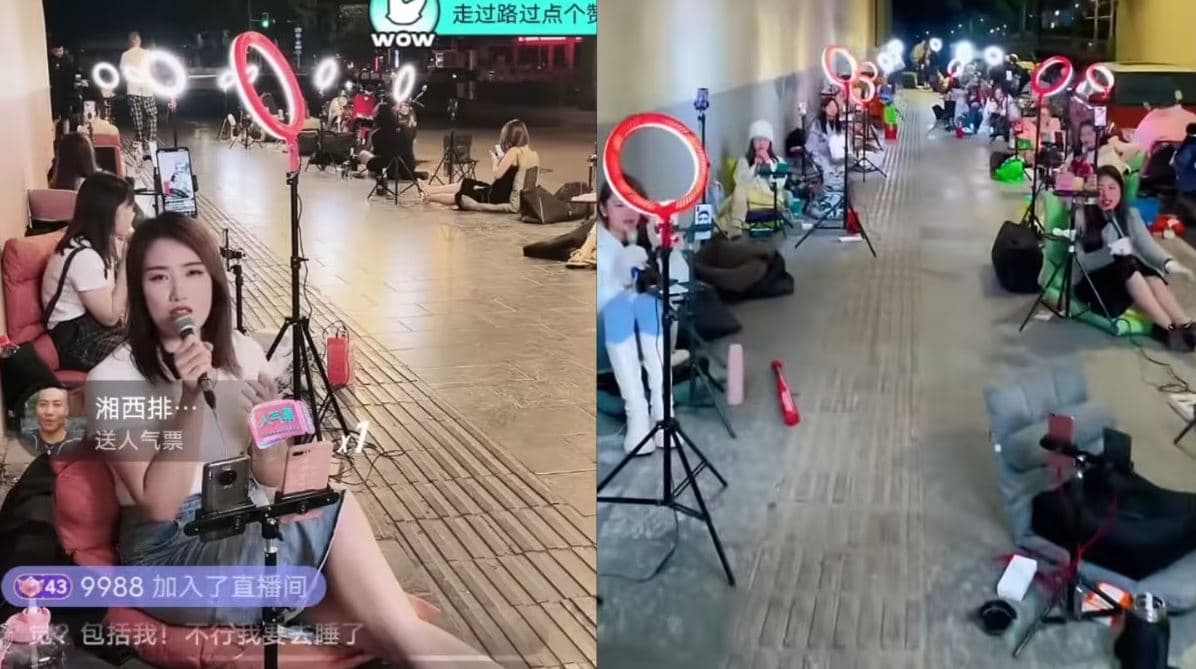
A stretch of pavement in a Chinese city has turned into an overnight sensation, not because of what happened there, but because of who showed up to film it. Videos circulating this week show dozens, and by some counts hundreds, of influencers seated shoulder to shoulder along a sidewalk, each lit by an individual ring light, each speaking into a phone propped on its own tripod. Viewers online have nicknamed it the "ghost street," a nod to how eerily synchronized and impersonal the scene looks from a distance.
As someone who has spent close to a decade tracking how viral content spreads and mutates online, I want to walk through what is actually happening here, why it is spreading so fast, and why the "is this real" debate attached to it matters more than the video itself.
What the Viral Footage Actually Shows
The clips making the rounds depict a long row of mostly female streamers, each broadcasting to her own individual audience from the same physical location. They are not collaborating on one show. They are competing for attention on the same strip of pavement, often in affluent neighborhoods where foot traffic and ambient wealth make for better backdrops.
Several details recur across the videos:
- Rows of ring lights positioned at near-identical angles, creating a strobing effect when filmed from a distance.
- Streamers speaking into their phones with almost no interaction with the people beside them.
- Locations chosen for aesthetic value, including upscale shopping districts and riverside walkways.
- A visible gap between the glamorous on-screen persona and the crowded, slightly chaotic real-world setting.
This is not an entirely new phenomenon. Chinese livestream culture has already produced the so-called "homeless streamer" trend, where creators broadcast from underpasses and bridges at night, and the "wall of phones" setups used by e-commerce hosts who livestream to hundreds of devices simultaneously to feed multiple platforms and accounts at once. The ghost street footage sits at the intersection of both trends, but its scale and uniformity are what pushed it into global feeds.
Why This Is Exploding Now
The Economics of Attention
China's livestreaming economy runs on a different engine than platforms in the West. Instead of relying primarily on advertising revenue, many Chinese platforms depend on direct viewer tipping and gifting. That structure rewards volume and visibility over polish, which is why so many creators are willing to sit in public, in a crowd of competitors, just to be seen.
Rising living costs and a tightening job market have also lowered the barrier to entry. Livestreaming requires a phone, a ring light, and a public space with decent lighting. Influencer agencies have picked up on this and now actively place talent on popular streets, treating them almost like shift workers clocking in for a broadcast slot.
The Optics Problem
There is also a simpler explanation for why this specific footage traveled so far: it looks strange. A single streamer talking to a phone is unremarkable. A hundred of them doing the same thing, in a straight line, under identical lighting, reads as uncanny. That visual novelty is exactly the kind of pattern that algorithmic feeds reward, regardless of platform.
Real, Staged, or AI-Generated? The Authenticity Debate
Almost as soon as the footage spread, a second conversation started alongside it: is any of this real?
This is where my work intersects most directly. Viral clips of this nature tend to fracture into three camps of skepticism:
- The AI-generation claim. Because the scene looks so uniform, some viewers assumed it was synthetically generated or heavily edited. There is no verified evidence supporting this, and the visual patterns are consistent with known livestreaming setups already documented in China over the past two years.
- The staged-for-virality claim. Others argue the scene was arranged specifically to be filmed and shared, effectively turning the "weirdness" itself into a marketing asset for the agencies involved.
- The organic-coincidence claim. A third group maintains this is simply what happens when a popular, well-lit public spot becomes known among streamers as a good broadcast location, with no orchestration required.
From a disinformation-analysis standpoint, the important lesson is not which theory is correct. It is how quickly an ambiguous piece of footage can generate competing, confidently stated explanations, each shared as fact. That pattern, more than the video itself, is worth paying attention to.
The Disinformation Angle: Why Ambiguous Virality Spreads Faster Than Verified News
Content that raises a question mark travels faster than content that answers one. A clip that looks slightly unreal, without a clear caption or verified source, invites viewers to fill in the gap with whatever explanation fits their existing assumptions about China, about influencer culture, or about AI. That gap-filling is where misinformation usually takes root.
A few patterns tend to show up whenever this kind of "prove it's real" content goes viral:
- Screenshots get recirculated without original source links, stripping away context.
- Captions shift slightly with each repost, gradually changing the claimed location, date, or scale of the event.
- Commentary framing the footage as evidence of a broader societal collapse or economic crisis, often without supporting data.
None of this means the ghost street trend is fake. The underlying livestreaming culture it depicts is well documented and economically real. But the way the story spreads online is a near-perfect case study in how viral ambiguity, not deliberate fabrication, is often the biggest driver of online confusion today.
What This Means for Media Literacy
The healthiest response to footage like this is not to declare it fake or fully verified within minutes. It is to slow down and ask where it came from, whether it has been geolocated or dated, and whether the explanation being shared alongside it is backed by anything more than a confident tone.
Viral street-livestreaming content will likely keep appearing as China's creator economy grows more saturated and competitive. Understanding the economic pressure behind it, rather than just reacting to how strange it looks, is what separates informed commentary from another round of unverified sharing.